
Ever wondered what a modern Ubuntu desktop environment would look like if it were being played back on a degraded, chewed-up VHS tape or rendered across the curved, phosphor-coated glass of an aged monochrome cathode-ray tube (CRT) monitor?
For the vast majority of Linux users focused on day-to-day productivity, the thought has likely never crossed their minds. Yet for those who appreciate retro computing nostalgia or distinctive visual aesthetics, an intriguing new utility has emerged in the Linux personalization ecosystem.
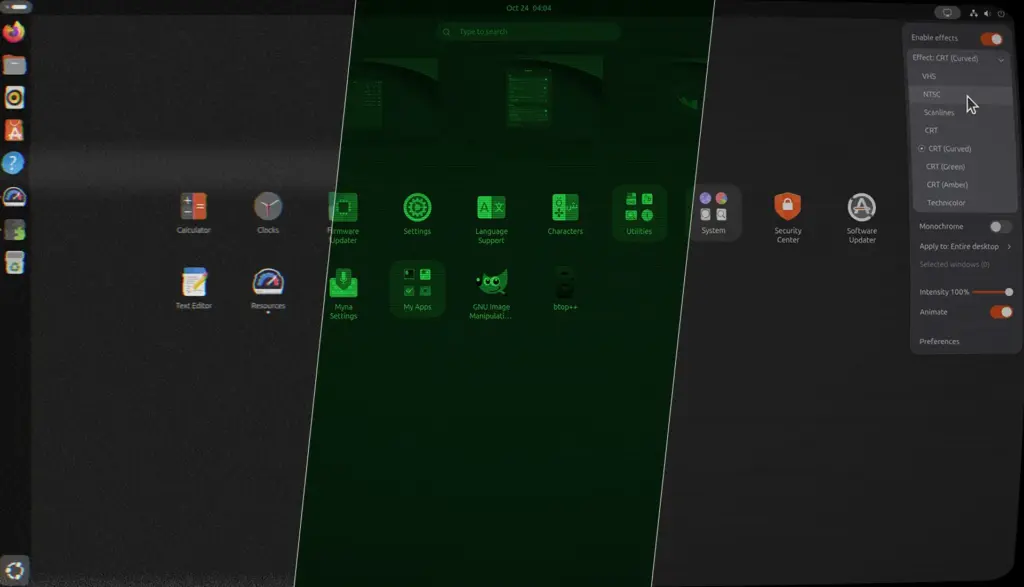
A recently released GNOME Shell extension titled Shader Effects, created by developer Murat Çileli, allows users to deliberately transform their pristine graphical displays into textured relics of past computing eras. By utilizing real-time, GPU-accelerated graphic filters, the tool accurately replicates the distinct visual artifacts of twentieth-century visual hardware, introducing features such as dynamic scan lines, classic NTSC composite color blooming, and the unmistakable, atmospheric flicker of monochrome green phosphor displays.
Rather than functioning as a mere novelty filter that sits on top of a static wallpaper, the extension alters the rendering of the active desktop environment itself. Users have the flexibility to apply these visual modifications across their entire graphical interface or restrict the effect exclusively to individual application windows.
A Granular Look at GPU-Driven Nostalgia
The Shader Effects extension operates by applying post-processing shaders directly to the desktop rendering pipeline managed by GNOME’s Mutter compositor. The software includes several dedicated presets designed to mimic distinct hardware quirks and historical display technologies.
Among the primary options integrated into the software are classic CRT emulations—including curved screen geometries that accurately reproduce the barrel distortion of vintage rounded glass panels—alongside phosphor variations such as classic CRT green. Additionally, the software features specialized filters simulating NTSC television signals, complete with characteristic color-bleed artifacts, as well as degraded VHS tracking effects that recreate horizontal tearing, rippling distortion, and magnetic tape degradation.
To enhance these filters further, the extension provides an independent monochrome toggle. This control switch can be overlaid across all included presets, allowing users to strip color information entirely regardless of the specific shader profile active at the time.
 Linux & Open Source Solutions
Orbit Global Menu Brings Pragmatic Global Application Menus Back to the GNOME Shell Desktop
For more than a decade, the global menu bar has remained one...
 Linux & Open Source Solutions
Combating Counterfeit Storage: How the Open-Source Tool F3 Exposes Fake Flash Drives on Linux
Surging hardware prices across the consumer electronics sector have created fertile ground...
 Linux & Open Source Solutions
Ubuntu 26.10 Flavours Arrive with Updated Desktops, System Modernization, and the Return of Ubuntu MATE
The launch of the Ubuntu 26.10 operating system cycle extends well beyond...







