
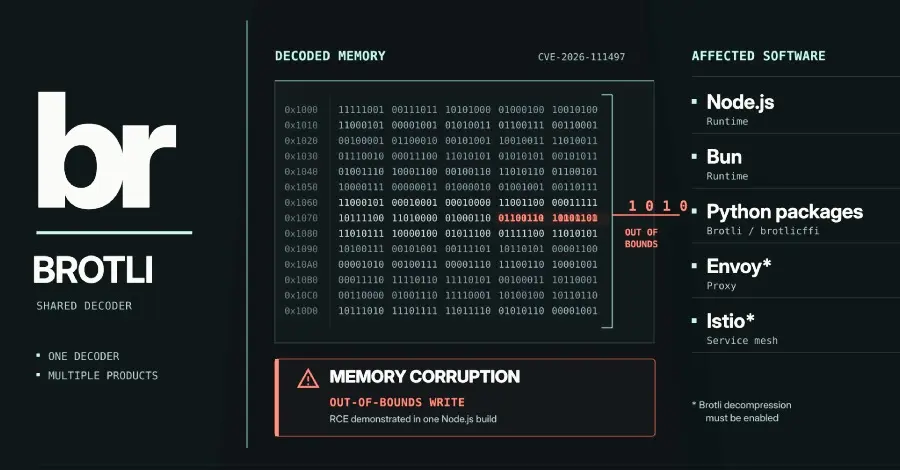
A pervasive memory-corruption vulnerability has been identified within Google’s Brotli compression library, a fundamental component used across the modern web to optimize data transmission. The flaw, tracked as CVE-2026-111497, resides in the C-based decoder responsible for decompressing Brotli-encoded data. Because this decoder is frequently embedded directly into language runtimes, web proxies, and various software packages, the vulnerability’s reach extends far beyond Google’s own ecosystem, affecting major technologies including Node.js, the Bun runtime, Envoy proxies, and a variety of Python-based networking tools.
The vulnerability is categorized as a memory corruption issue that occurs when the decoder processes a specially crafted compressed data stream. In such scenarios, the malicious data can force the decoder to overwrite memory past the end of an allocated buffer. This type of memory corruption is a classic security failure that can lead to several severe outcomes, ranging from immediate application crashes and denial-of-service states to more insidious memory leaks. Most critically, researchers have demonstrated that this flaw can be leveraged to achieve remote code execution (RCE), allowing an attacker to run unauthorized commands on a vulnerable system.
Brotli, developed by Google, has become a staple of web performance, offering superior compression ratios compared to older standards like Gzip. It is widely utilized to shrink the size of web pages, scripts, and other assets as they travel between servers and browsers. However, because the core logic for unpacking these streams is written in C for performance reasons, it is susceptible to the memory management risks inherent in that language. When a program incorporates the Brotli library to handle untrusted data, it inherits these risks.
The Scope of Affected Software and Infrastructure
The impact of CVE-2026-111497 is notably broad because of how the Brotli decoder is distributed. Rather than relying on a single shared system library, many high-profile programs ship their own internal copy of the Brotli source code. Consequently, a fix released by Google does not automatically protect the rest of the software world; every individual maintainer of a project that bundles Brotli must manually update their internal version and issue a new release.
In the realm of JavaScript runtimes, Node.js and Bun have both confirmed susceptibility. For Node.js, the vulnerability affects the 22.x, 24.x, and 26.x release lines. The security team for Node.js has responded by issuing patches in versions 22.23.4, 24.22.1, and 26.12.1. Older versions, such as 20.x and below, are also considered vulnerable but have reached their end-of-life status, meaning they will not receive official security updates. Users of these legacy versions are strongly encouraged to migrate to a supported release.
The Bun runtime, which positions itself as a fast alternative to Node.js, was found to be vulnerable in version 1.4.3 and all earlier iterations. The project has since released version 1.4.4 to address the issue. In both Node.js and Bun, the primary exposure occurs when the runtime’s built-in fetch() function is used to retrieve a response from a remote server that uses "br" (Brotli) content encoding. Additionally, applications using the node:zlib module or web frameworks like Express 5 and body-parser 2—which may unpack Brotli-compressed uploads—are at risk. It is important to note that a standard Node.js HTTP server does not decode request bodies automatically, which somewhat limits the attack surface for simple server configurations.

Enterprise-grade infrastructure is also in the crosshairs. Envoy, the popular high-performance proxy used in many cloud-native environments, and Istio, the service mesh that often manages Envoy instances, are both affected. Envoy versions 1.39.2, 1.38.5, 1.37.7, and 1.36.11 contain the flaw, with fixes provided in the 1.40.0 series and subsequent point releases for older branches. For Istio, the vulnerability impacts versions ranging from 1.29.0 through 1.31.1. In these environments, the risk is only present if the Brotli decompressor filter is explicitly configured and enabled. If the proxy is not set up to decompress Brotli traffic, the vulnerable code path remains unreachable.
 Cybersecurity Basics & Security News
LiteLLM Supply Chain Breach: How a Leaked Master Key Led to the Distribution of Malicious Python Packages
The cybersecurity landscape has been served a stark reminder of the long-tail...
 Cybersecurity Basics & Security News
NGINX Issues Critical Security Updates to Address Five Vulnerabilities, Including a Two-Decade-Old Memory Bug
NGINX, the high-performance web server and reverse proxy that powers a vast...
 Cybersecurity Basics & Security News
OpenSSH "SSHole" Vulnerability and the Persistence of Simple Misconfigurations Lead Weekly Cybersecurity Briefing
The cybersecurity landscape in late 2026 continues to demonstrate a paradoxical truth:...







