
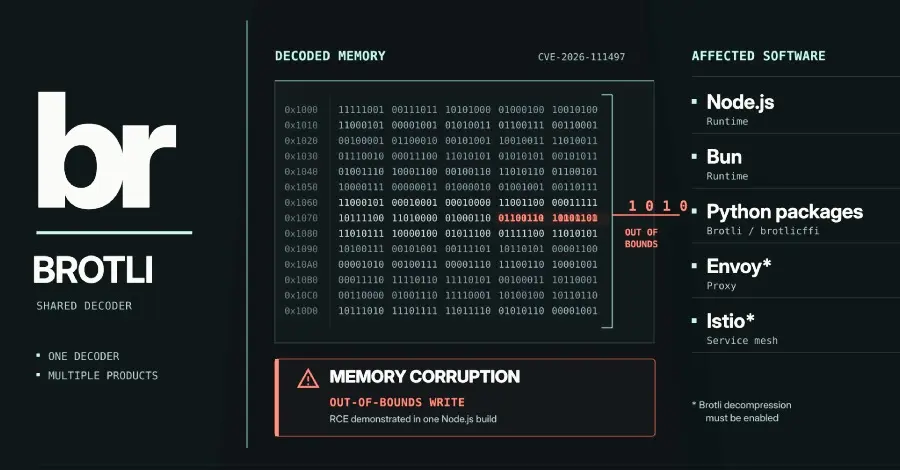
The Python ecosystem faces a unique challenge regarding this CVE. The vulnerability exists in the Brotli and brotlicffi packages, which are the standard ways Python developers interact with the format. These packages are often installed as dependencies for popular HTTP clients such as requests, urllib3, httpx, and aiohttp. If either of these Brotli packages is present on a system, these clients will often automatically attempt to decode Brotli-compressed responses. This means an application could be vulnerable even if the developer never explicitly imported a Brotli library in their own code. Fixes have been released in version 1.2.1 of the Brotli package and 1.2.1.0 of brotlicffi.
Demonstrating the "Node2Shell" Exploit
While many memory corruption bugs remain theoretical or result only in application crashes, researchers from Imperva’s Red Team have demonstrated a viable path to full system compromise. Using a technique they dubbed "Node2Shell," the researchers were able to achieve remote code execution on an unmodified build of Node.js 24.22.0 running on Linux with ARM64 architecture.
The Imperva team showed that the exploit could be delivered through two different vectors: as a malicious response fetched by the application from a rogue server, or as a malicious request body sent to an application using the Express framework. The researchers noted that while the exploit was successful, it was not entirely stable and required several attempts to trigger the desired code execution. As of now, the technical details of this exploit have not been made public, and there have been no reports of this vulnerability being exploited in the wild.
The Codex Security team at OpenAI, which originally reported the flaw, emphasized that the danger is bidirectional. In their assessment, an unpatched server that accepts compressed input could be hijacked by a malicious client. Conversely, an unpatched client—even a command-line tool like curl if it is configured to handle compressed data—could be taken over by a malicious server. This makes the vulnerability a significant concern for both backend infrastructure and client-side applications.
A History of the "Silent" Fix
One of the more unusual aspects of CVE-2026-111497 is the timeline of its remediation. According to OpenAI, the root cause of the memory corruption was actually addressed in the Brotli source code as early as February 27. However, at that time, the change was not identified as a security fix. It was integrated into the codebase without a corresponding security advisory or a new tagged release of the library.
As a result, many downstream projects that rely on stable releases of Brotli continued to use the older, vulnerable code for months. It was only in October, following the investigation by OpenAI’s Codex Security team, that the security implications were fully understood. This led to a coordinated disclosure on October 21, coinciding with the official release of patched versions of the Brotli C library (1.0.10, 1.1.1, and 1.2.1) and the subsequent rollout of updates across the software industry.
 Cybersecurity Basics & Security News
Russia-Aligned Cyber Espionage Group UAC-0099 Deploys New ASHVEIN Malware in Sophisticated Campaign Against Ukraine
The landscape of cyber warfare in Eastern Europe continues to shift as...
 Cybersecurity Basics & Security News
Security Researcher Unveils ‘Tailworm’ Report, Highlighting Critical Privilege Escalation Risks in Tailscale SSH
A comprehensive security analysis published this week has sent ripples through the...
 Cybersecurity Basics & Security News
The Rise of the Personal AI Agent: Navigating the Shift from BYOD to BYOAI in the Corporate Security Landscape
The rollout of personal artificial intelligence agents is proving to be a...







