
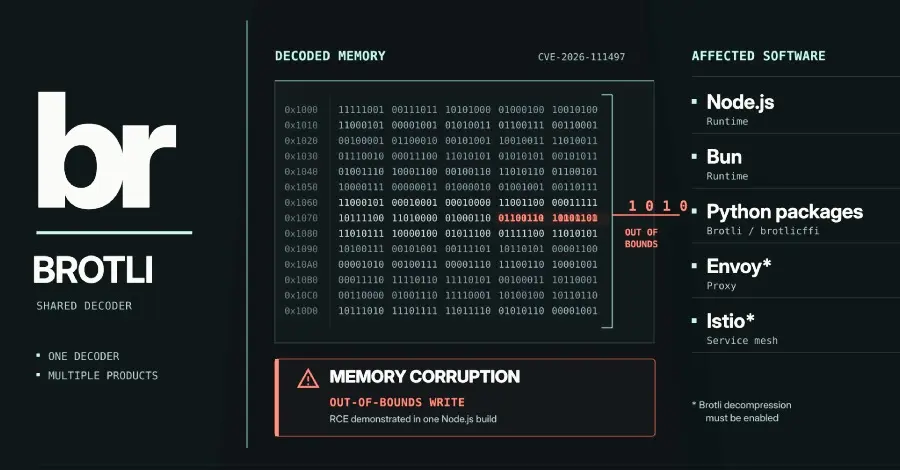
A pervasive memory-corruption vulnerability has been identified within Google’s Brotli compression library, a fundamental component used across the modern web to optimize data transmission. The flaw, tracked as CVE-2026-111497, resides in the C-based decoder responsible for decompressing Brotli-encoded data. Because this decoder is frequently embedded directly into language runtimes, web proxies, and various software packages, the vulnerability’s reach extends far beyond Google’s own ecosystem, affecting major technologies including Node.js, the Bun runtime, Envoy proxies, and a variety of Python-based networking tools.
The vulnerability is categorized as a memory corruption issue that occurs when the decoder processes a specially crafted compressed data stream. In such scenarios, the malicious data can force the decoder to overwrite memory past the end of an allocated buffer. This type of memory corruption is a classic security failure that can lead to several severe outcomes, ranging from immediate application crashes and denial-of-service states to more insidious memory leaks. Most critically, researchers have demonstrated that this flaw can be leveraged to achieve remote code execution (RCE), allowing an attacker to run unauthorized commands on a vulnerable system.
Brotli, developed by Google, has become a staple of web performance, offering superior compression ratios compared to older standards like Gzip. It is widely utilized to shrink the size of web pages, scripts, and other assets as they travel between servers and browsers. However, because the core logic for unpacking these streams is written in C for performance reasons, it is susceptible to the memory management risks inherent in that language. When a program incorporates the Brotli library to handle untrusted data, it inherits these risks.
The Scope of Affected Software and Infrastructure
The impact of CVE-2026-111497 is notably broad because of how the Brotli decoder is distributed. Rather than relying on a single shared system library, many high-profile programs ship their own internal copy of the Brotli source code. Consequently, a fix released by Google does not automatically protect the rest of the software world; every individual maintainer of a project that bundles Brotli must manually update their internal version and issue a new release.
In the realm of JavaScript runtimes, Node.js and Bun have both confirmed susceptibility. For Node.js, the vulnerability affects the 22.x, 24.x, and 26.x release lines. The security team for Node.js has responded by issuing patches in versions 22.23.4, 24.22.1, and 26.12.1. Older versions, such as 20.x and below, are also considered vulnerable but have reached their end-of-life status, meaning they will not receive official security updates. Users of these legacy versions are strongly encouraged to migrate to a supported release.
The Bun runtime, which positions itself as a fast alternative to Node.js, was found to be vulnerable in version 1.4.3 and all earlier iterations. The project has since released version 1.4.4 to address the issue. In both Node.js and Bun, the primary exposure occurs when the runtime’s built-in fetch() function is used to retrieve a response from a remote server that uses "br" (Brotli) content encoding. Additionally, applications using the node:zlib module or web frameworks like Express 5 and body-parser 2—which may unpack Brotli-compressed uploads—are at risk. It is important to note that a standard Node.js HTTP server does not decode request bodies automatically, which somewhat limits the attack surface for simple server configurations.

Enterprise-grade infrastructure is also in the crosshairs. Envoy, the popular high-performance proxy used in many cloud-native environments, and Istio, the service mesh that often manages Envoy instances, are both affected. Envoy versions 1.39.2, 1.38.5, 1.37.7, and 1.36.11 contain the flaw, with fixes provided in the 1.40.0 series and subsequent point releases for older branches. For Istio, the vulnerability impacts versions ranging from 1.29.0 through 1.31.1. In these environments, the risk is only present if the Brotli decompressor filter is explicitly configured and enabled. If the proxy is not set up to decompress Brotli traffic, the vulnerable code path remains unreachable.
The Python ecosystem faces a unique challenge regarding this CVE. The vulnerability exists in the Brotli and brotlicffi packages, which are the standard ways Python developers interact with the format. These packages are often installed as dependencies for popular HTTP clients such as requests, urllib3, httpx, and aiohttp. If either of these Brotli packages is present on a system, these clients will often automatically attempt to decode Brotli-compressed responses. This means an application could be vulnerable even if the developer never explicitly imported a Brotli library in their own code. Fixes have been released in version 1.2.1 of the Brotli package and 1.2.1.0 of brotlicffi.
Demonstrating the "Node2Shell" Exploit
While many memory corruption bugs remain theoretical or result only in application crashes, researchers from Imperva’s Red Team have demonstrated a viable path to full system compromise. Using a technique they dubbed "Node2Shell," the researchers were able to achieve remote code execution on an unmodified build of Node.js 24.22.0 running on Linux with ARM64 architecture.
The Imperva team showed that the exploit could be delivered through two different vectors: as a malicious response fetched by the application from a rogue server, or as a malicious request body sent to an application using the Express framework. The researchers noted that while the exploit was successful, it was not entirely stable and required several attempts to trigger the desired code execution. As of now, the technical details of this exploit have not been made public, and there have been no reports of this vulnerability being exploited in the wild.
The Codex Security team at OpenAI, which originally reported the flaw, emphasized that the danger is bidirectional. In their assessment, an unpatched server that accepts compressed input could be hijacked by a malicious client. Conversely, an unpatched client—even a command-line tool like curl if it is configured to handle compressed data—could be taken over by a malicious server. This makes the vulnerability a significant concern for both backend infrastructure and client-side applications.
A History of the "Silent" Fix
One of the more unusual aspects of CVE-2026-111497 is the timeline of its remediation. According to OpenAI, the root cause of the memory corruption was actually addressed in the Brotli source code as early as February 27. However, at that time, the change was not identified as a security fix. It was integrated into the codebase without a corresponding security advisory or a new tagged release of the library.
As a result, many downstream projects that rely on stable releases of Brotli continued to use the older, vulnerable code for months. It was only in October, following the investigation by OpenAI’s Codex Security team, that the security implications were fully understood. This led to a coordinated disclosure on October 21, coinciding with the official release of patched versions of the Brotli C library (1.0.10, 1.1.1, and 1.2.1) and the subsequent rollout of updates across the software industry.

The severity of the flaw has been a point of discussion among security organizations, with varying scores reflecting different assessment methodologies. Google, the maintainer of the library, assigned the vulnerability a CVSS 4.0 score of 9.2, placing it firmly in the "Critical" category. Red Hat, meanwhile, provided a slightly lower but still significant score of 8.1, labeling it as "Important." Node.js maintainers have categorized the risk as "High." Despite these high ratings, the Cybersecurity and Infrastructure Security Agency (CISA) noted in an October 23 assessment that there was no evidence of active exploitation or automated attack tools targeting this specific flaw at that time.
Mitigation and Practical Challenges
For organizations and developers, the primary recommendation is to update affected software to the versions specified by their respective maintainers. However, simply updating a package or runtime may not be sufficient in modern deployment environments. Because a running process loads the decoder into memory, the service must be restarted to apply the patch. Furthermore, in containerized environments, container images must be rebuilt to ensure the new libraries are included in the deployment pipeline.
In situations where an immediate update is not possible, security experts suggest disabling Brotli decompression for untrusted data. This can be done by removing "br" from the Accept-Encoding header in outgoing requests, though this is not a foolproof solution. A malicious server can ignore the client’s header and send Brotli-compressed data anyway, which an unpatched client might still attempt to decode. For Node.js specifically, no reliable workaround has been identified other than updating the runtime itself.
The use of Web Application Firewalls (WAFs) provides only a partial defense. While some providers, such as Vercel, implemented firewall rules immediately following the disclosure, they have cautioned that these rules typically only inspect incoming traffic to the platform. They do not necessarily protect against malicious responses that an application’s internal functions might fetch from external, third-party servers.
Finally, there are challenges related to automated security tooling. Dependency scanners and software composition analysis (SCA) tools may not immediately flag the vulnerability in Python environments. Because the CVE record is primarily associated with Google’s Brotli repository rather than the specific PyPI packages, some scanners that rely on GitHub’s advisory database or Dependabot may experience a delay in reporting. For example, the official PYSEC advisories for the Python packages were only added on October 23, several days after the initial disclosure. Security teams are advised to manually verify the versions of Brotli and brotlicffi installed in their environments to ensure they are running version 1.2.1 or higher.
As the industry continues to digest the implications of CVE-2026-111497, the focus remains on the rapid adoption of patches. While the lack of active exploitation is a positive sign, the demonstration of remote code execution by researchers serves as a stark reminder of the potential risks embedded in the fundamental building blocks of web infrastructure.
 Cybersecurity Basics & Security News
Google Intelligence Report Warns of Paradigm Shift as Threat Actors Deploy Autonomous Agentic AI Frameworks
In a comprehensive assessment that underscores a fundamental transformation in the digital...
 Cybersecurity Basics & Security News
Google Pixel 10 and Samsung Galaxy S26 Breached as Ikotas Labs Claims Top Honors at Pwn2Own Ireland 2026
The competitive landscape of cybersecurity research reached a fever pitch this week...
 Cybersecurity Basics & Security News
Critical Security Flaws in Meta Muse AI Agent Allowed Silent Data Theft and Full System Compromise
A sophisticated security vulnerability discovered in Meta’s personal artificial intelligence assistant, Muse,...







