
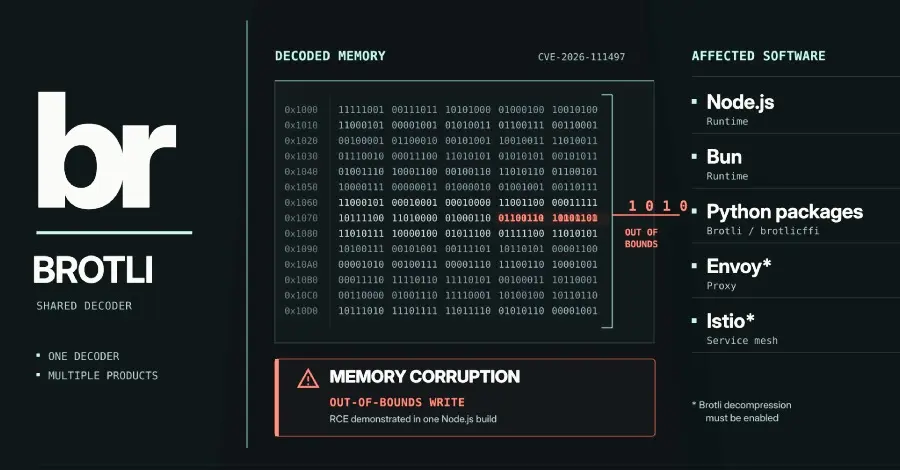

The severity of the flaw has been a point of discussion among security organizations, with varying scores reflecting different assessment methodologies. Google, the maintainer of the library, assigned the vulnerability a CVSS 4.0 score of 9.2, placing it firmly in the "Critical" category. Red Hat, meanwhile, provided a slightly lower but still significant score of 8.1, labeling it as "Important." Node.js maintainers have categorized the risk as "High." Despite these high ratings, the Cybersecurity and Infrastructure Security Agency (CISA) noted in an October 23 assessment that there was no evidence of active exploitation or automated attack tools targeting this specific flaw at that time.
Mitigation and Practical Challenges
For organizations and developers, the primary recommendation is to update affected software to the versions specified by their respective maintainers. However, simply updating a package or runtime may not be sufficient in modern deployment environments. Because a running process loads the decoder into memory, the service must be restarted to apply the patch. Furthermore, in containerized environments, container images must be rebuilt to ensure the new libraries are included in the deployment pipeline.
In situations where an immediate update is not possible, security experts suggest disabling Brotli decompression for untrusted data. This can be done by removing "br" from the Accept-Encoding header in outgoing requests, though this is not a foolproof solution. A malicious server can ignore the client’s header and send Brotli-compressed data anyway, which an unpatched client might still attempt to decode. For Node.js specifically, no reliable workaround has been identified other than updating the runtime itself.
The use of Web Application Firewalls (WAFs) provides only a partial defense. While some providers, such as Vercel, implemented firewall rules immediately following the disclosure, they have cautioned that these rules typically only inspect incoming traffic to the platform. They do not necessarily protect against malicious responses that an application’s internal functions might fetch from external, third-party servers.
Finally, there are challenges related to automated security tooling. Dependency scanners and software composition analysis (SCA) tools may not immediately flag the vulnerability in Python environments. Because the CVE record is primarily associated with Google’s Brotli repository rather than the specific PyPI packages, some scanners that rely on GitHub’s advisory database or Dependabot may experience a delay in reporting. For example, the official PYSEC advisories for the Python packages were only added on October 23, several days after the initial disclosure. Security teams are advised to manually verify the versions of Brotli and brotlicffi installed in their environments to ensure they are running version 1.2.1 or higher.
As the industry continues to digest the implications of CVE-2026-111497, the focus remains on the rapid adoption of patches. While the lack of active exploitation is a positive sign, the demonstration of remote code execution by researchers serves as a stark reminder of the potential risks embedded in the fundamental building blocks of web infrastructure.
 Cybersecurity Basics & Security News
The Silent Proliferation: Enterprise Security Grapples with the Rise of Invisible AI Agents
As the enterprise landscape prepares for the full-scale integration of artificial intelligence,...
 Cybersecurity Basics & Security News
CISA Alerts Federal Agencies to Exploited VMware ESX Vulnerability Following Targeted Cyber Espionage Campaign
The United States Cybersecurity and Infrastructure Security Agency (CISA) has formally expanded...
 Cybersecurity Basics & Security News
GMO Internet Group Launches $1 Million Global Bounty After Refusing $50 Million Cyber-Extortion Demand
In a decisive counter-offensive against cyber-extortionists, the Japanese technology conglomerate GMO Internet...







