
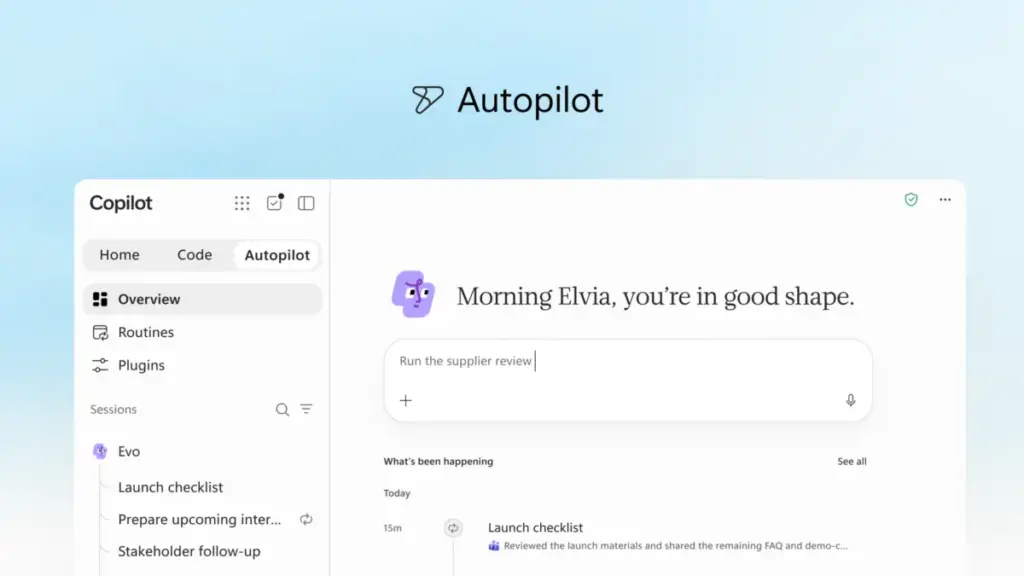
Microsoft has announced a comprehensive reimagining of its Copilot platform, signaling a significant shift in how artificial intelligence is integrated into the daily flow of professional work. The update introduces a redesigned Copilot app designed to serve as a central nervous system for organizational productivity, connecting the traditional tools of the Microsoft 365 suite with a new generation of autonomous agents and low-code development capabilities.
This transformation is rooted in a vision to expand what individuals and organizations can achieve by embedding AI directly into the "flow of human ambition." Rather than acting as a peripheral assistant, the new Copilot is positioned as a foundational layer that can build, customize, and scale AI solutions across various business functions. The announcement highlights three primary pillars of the new experience: Home, Code, and Autopilot, alongside significant updates to how businesses manage the costs and data grounding associated with enterprise-grade AI.
A New Experience for Every Mode of Work
The centerpiece of this update is "Home," a redesigned starting point within the Copilot app that serves as a unified interface where conversational interaction and delegated tasks converge. In the modern workplace, where employees constantly pivot between meetings, emails, and document editing, Home is intended to provide a grounding experience. It allows users to review recent activities, receive proactive suggestions on how AI can assist with current projects, and resume work exactly where it was left off.
Within this new interface, Microsoft distinguishes between two primary modes of interaction: Chat and Cowork. Chat remains the familiar, instant conversational interface used for quick inquiries, data lookups, and drafting short communications. Cowork, however, represents a shift toward delegation. In this mode, users define a complex task—such as responding to a Request for Proposal (RFP), creating a product launch kit, or preparing a financial close package—and Copilot manages the process from end-to-end. This involves iterative work that traditionally required human oversight at every minor step, but can now be managed as a holistic project by the AI.
Furthermore, Microsoft is tightening the integration between Copilot and its core productivity software through "Office in Copilot." This feature embeds the full functionality of Word, Excel, and PowerPoint directly into the Copilot experience. The objective is to eliminate the friction of app-switching, which often leads to broken formatting or the creation of multiple, disconnected versions of the same file. Users can now draft briefs or model budgets within the Copilot interface, and the AI creates real, editable documents that remain in sync across the entire Microsoft 365 ecosystem. This allows for live collaboration; for instance, a user can @mention a teammate within the Copilot conversation, and that teammate’s edits will appear in real-time within the document being generated.

The individual Office apps are also receiving specialized updates. PowerPoint can now automatically ensure decks remain on-brand while allowing users to fine-tune specific slides or apply custom templates via AI. Excel has been enhanced to show exactly what changes Copilot or other collaborators have made, providing a clear audit trail of data manipulations. Additionally, new "Skills" are being introduced across the suite, bringing role-specific expertise—such as specialized legal terminology in Word or complex financial modeling in Excel—directly to the user.
Democratizing Solution Building Through Code
Perhaps the most technical expansion in this update is "Code," a feature that moves AI-assisted solution building beyond the exclusive domain of software developers. Historically, the primary units of knowledge work have been files: documents, spreadsheets, and presentations. Microsoft is now introducing a fourth unit: the purpose-built solution.
 Productivity Software & Office Suites
Microsoft Unveils ‘Autopilots’ and Scout: A New Frontier for Autonomous AI Agents in the Enterprise
The nature of professional productivity is undergoing a fundamental shift, moving away...
 Productivity Software & Office Suites
Microsoft Expands Copilot Ecosystem with Natural Language App Building to Democratize Enterprise Software Development
The landscape of software development is undergoing a fundamental transformation, driven by...
 Productivity Software & Office Suites
Microsoft Announces Global Launch of Copilot Cowork, Introducing Agentic AI to the Modern Enterprise
In a move that signals a significant shift in the landscape of...







