
In a significant strategic pivot, Microsoft has announced a comprehensive "reimagining" of its Copilot ecosystem, moving beyond a simple AI assistant to create a unified platform designed to scale with the evolving nature of modern work. The technology giant introduced the "new Copilot" this week, unveiling a suite of capabilities aimed at connecting the tools employees rely on daily with next-generation AI agents that can build, customize, and automate complex workflows.
The update represents a shift in how Microsoft views the intersection of human ambition and artificial intelligence. Rather than treating AI as a secondary interface, the new Copilot is designed to sit directly in the flow of work, providing a persistent environment where individuals and organizations can delegate tasks, write code, and manage business processes with unprecedented autonomy.
A new experience for every mode of work
At the center of this transformation is the new Copilot app, which introduces three distinct pillars of functionality: Home, Code, and Autopilot. These features are designed to address the fragmented nature of the modern digital workspace, where employees often find themselves bouncing between disparate applications, meetings, and document versions.
The "Home" interface serves as the new starting point for the Copilot experience. It acts as a navigational anchor, bringing together "Chat" and "Cowork" into a single, cohesive environment. While Chat remains the go-to for instant, conversational interactions—such as drafting a quick email or looking up a specific piece of information—Cowork is designed for more substantial delegation. In the Cowork mode, users define a complex task, such as responding to a Request for Proposal (RFP) or creating a comprehensive launch kit. The AI then handles the process from end-to-end, iterating on the work until a finished product is delivered.

Crucially, Microsoft is integrating the full power of its flagship productivity suite directly into this experience through "Office in Copilot." This integration aims to solve the common friction points of AI-assisted content creation, such as broken formatting or the loss of context when moving text between a chat window and a document. Within the Copilot app, users can now draft Word documents, model Excel budgets, or build PowerPoint decks that exist as real, editable files from the moment of creation. These files are live and synchronized, allowing team members to @mention colleagues and see edits in real-time, ensuring that progress is never siloed within an individual’s AI session.
The "Code" feature represents perhaps the most significant expansion of Copilot’s utility for the general workforce. Recognizing that the traditional unit of knowledge work—the file—is being supplemented by purpose-built applications, Microsoft is enabling non-developers to create their own solutions. By describing a desired tool in natural language, users can prompt Copilot to build trackers, dashboards, and automations. This capability is powered by the same underlying technology as GitHub Copilot, but it is tailored for the business environment. It operates within a secured, sandboxed environment, ensuring that the apps built by employees remain governed by corporate IT standards while remaining grounded in the specific context of the organization’s data.
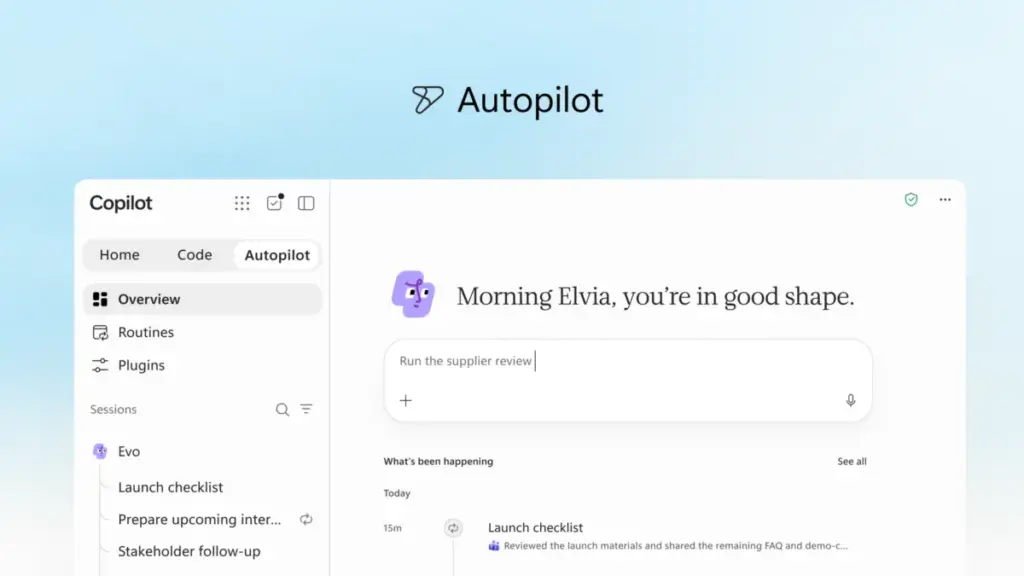
Perhaps the most forward-looking addition is "Autopilot," a proactive digital agent previously known by the internal codename "Scout." Unlike traditional AI assistants that require a prompt for every action, Autopilot is designed to work independently. Users can assign Autopilot a specific role and a goal—such as managing a supplier review process—and the agent will monitor communication channels, follow up on threads, and manage schedules without human intervention. Because Autopilot is cloud-hosted and possesses its own identity and memory within the organization’s tenant, it continues to work even when the user is offline, functioning more like a virtual colleague than a software tool.
 Productivity Software & Office Suites
Microsoft Unveils Natural Language App Creation in Copilot Studio, Bridging the Gap Between AI Innovation and Enterprise Governance
The landscape of software development is undergoing a fundamental transformation, driven by...
 Productivity Software & Office Suites
Microsoft Reimagines Copilot as a Centralized Engine for the Future of AI-Driven Work
In a major strategic shift aimed at redefining the intersection of human...
 Productivity Software & Office Suites
Microsoft Announces General Availability of Work IQ APIs, Ushering in the Era of Agentic Software
REDMOND, Wash. — In a move that signals a fundamental transformation in...







