
Expanding your business context
For AI to be truly effective in an enterprise setting, it must understand the specific nuances of the business it serves. Microsoft is addressing this through "Microsoft IQ," a unified intelligence platform that connects an organization’s operational data with the knowledge it holds. This platform provides a real-time, governed view that grounds Copilot’s responses in factual, company-specific information.
A major expansion of this context comes via "Fabric IQ," which integrates Power BI’s vast library of semantic models into the Copilot environment. This allows the AI to draw upon trusted data visualizations and analytics when answering queries or performing tasks in Chat and Cowork. Furthermore, Microsoft is rolling out a public preview that grounds Copilot in data from Dynamics 365 and the Power Platform. For sales and operations teams, this means Copilot can automatically incorporate deal histories, support ticket status, and customer relationship data into proposals and briefings without requiring the user to manually switch between applications.

To manage the growing ecosystem of AI capabilities, Microsoft also introduced a new plugin registry. This centralized catalog allows IT departments to discover, approve, and govern plugins from Microsoft, third-party partners, and custom internal builds. By providing a "publish once" model for developers, the registry ensures that trusted AI skills and data connectors can be deployed across all Copilot-supported experiences at scale, maintaining a balance between user innovation and organizational control.
Managing AI spend
As organizations move from experimental AI use to broad deployment, the cost of compute and model access has become a primary concern for leadership. Microsoft is addressing these economic challenges through a framework called "FinOps for AI," which introduces new transparency and control mechanisms for AI spending.
The company is bifurcating its pricing and routing logic to optimize for both quality and cost. For "everyday AI" tasks—such as summaries and basic analysis—Microsoft utilizes a User Subscription License (USL). At the heart of this model is "Auto," an intelligent routing system that evaluates each request to determine the most cost-effective model that can achieve the required accuracy and speed.
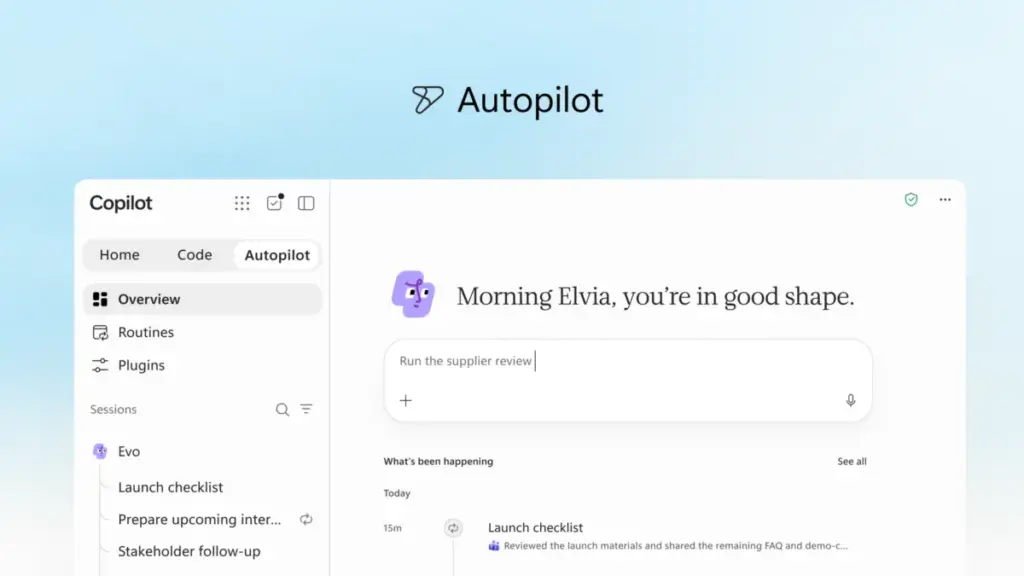
In contrast, more intensive "agentic" work—including the long-running processes handled by Cowork, Code, and Autopilot—will move toward Usage-Based Billing (UBB). This model is designed for high-value tasks that require frontier models, such as Microsoft’s Astra and Fable. UBB gives organizations the flexibility to match their spending directly to the business value generated by these advanced agents.
 Productivity Software & Office Suites
Microsoft Reports 30 Million Copilot Seats as Enterprise AI Shifts from Assistance to Autonomous Agents
In its most recent earnings report, Microsoft announced a significant milestone in...
 Productivity Software & Office Suites
Microsoft Unveils Specialized AI Capabilities for Finance Professionals in Excel to Address Sector-Specific Complexity
The trajectory of transformative technology has followed a consistent, predictable rhythm for...
 Productivity Software & Office Suites
Microsoft Announces Fifth Annual Power Platform Community Conference in Las Vegas to Bridge the Gap Between AI Innovation and Business Process
As the global enterprise landscape continues to evolve, the fundamental machinery of...







