
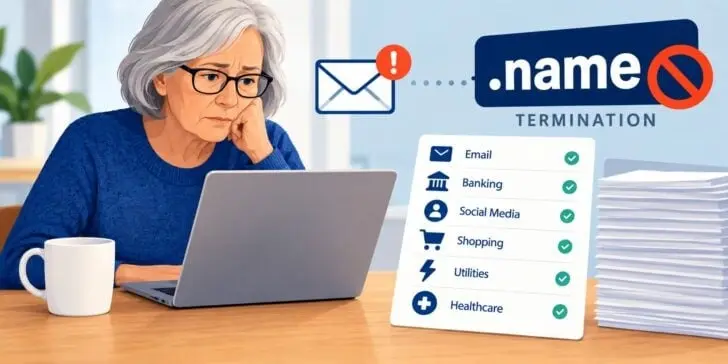
For more than two decades, the .name top-level domain has served as a niche but significant corner of the internet, designed specifically for individuals to establish a permanent digital identity. However, a recent decision by the Internet Corporation for Assigned Names and Numbers (ICANN) and Verisign, the registry operator for .name, to terminate third-level domain registrations has sparked a wave of concern among long-time users. What might appear to be a technical sunsetting of an aging system is, for many, a looming administrative disaster that threatens to sever their primary connection to the modern world.
The gravity of this transition is perhaps best illustrated by a formal reconsideration request recently published by ICANN. The filing, submitted by Judy Johnston, provides a stark look at the personal hardship and logistical nightmare facing those who have spent the better part of twenty-five years building their digital lives on a .name foundation. For Johnston and her 97-year-old mother, the termination of their email addresses is not merely an inconvenience; it is a disruption of their fundamental ability to manage their affairs.
A Legacy of Personal Branding Under Threat
The .name top-level domain was launched in 2001 with a specific vision: to provide individuals with a personalized space on the web. Unlike .com or .org, which were often crowded with commercial and organizational interests, .name offered a structured format, often utilizing third-level registrations such as "jane.doe.name." This structure allowed families to share a surname domain while maintaining individual identities.
Judy Johnston was an early adopter of this vision, registering her third-level .name domain in 2002. For nearly a quarter-century, this domain has been the cornerstone of her digital existence. It is the address through which she communicates with friends, manages her finances, and accesses essential services. Her 97-year-old mother is equally dependent on the service, using a corresponding address for her own daily correspondence and account management.
The decision by Verisign and ICANN to move away from these third-level registrations effectively evicts these users from their digital homes. While the industry often views domain names as temporary leases, for users like Johnston, they are permanent identifiers. The upcoming termination means that every email sent to these addresses will eventually bounce, and every account tied to them will become a potential security or access risk.
The Herculean Task of Account Migration
In her reconsideration request to ICANN, Johnston detailed the sheer scale of the work required to mitigate the loss of her domain. She estimated that she will need to manually update at least 211 different online accounts. This list likely includes everything from banking and utility portals to healthcare providers, government agencies, and social media platforms.
The process of changing an email address on a single account can be straightforward, but multiplying that task by several hundred reveals a staggering burden. Johnston described the effort as a "full-time daily job" that has already consumed weeks of her time. The difficulty is compounded by the varying security protocols of different platforms. In an era of heightened cybersecurity, many services make it intentionally difficult to change a primary email address, often requiring multi-factor authentication (MFA) linked to the very address that is being phased out.
 Web Hosting & Domain Management
Verisign Unveils New "Verisign Informed" Security Service and Moves to Secure .pki Top-Level Domain
In a significant expansion of its security and infrastructure portfolio, Verisign (NASDAQ:...
 Web Hosting & Domain Management
Industry Anxiety Mounts as ICANN Withholds Critical Timeline for New gTLD Reveal Day
The global domain name industry is currently suspended in a state of...
 Web Hosting & Domain Management
Identity Digital Secures U.S. Government Contract to Manage .us Domain Registry
In a significant shift for the landscape of the American internet infrastructure,...







