

For more than two decades, the .name top-level domain has served as a niche but significant corner of the internet, designed specifically for individuals to establish a permanent digital identity. However, a recent decision by the Internet Corporation for Assigned Names and Numbers (ICANN) and Verisign, the registry operator for .name, to terminate third-level domain registrations has sparked a wave of concern among long-time users. What might appear to be a technical sunsetting of an aging system is, for many, a looming administrative disaster that threatens to sever their primary connection to the modern world.
The gravity of this transition is perhaps best illustrated by a formal reconsideration request recently published by ICANN. The filing, submitted by Judy Johnston, provides a stark look at the personal hardship and logistical nightmare facing those who have spent the better part of twenty-five years building their digital lives on a .name foundation. For Johnston and her 97-year-old mother, the termination of their email addresses is not merely an inconvenience; it is a disruption of their fundamental ability to manage their affairs.
A Legacy of Personal Branding Under Threat
The .name top-level domain was launched in 2001 with a specific vision: to provide individuals with a personalized space on the web. Unlike .com or .org, which were often crowded with commercial and organizational interests, .name offered a structured format, often utilizing third-level registrations such as "jane.doe.name." This structure allowed families to share a surname domain while maintaining individual identities.
Judy Johnston was an early adopter of this vision, registering her third-level .name domain in 2002. For nearly a quarter-century, this domain has been the cornerstone of her digital existence. It is the address through which she communicates with friends, manages her finances, and accesses essential services. Her 97-year-old mother is equally dependent on the service, using a corresponding address for her own daily correspondence and account management.
The decision by Verisign and ICANN to move away from these third-level registrations effectively evicts these users from their digital homes. While the industry often views domain names as temporary leases, for users like Johnston, they are permanent identifiers. The upcoming termination means that every email sent to these addresses will eventually bounce, and every account tied to them will become a potential security or access risk.
The Herculean Task of Account Migration
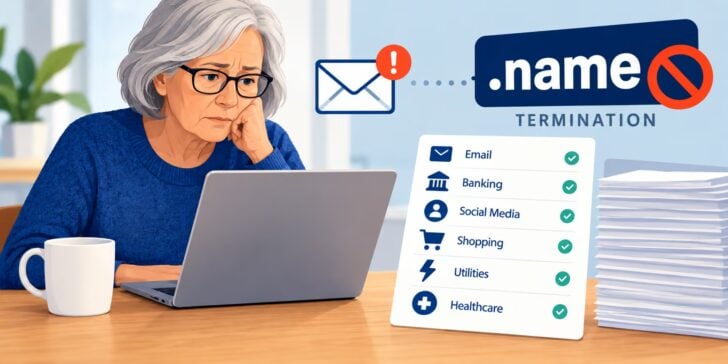
In her reconsideration request to ICANN, Johnston detailed the sheer scale of the work required to mitigate the loss of her domain. She estimated that she will need to manually update at least 211 different online accounts. This list likely includes everything from banking and utility portals to healthcare providers, government agencies, and social media platforms.
The process of changing an email address on a single account can be straightforward, but multiplying that task by several hundred reveals a staggering burden. Johnston described the effort as a "full-time daily job" that has already consumed weeks of her time. The difficulty is compounded by the varying security protocols of different platforms. In an era of heightened cybersecurity, many services make it intentionally difficult to change a primary email address, often requiring multi-factor authentication (MFA) linked to the very address that is being phased out.
For Johnston and her mother, both of whom are senior citizens, the technical hurdles are particularly daunting. Some services have already begun demanding multiple forms of identification and the completion of complex data protection forms to verify their identities before allowing an email change. This bureaucratic friction turns a simple update into an exhausting ordeal, one that is being forced upon them through no fault of their own.
If the domains are terminated before these updates are complete, the situation becomes even more dire. Once an email address is no longer functional, "forgot password" features and identity verification emails become useless. Users can find themselves permanently locked out of their own data, forced to undergo manual account recovery processes that can take weeks and offer no guarantee of success.
Confusion and Misinformation at the Registrar Level
Adding to the frustration of affected users is a significant breakdown in communication between the registry, ICANN, and the registrars who interface with the public. Johnston’s experience with her registrar, Network Solutions, highlights a troubling lack of awareness regarding the termination policy.
Upon receiving a notification that her domain would be terminated, Johnston contacted Network Solutions to explore her options and seek clarification. To her surprise, multiple customer service representatives repeatedly informed her that the notification was a scam. The representatives pointed to the fact that her domain was officially registered and "secured" through 2030, leading them to believe that any talk of early termination must be fraudulent.
This internal confusion at a major registrar suggests that the rollout of the termination plan has been poorly coordinated. Johnston reported that she eventually had to instruct a customer service representative to perform a web search for ".name termination" to prove that the situation was real. When the frontline support staff of a multi-billion-dollar domain registrar are unaware of a major policy shift affecting their customers, it leaves users like Johnston in an incredibly vulnerable position, fighting against both the policy itself and the ignorance of those supposed to help them navigate it.
The Case for Reversing Course
The hardship described in Johnston’s reconsideration request has added weight to the arguments of industry observers who believe ICANN and Verisign should reconsider their path. The core of the issue lies in the discrepancy between the technical goals of the registry and the real-world impact on long-term users.
From a technical or business standpoint, Verisign may view the third-level .name registrations as a legacy system that is no longer profitable or efficient to maintain. However, critics argue that the "personal" nature of the .name TLD carries a higher ethical obligation to users. Unlike a business that might change its name or a hobbyist who might let a domain lapse, individuals who have used the same email address for 25 years have integrated that address into the very fabric of their lives.
The argument for a reversal of course is rooted in the principle of digital stability. If the organizations that govern the internet’s infrastructure can arbitrarily terminate a twenty-year-old identity, it undermines trust in the system as a whole. For senior citizens like Johnston and her mother, who may have limited technical support and are more vulnerable to the complexities of modern digital security, the forced migration is particularly punitive.
Furthermore, the fact that Johnston’s domain was paid for and "secured" through 2030 raises questions about the contractual obligations of the registry and registrars. Users who have paid for long-term registrations did so under the assumption that their digital identity was safe for the duration of that term. Truncating that period creates a breach of expectations that many feel ICANN is obligated to address.
The Broader Implications for Digital Identity
The struggle facing .name users serves as a cautionary tale for the broader internet community. As the digital landscape evolves, the permanence of our online identities is often taken for granted. We treat our email addresses and domains as fixed points, yet they are ultimately dependent on the policy decisions of a few centralized entities.
The situation with .name highlights the need for better "sunset" protocols for legacy internet services. If a service must be discontinued, the transition period and the support offered to users must be commensurate with the duration and importance of the service. A few months of notice is arguably insufficient for a twenty-five-year-old account linked to hundreds of external services.
As ICANN reviews the reconsideration requests coming in from users like Judy Johnston, the domain industry is watching closely. The outcome will signal whether the governing bodies of the internet prioritize technical consolidation and registry efficiency over the stability and rights of individual long-term users.
For now, Johnston continues the grueling process of auditing her digital life, one account at a time. Her story remains a powerful testament to the fact that behind every domain record is a human being whose life is increasingly defined by the strings of characters they use to log in, communicate, and exist online. The "full-time job" of reclaiming her identity from a looming termination is a burden she—and many others—believe they should never have had to carry.
 Web Hosting & Domain Management
The AI-Driven Acceleration of the Domain Aftermarket: Why 2026 is Seeing Record-Breaking Development Speeds
The secondary market for domain names has long been characterized by a...
 Web Hosting & Domain Management
Identity Digital spins out agentic effort, now called Known
The transition marks a significant milestone for the project previously known as...
 Web Hosting & Domain Management
Corporate Giants and Emerging Startups Secure Strategic Digital Real Estate in Latest Domain Sales Report
The secondary domain name market continues to serve as a reliable barometer...







