
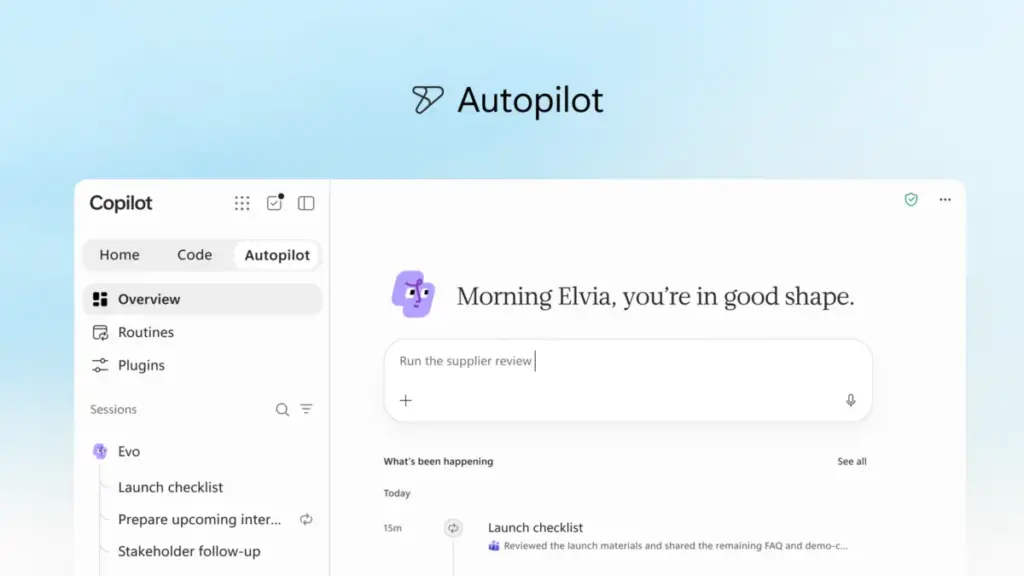
In a significant shift that signals the next phase of the generative AI era, Microsoft has announced a sweeping reimagining of its Copilot platform. The technology giant is moving beyond the concept of a simple AI assistant to create a more integrated, proactive, and customizable ecosystem designed to sit at the center of professional workflows. This new iteration of Copilot is built to align with the evolving nature of modern work, aiming to bridge the gap between human ambition and the technical execution required to achieve large-scale organizational goals.
Led by Jared Spataro, Microsoft’s head of AI at Work, the company is introducing a reconstructed Copilot app that serves as a unified interface for three core pillars of productivity: Home, Code, and Autopilot. This evolution is intended to help organizations not only use AI for basic tasks but to build, customize, and scale artificial intelligence across every facet of their operations. By connecting the tools people rely on daily with next-generation agentic capabilities, Microsoft is attempting to redefine how work is delegated and completed in the digital age.
A New Experience for Every Mode of Work
The centerpiece of this update is the "Home" experience, which serves as a new starting point for users. Microsoft’s vision for Home is to create a centralized hub where "Chat" and "Cowork" converge. In the current corporate environment, employees often find themselves bouncing between disparate platforms—meetings in Teams, threads in email, and document creation in Word. Home is designed to provide a "grounding" experience, allowing users to get their bearings, review recent activity, and pick up work exactly where they left off.
The distinction between Chat and Cowork is fundamental to this new structure. Chat remains the conversational interface for instant interactions, such as asking quick questions, conducting lookups, or generating initial drafts. Cowork, however, represents a shift toward delegation. In this mode, users define a complex task—such as responding to a Request for Proposal (RFP), creating a product launch kit, or preparing a financial close package—and the AI manages the process end-to-end to return a completed result. Microsoft noted that in the near future, the system will become even more intuitive; users will simply state their objective, and Copilot will automatically route the task to the most appropriate capability, whether it be Chat, Cowork, or Code.
Deeply integrated into this Home experience is "Office in Copilot." This feature brings the full functionality of Word, Excel, and PowerPoint directly into the Copilot app. The goal is to eliminate the friction often associated with AI-generated content, such as broken formatting or the need to copy-paste context between different windows. From within the Copilot interface, a user can ask to model a budget or build a presentation deck. The result is a live, editable document that remains in sync with the original Office apps. This allows for side-by-side refinement and real-time collaboration, where teammates can be @mentioned to join the editing process.

The specific Office applications are also receiving targeted enhancements. PowerPoint can now automatically maintain brand consistency while allowing users to fine-tune images or apply custom templates. Excel users can now track changes made by Copilot or other collaborators to understand the reasoning behind data modifications, and the AI can recommend optimal visualizations for complex datasets. Furthermore, Microsoft is introducing "Skills" across the 365 suite, bringing specialized expertise—such as legal or financial workflows—directly into the applications to help organizations scale best practices through role-specific automation.
Expanding the Boundaries of Development
One of the most ambitious components of the new Copilot is "Code," a feature that aims to move solution-building beyond the exclusive domain of professional software developers. Microsoft suggests that for decades, the primary unit of knowledge work has been the file—the document, the spreadsheet, or the slide deck. With Code, the company is introducing a fourth unit: small, purpose-built applications and automations that anyone can create using natural language.
 Productivity Software & Office Suites
Microsoft Announces New AI-Integrated Office Suites to Streamline Small Business Operations
In the demanding ecosystem of small business management, success is often measured...
 Productivity Software & Office Suites
Microsoft Reports 30 Million Copilot Seats as Enterprise AI Shifts from Assistance to Autonomous Agents
In its most recent earnings report, Microsoft announced a significant milestone in...
 Productivity Software & Office Suites
Microsoft Democratizes Software Development with Natural Language App Building in Copilot Studio
The landscape of software development is undergoing a fundamental transformation as artificial...







