
In the bustling cultural landscape of Madrid, where neighborhood cafes and local libraries serve as the lifeblood of the independent art scene, the transition from a finished piece of art to a public exhibition is often a grueling administrative marathon. For many independent creators, the "business" of art—tracking inventory, scouting venues, and pitching to gallery managers—is a manual process that consumes time better spent in the studio. Recognizing this friction, a developer participating in the 2024 Hacktoberfest "Build for a Friend" challenge has unveiled a bespoke solution: the Art Exposition Manager.
The project, developed by a Madrid-based software engineer for his partner—an analogue collage artist—represents a growing trend in the developer community: using local-first artificial intelligence to solve hyper-specific, real-world problems without relying on expensive or privacy-invasive corporate APIs.

The Administrative Burden of the Independent Artist
The artist at the center of this story creates intricate analogue collages, repurposing vintage and modern magazines into vibrant, humorous, and surreal compositions. While her work frequently finds its way onto the walls of Madrid’s diverse exhibition spaces, the path to those walls was, until recently, paved with spreadsheets and manual Gmail threads.
Prior to the development of the Art Exposition Manager, the artist’s workflow was a patchwork of traditional digital tools. She managed her growing portfolio through a private Gmail account and tracked potential venues and exhibition history in a complex Excel sheet. When she encountered a potential venue during a walk through the city, the process of researching contact information, determining the "vibe" of the space, and drafting a tailored pitch was a task that often waited until she was back at her desk, leading to lost momentum and missed opportunities.
The developer identified that the core problem was not the lack of talent or interest from venues, but the sheer friction of the "pitch" process. The goal was to create a tool that could take an artist from the moment of inspiration—standing in front of a library or cafe—to a ready-to-send, professionally drafted email in a matter of minutes.

A New Workflow: From Telegram to the Gallery Wall
The resulting application, the Art Exposition Manager, is designed to streamline the entire lifecycle of an art exhibition. The system allows the artist to maintain a digital inventory of her work, including high-resolution scans and metadata about each piece. However, the most significant innovation lies in its venue management and pitching capabilities.
One of the standout features of the application is its integration with Telegram. This allows the artist to interact with her management system while on the move. If she passes a coffee shop in the Malasaña or Chamberí neighborhoods that seems like a fit for her colorful style, she can simply message the bot: "Add the X library in the Y neighborhood."
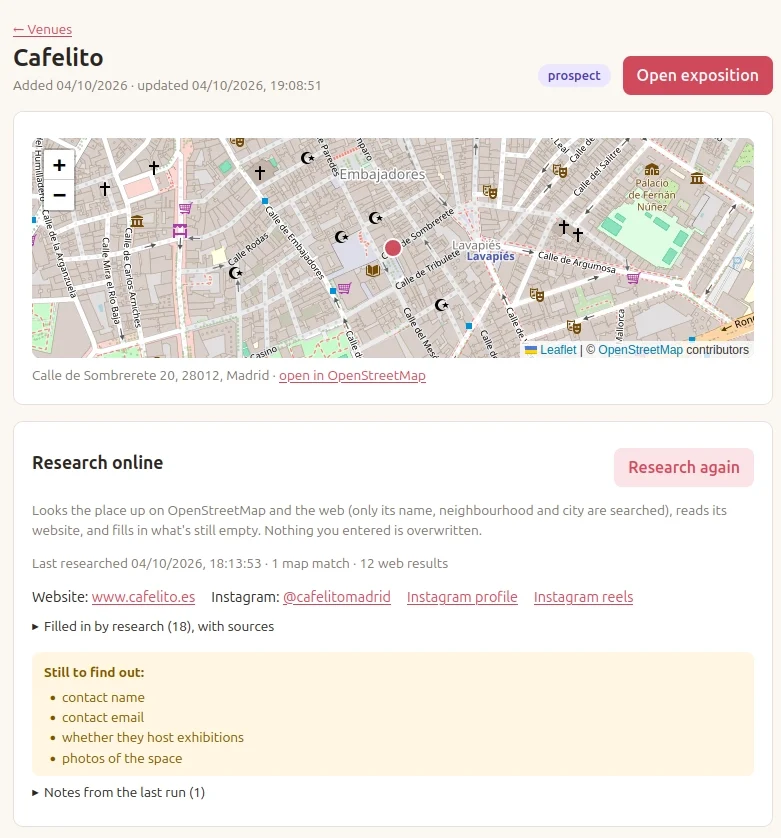
The system then takes over. Using a combination of local AI and open-source search tools, the application researches the venue, finds relevant details, and stores them in a local SQLite database. When the artist is ready to pitch, the AI analyzes the venue’s characteristics and suggests specific artworks from her portfolio that would best complement the space. It then drafts a personalized pitch email, explaining the thematic connections between the art and the venue.
 Software Development & Scripting for IT
The Crisis of the "Almost Right" Illusion: How AI-Driven Developer Burnout is Reshaping Software Engineering
The initial promise of Artificial Intelligence in software development was centered on...
 Software Development & Scripting for IT
"Outside in 20" Redefines Digital Wellness with Local AI-Driven Outdoor Encouragement
In an era where digital connectivity often feels inescapable, a new open-source...
 Software Development & Scripting for IT
Re-evaluating the Enterprise Test Automation Stack: Why Past Decisions Require New Scrutiny in the Age of AI
In the fast-moving world of enterprise software, a test automation tool that...







