
In the bustling cultural landscape of Madrid, where neighborhood cafes and local libraries serve as the lifeblood of the independent art scene, the transition from a finished piece of art to a public exhibition is often a grueling administrative marathon. For many independent creators, the "business" of art—tracking inventory, scouting venues, and pitching to gallery managers—is a manual process that consumes time better spent in the studio. Recognizing this friction, a developer participating in the 2024 Hacktoberfest "Build for a Friend" challenge has unveiled a bespoke solution: the Art Exposition Manager.
The project, developed by a Madrid-based software engineer for his partner—an analogue collage artist—represents a growing trend in the developer community: using local-first artificial intelligence to solve hyper-specific, real-world problems without relying on expensive or privacy-invasive corporate APIs.

The Administrative Burden of the Independent Artist
The artist at the center of this story creates intricate analogue collages, repurposing vintage and modern magazines into vibrant, humorous, and surreal compositions. While her work frequently finds its way onto the walls of Madrid’s diverse exhibition spaces, the path to those walls was, until recently, paved with spreadsheets and manual Gmail threads.
Prior to the development of the Art Exposition Manager, the artist’s workflow was a patchwork of traditional digital tools. She managed her growing portfolio through a private Gmail account and tracked potential venues and exhibition history in a complex Excel sheet. When she encountered a potential venue during a walk through the city, the process of researching contact information, determining the "vibe" of the space, and drafting a tailored pitch was a task that often waited until she was back at her desk, leading to lost momentum and missed opportunities.
The developer identified that the core problem was not the lack of talent or interest from venues, but the sheer friction of the "pitch" process. The goal was to create a tool that could take an artist from the moment of inspiration—standing in front of a library or cafe—to a ready-to-send, professionally drafted email in a matter of minutes.

A New Workflow: From Telegram to the Gallery Wall
The resulting application, the Art Exposition Manager, is designed to streamline the entire lifecycle of an art exhibition. The system allows the artist to maintain a digital inventory of her work, including high-resolution scans and metadata about each piece. However, the most significant innovation lies in its venue management and pitching capabilities.
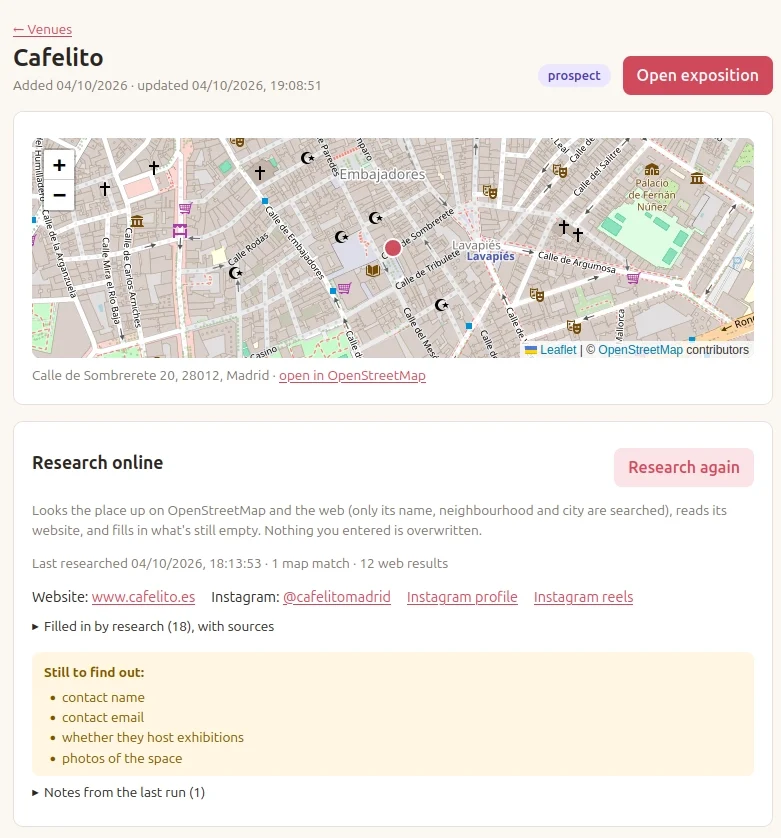
One of the standout features of the application is its integration with Telegram. This allows the artist to interact with her management system while on the move. If she passes a coffee shop in the Malasaña or Chamberí neighborhoods that seems like a fit for her colorful style, she can simply message the bot: "Add the X library in the Y neighborhood."
The system then takes over. Using a combination of local AI and open-source search tools, the application researches the venue, finds relevant details, and stores them in a local SQLite database. When the artist is ready to pitch, the AI analyzes the venue’s characteristics and suggests specific artworks from her portfolio that would best complement the space. It then drafts a personalized pitch email, explaining the thematic connections between the art and the venue.

Crucially, the system adheres to a "human-in-the-loop" philosophy. The AI drafts the correspondence, but nothing is ever sent automatically. The artist retains full creative control, modifying the drafts as she sees fit before hitting send from her own account.
Putting the MVP to the Test in Central Madrid
The true test of any software is its performance in the field. Shortly after completing the Minimum Viable Product (MVP), the developer and the artist tested the system during a walk through Madrid’s city center.
Upon finding an interesting coffee shop, the artist—who did not previously have the Telegram app installed—used the developer’s phone to send a message to the bot. The system successfully identified the venue, confirmed the details with her, and stored the information for future follow-up. The developer noted that the artist was particularly impressed by the speed of development; the transition from a casual conversation about the idea to a functional, mobile-accessible tool took less than twenty-four hours.

During this testing phase, the developer identified and corrected early technical hurdles. Initially, the AI agent attempted to write the email drafts directly within the chat interface rather than invoking the specific application logic designed for that task. By refining the prompts and updating the Model Context Protocol (MCP) settings, the developer was able to ensure the AI followed the intended architectural flow.
The Technical Architecture: Local-First and Privacy-Centric
The Art Exposition Manager is built on a sophisticated stack that prioritizes local execution over cloud-based services. This approach not only eliminates the costs associated with paid AI APIs but also ensures that the artist’s data—her original scans, database of venues, and private correspondence—remains entirely on her own hardware.
The "brain" of the system is Gemma 4 26B-A4B, a mixture-of-experts model with approximately 4 billion active parameters per token. The model is served locally on a Mac GPU using llama.cpp. This specific model was chosen for its multimodal capabilities; it can both analyze the visual content of the artworks and generate the text for the pitch emails.

To manage the complex logic of the application, the developer utilized Mastra, an agentic framework that allows for the creation of structured AI workflows. Each task, from analyzing an image to researching a venue, is handled by a specific Mastra agent. These agents are governed by Zod schemas to ensure that the data they output is consistent and reliable.
The workflow also includes non-AI steps to ensure quality and accuracy. For instance, the system uses a self-hosted SearXNG container for web searches and OpenStreetMap’s Nominatim for location lookups. This ensures that only the venue name and city ever leave the local machine. Furthermore, every AI-generated draft undergoes a code-only check to reject any placeholders (like [Insert Name]), verify the language, and ensure the word count falls between a professional 120 and 350 words.
The Power of Vision and Local Innovation
One of the most impressive aspects of the system is the "vision pass." When the AI analyzes a piece of art, it doesn’t just see pixels; it interprets context. For example, when analyzing a collage titled Viaja por un ojo de la cara, the model correctly identified that the title is a play on the Spanish idiom "costar un ojo de la cara" (equivalent to "costing an arm and a leg").

The AI noted that the collage literalizes the phrase by showing a creature interacting with a woman’s eye. These nuanced descriptions allow the "Art Picker" agent to make intelligent recommendations. Rather than choosing pieces at random, the system can suggest "the muted blue piece that suits a quiet reading room" or "the vibrant, humorous collage for a high-energy cafe."
The developer’s decision to keep the project open-source and locally hosted is a deliberate stance on the future of innovation. He argued that as the industry becomes increasingly dependent on massive, centralized AI providers, the ability to run powerful models locally is vital for maintaining developer independence and privacy.
"Open innovation lets others learn too," the developer stated, reflecting on the project. "I would not be able to learn how to serve an LLM if it wasn’t for the fact that there are so many tools available for easily downloading and spinning one up. We’re truly standing on the shoulders of giants."

Looking Ahead
While the developer acknowledged that a "frontier" closed-source model might write a slightly more polished first draft, the benefits of the local-first approach—privacy, zero cost, and the ability to deeply integrate with local tools—far outweighed the marginal gains in prose.
The Art Exposition Manager stands as a testament to what can be achieved during a single weekend of focused development. By combining a deep understanding of a user’s needs with the latest advancements in local AI, the project has transformed a cumbersome administrative process into a streamlined, mobile-friendly experience. For one artist in Madrid, the journey from the studio to the public eye has just become a little bit shorter.
 Software Development & Scripting for IT
The Crisis of the "Almost Right" Illusion: How AI-Driven Developer Burnout is Reshaping Software Engineering
The initial promise of Artificial Intelligence in software development was centered on...
 Software Development & Scripting for IT
The Hidden Risks of DNS Drift: Why Engineering Teams are Prioritizing Reconciliation Safety over Speed
In the modern landscape of cloud-native logistics and software-as-a-service platforms, the reliability...
 Software Development & Scripting for IT
The Architecture of Thought: Why Modern Software Engineering Mentorship is Moving Beyond Syntax
In the modern landscape of software development, a stark divide has emerged...







