
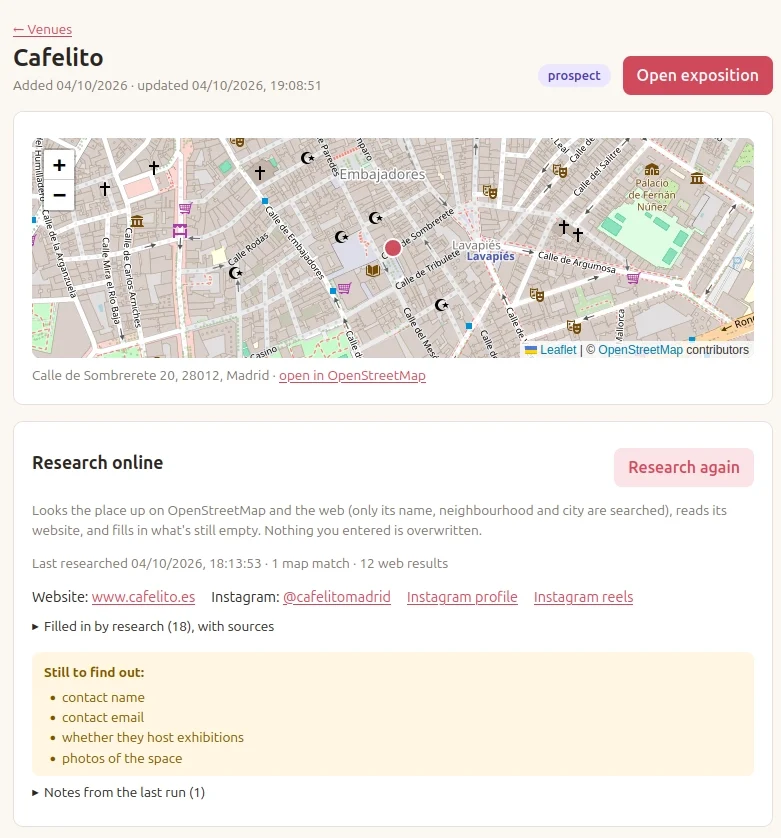
The workflow also includes non-AI steps to ensure quality and accuracy. For instance, the system uses a self-hosted SearXNG container for web searches and OpenStreetMap’s Nominatim for location lookups. This ensures that only the venue name and city ever leave the local machine. Furthermore, every AI-generated draft undergoes a code-only check to reject any placeholders (like [Insert Name]), verify the language, and ensure the word count falls between a professional 120 and 350 words.
The Power of Vision and Local Innovation
One of the most impressive aspects of the system is the "vision pass." When the AI analyzes a piece of art, it doesn’t just see pixels; it interprets context. For example, when analyzing a collage titled Viaja por un ojo de la cara, the model correctly identified that the title is a play on the Spanish idiom "costar un ojo de la cara" (equivalent to "costing an arm and a leg").

The AI noted that the collage literalizes the phrase by showing a creature interacting with a woman’s eye. These nuanced descriptions allow the "Art Picker" agent to make intelligent recommendations. Rather than choosing pieces at random, the system can suggest "the muted blue piece that suits a quiet reading room" or "the vibrant, humorous collage for a high-energy cafe."
The developer’s decision to keep the project open-source and locally hosted is a deliberate stance on the future of innovation. He argued that as the industry becomes increasingly dependent on massive, centralized AI providers, the ability to run powerful models locally is vital for maintaining developer independence and privacy.
"Open innovation lets others learn too," the developer stated, reflecting on the project. "I would not be able to learn how to serve an LLM if it wasn’t for the fact that there are so many tools available for easily downloading and spinning one up. We’re truly standing on the shoulders of giants."

Looking Ahead
While the developer acknowledged that a "frontier" closed-source model might write a slightly more polished first draft, the benefits of the local-first approach—privacy, zero cost, and the ability to deeply integrate with local tools—far outweighed the marginal gains in prose.
The Art Exposition Manager stands as a testament to what can be achieved during a single weekend of focused development. By combining a deep understanding of a user’s needs with the latest advancements in local AI, the project has transformed a cumbersome administrative process into a streamlined, mobile-friendly experience. For one artist in Madrid, the journey from the studio to the public eye has just become a little bit shorter.
 Software Development & Scripting for IT
Bridging the Context Gap: TokenCap Introduces Schema Intelligence to Eliminate AI Coding Errors
In the rapidly evolving landscape of software development, the integration of Artificial...
 Software Development & Scripting for IT
AI That Urges You to Unplug: Pranav Suryawanshi Unveils TouchCall Voice Assistant for the Hacktoberfest AI Challenge
In an era where digital wellness applications often paradoxically demand more of...
 Software Development & Scripting for IT
"Outside in 20" Redefines Digital Wellness with Local AI-Driven Outdoor Encouragement
In an era where digital connectivity often feels inescapable, a new open-source...







