
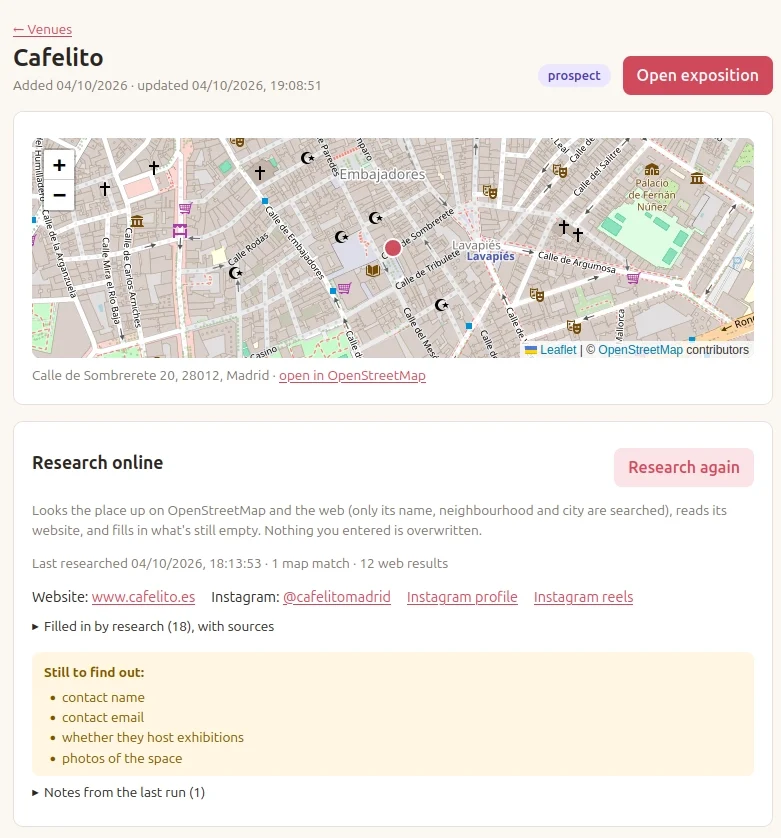

Crucially, the system adheres to a "human-in-the-loop" philosophy. The AI drafts the correspondence, but nothing is ever sent automatically. The artist retains full creative control, modifying the drafts as she sees fit before hitting send from her own account.
Putting the MVP to the Test in Central Madrid
The true test of any software is its performance in the field. Shortly after completing the Minimum Viable Product (MVP), the developer and the artist tested the system during a walk through Madrid’s city center.
Upon finding an interesting coffee shop, the artist—who did not previously have the Telegram app installed—used the developer’s phone to send a message to the bot. The system successfully identified the venue, confirmed the details with her, and stored the information for future follow-up. The developer noted that the artist was particularly impressed by the speed of development; the transition from a casual conversation about the idea to a functional, mobile-accessible tool took less than twenty-four hours.

During this testing phase, the developer identified and corrected early technical hurdles. Initially, the AI agent attempted to write the email drafts directly within the chat interface rather than invoking the specific application logic designed for that task. By refining the prompts and updating the Model Context Protocol (MCP) settings, the developer was able to ensure the AI followed the intended architectural flow.
The Technical Architecture: Local-First and Privacy-Centric
The Art Exposition Manager is built on a sophisticated stack that prioritizes local execution over cloud-based services. This approach not only eliminates the costs associated with paid AI APIs but also ensures that the artist’s data—her original scans, database of venues, and private correspondence—remains entirely on her own hardware.
The "brain" of the system is Gemma 4 26B-A4B, a mixture-of-experts model with approximately 4 billion active parameters per token. The model is served locally on a Mac GPU using llama.cpp. This specific model was chosen for its multimodal capabilities; it can both analyze the visual content of the artworks and generate the text for the pitch emails.

To manage the complex logic of the application, the developer utilized Mastra, an agentic framework that allows for the creation of structured AI workflows. Each task, from analyzing an image to researching a venue, is handled by a specific Mastra agent. These agents are governed by Zod schemas to ensure that the data they output is consistent and reliable.
 Software Development & Scripting for IT
The Crisis of the "Almost Right" Illusion: How AI-Driven Developer Burnout is Reshaping Software Engineering
The initial promise of Artificial Intelligence in software development was centered on...
 Software Development & Scripting for IT
Architecting Precision: Why Staged Retrieval and Explicit Contracts are Redefining AI Insurance Claims Intake
In the rapidly evolving landscape of insurance technology, the integration of Large...
 Software Development & Scripting for IT
The Museum of Almost: Redefining Digital Narrative through Speculative Design and Technical Rigor
In the evolving landscape of digital art and web development, the boundary...







