

This unified approach addresses a major pain point for data center operators: the complexity of managing disparate networking technologies. The ability to use any CPU, GPU, or XPU, fronted by standard NICs or DPUs, and have them all participate in a single, manageable fabric is a compelling value proposition. It offers a level of flexibility that is currently difficult to achieve within the "walled garden" of proprietary AI stacks.
However, the path forward is not without significant hurdles. While companies like AMD are likely to embrace third-party scale-up options like SkyHammer to bolster their own AI offerings, Nvidia has little incentive to support an alternative to its lucrative NVSwitch ecosystem. Currently, there is no supported way to use Nvidia GPUs within a SkyHammer-based scale-up domain.
The industry is now entering a period of intense experimentation. As organizations begin to deploy UALoE and ESUN protocols over optimized Ethernet switches, the market will finally see if a standardized approach can truly match the performance of a vertically integrated, proprietary solution.
The outcome of this battle will likely determine the economic landscape of AI for the next decade. If Upscale AI and the broader standards movements succeed, the cost of building massive AI clusters could drop significantly as competition enters the interconnect market. If proprietary systems maintain their performance lead, the "tax" on high-end AI compute will remain high.
In the long run, even a dominant player like Nvidia might be forced to adapt. If a standard scale-up network reaches a certain level of maturity and market share, particularly for inference workloads, Nvidia could eventually choose to adopt the standard while layering its own proprietary protocol enhancements on top. Until then, the industry will watch closely to see if SkyHammer can truly break the proprietary "glue" that has held the high-performance computing world together for so long.
 Enterprise Tech & Infrastructure
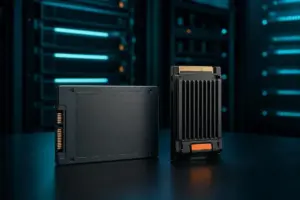
Understanding the Architecture of Modern Storage: Why the ‘Flash vs. SSD’ Debate Misses the Point
In the rapidly evolving landscape of enterprise data management, the terminology used...
 Enterprise Tech & Infrastructure
The Hidden Architecture of Amazon S3 Costs: Why the Per-Gigabyte Rate is Only the Tip of the Iceberg
For many enterprise IT leaders, the initial appeal of Amazon S3 lies...
 Enterprise Tech & Infrastructure
Micron Technology and the Global Memory Boom: HBM’s Ascent to the Most Profitable Product in IT History
The history of the commercial information technology sector spans more than six...







