

The SkyFabriX architecture is designed to scale significantly. While a single networking tier can support up to 576 accelerators, the use of multiple tiers could allow the fabric to scale to thousands of devices. In the current landscape, these numbers are competitive. The emerging UALink consortium is aiming for 1,024 XPUs in a single tier, and Nvidia’s future "Rubin Ultra" generation is expected to push NVSwitch boundaries to 1,152 GPUs using multi-tier configurations.
However, the raw bandwidth numbers tell only part of the story. When calculating the bandwidth per device, SkyHammer appears to offer significantly less throughput than Nvidia’s latest generations. On a Grace-Blackwell NVL72 system, NVLink 5 provides approximately 1.8 TB/sec per GPU, a figure set to double with the upcoming Vera-Rubin generation. In contrast, SkyHammer’s current specifications suggest a more modest memory bandwidth over the scale-up network.
Upscale AI contends that bandwidth is not the only metric that matters, particularly for AI inference workloads where latency and, more importantly, predictable jitter are the critical factors. In the world of large language models, the speed at which tokens are generated is heavily dependent on the reliability and consistency of the network fabric. The SkyHammer ASIC incorporates specific mechanisms to ensure a 100 percent lossless fabric with minimized and predictable latency. By avoiding the rigid, less-parallel pipeline arrangements of traditional Ethernet fabrics, Upscale AI believes it can offer a performance profile that challenges proprietary alternatives.
Technically, SkyHammer is an Ethernet-based ASIC, but it is one that has been heavily optimized for specialized protocols. It supports UALoE (UALink over Ethernet) and the ESUN memory protocols. This choice reflects a broader industry trend where the ubiquity and cost-effectiveness of Ethernet are being harnessed to perform tasks once reserved for specialized, low-latency technologies like InfiniBand.
While SkyHammer targets the scale-up portion of the AI cluster—the high-speed connections within a rack or a group of accelerators sharing memory—Upscale AI is not ignoring the scale-out portion of the network. In a strategic move, the company has partnered with Nvidia to use Spectrum-X Ethernet ASICs for its scale-out fabrics. Upscale AI will build its own switches based on these ASICs, which support port speeds of 400 Gb/sec, 800 Gb/sec, and 1.6 Tb/sec.
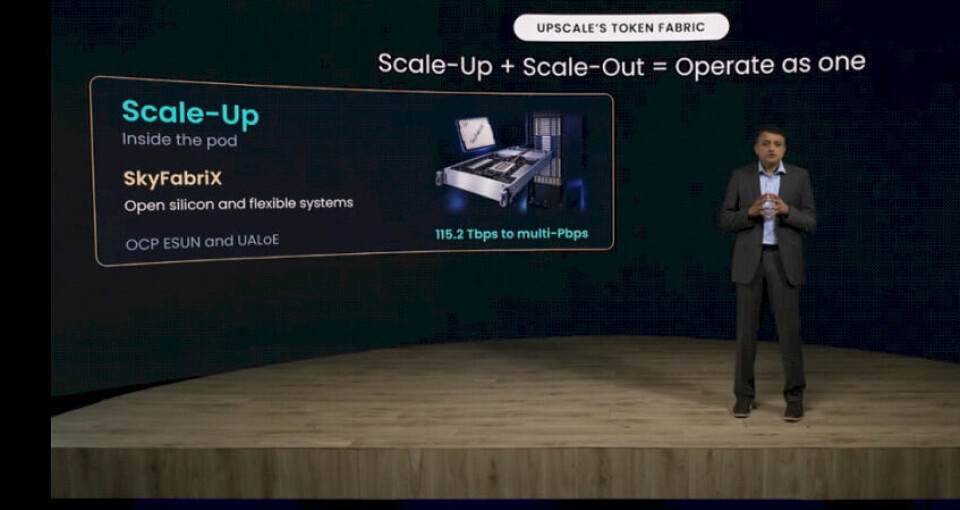
The bridge between these two worlds is "SkyOS," the company’s network operating system. SkyOS is an AI-optimized evolution of SONiC (Software for Open Networking in the Cloud), the open-source operating system originally developed by Microsoft that has since become a standard in hyperscale data centers. By running SkyOS across both SkyHammer (scale-up) and Spectrum-X (scale-out) hardware, Upscale AI offers a unified management and orchestration layer. Their "SkyCMD" tool provides telemetry and control over the entire cluster as a single entity, regardless of whether the traffic is moving within a memory domain or across the broader data center network.
 Enterprise Tech & Infrastructure
AMD Acquires World Labs for $8.2 Billion to Rival Nvidia in the Frontier of World Models
In a massive strategic move designed to reshape its standing in the...
 Enterprise Tech & Infrastructure
IonQ Breakthrough Demonstrates Real-Time Quantum Error Correction Using Standard CPU Architecture
The global pursuit of fault-tolerant, scalable quantum computing has long been defined...
 Enterprise Tech & Infrastructure
Understanding Fibre Channel over Ethernet: Bridging the Gap Between High-Performance Storage and Ethernet Ubiquity
In the rapidly evolving landscape of data center infrastructure, the quest for...







