
Triple-Level Cell (TLC) has become the mainstream standard for the modern PC market. By storing three bits per cell, it offers a pragmatic balance of high capacity and reasonable performance. Most high-end consumer NVMe drives utilize TLC to provide the speeds required for gaming and professional video editing without the prohibitive costs of SLC.
At the budget-friendly end of the spectrum lies Quad-Level Cell (QLC). By packing four bits into every cell, QLC drives achieve massive capacities at lower price points, often showing up in 4TB models and above. The trade-off, however, is a reduction in write speeds and overall lifespan. Because the controller must precisely manage sixteen different voltage levels within a single transistor to read four bits of data, the process is slower and more taxing on the hardware. This makes QLC ideal for "read-heavy" workloads—such as storing a massive library of movies or games—but less suitable for "write-heavy" environments like database logging.
The Controller: The Brain of the SSD
If NAND chips are the "storage bins," the controller is the "warehouse manager." This is the component that truly transforms raw flash into an SSD. A stack of NAND chips on its own is relatively "dumb" and prone to rapid degradation. The controller provides the intelligence necessary to keep the drive functioning over several years.
Two of the most critical tasks handled by the controller and its firmware are wear-leveling and garbage collection. NAND cells have a finite lifespan; they can only be written to and erased a certain number of times before they lose the ability to hold a charge. Wear-leveling ensures that the controller spreads data writes evenly across all available cells, preventing any single block of memory from wearing out prematurely. Garbage collection is a background process that reclaims memory blocks containing "stale" data that has been deleted by the operating system, ensuring that the drive always has clean blocks ready for new information.
To support these maintenance tasks, manufacturers employ "over-provisioning." This involves reserving a portion of the drive’s total NAND capacity—often between 7% and 28%—that remains invisible to the user. This extra space acts as a buffer for the controller to move data around during wear-leveling and garbage collection. According to SK Hynix, higher grades of SSDs typically feature more over-provisioning to sustain consistent performance under heavy workloads.
Performance is further enhanced through pseudo-SLC caching. Many TLC and QLC drives treat a small portion of their capacity as if it were SLC (writing only one bit per cell) to provide a burst of high speed. While this allows for impressive "headline" speeds in marketing materials, Computer Compatibility warns that once this cache is filled during a long file transfer, write speeds will drop significantly to the drive’s native, slower rate.
Interface, Form Factor, and the Reality of Endurance
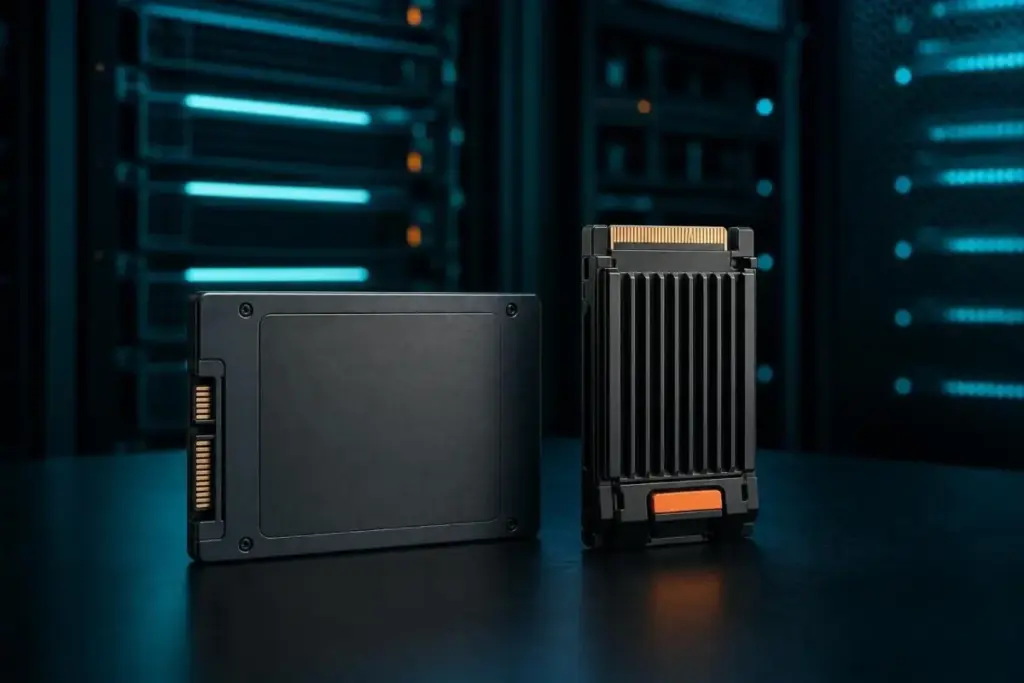
The physical and logical connection between the SSD and the computer is the final piece of the puzzle. For years, the SATA interface was the standard, but it is now a bottleneck. Capped at roughly 550 MB/s, SATA was designed for the era of spinning hard drives. The modern successor is NVMe (Non-Volatile Memory Express), which allows the SSD to communicate directly with the CPU via PCIe lanes. A Gen 4 NVMe drive can reach speeds of 7,000 MB/s, more than ten times the limit of SATA.
 Enterprise Tech & Infrastructure
GenAI Surge Triggers Record-Breaking Growth in Global Ethernet Switch and Router Markets
The massive wave of investment in Generative AI (GenAI) has long been...
 Enterprise Tech & Infrastructure
Mastering the Economics of Amazon S3: Strategies for Navigating Complex Cloud Storage Costs
For modern enterprises, the migration to cloud storage was once championed as...
 Enterprise Tech & Infrastructure
Understanding Fibre Channel over Ethernet: Bridging the Gap Between High-Performance Storage and Ethernet Ubiquity
In the rapidly evolving landscape of data center infrastructure, the quest for...







