
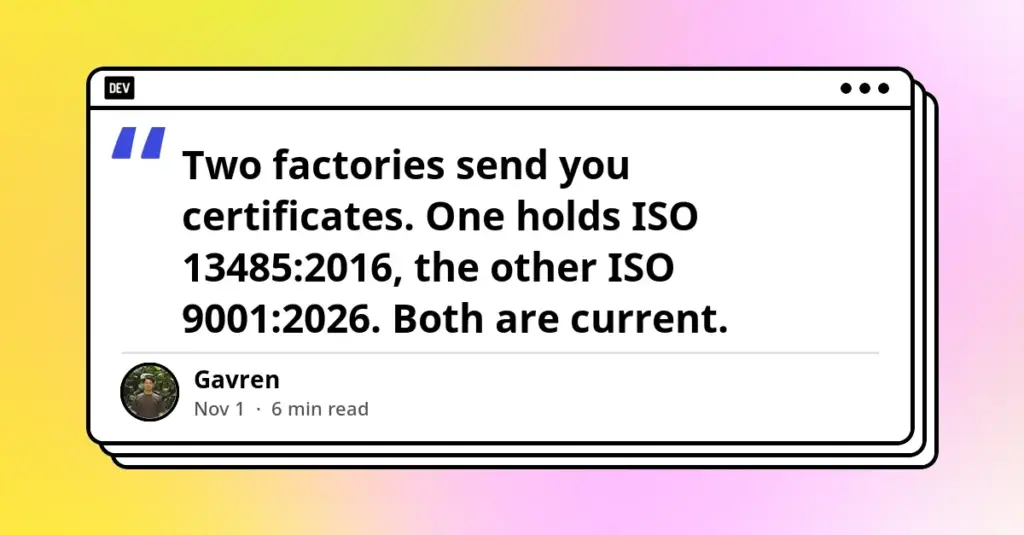
Interestingly, ISO 13485 has not followed this update cycle. Following a systematic review concluded in 2025, the 2016 edition of ISO 13485 was retained without changes. This stability reflects the standard’s continued effectiveness in meeting the rigorous demands of global medical device regulations, including the EU Medical Device Regulation (MDR).
Practical Evaluation of a Supplier
For an engineer or a buyer, the true test of these systems happens on the factory floor, not in a document review. These capabilities can be tested in an afternoon by asking targeted questions that move beyond the certificate.
When evaluating design control, one should ask to see the last design change on a specific model. A robust system will show a clear chain of evidence: the initial change request, the specific re-verification tests performed after the change, and a drawing revision on the production line that matches the current build. A "bad" answer often involves a disconnect between engineering and production, where drawings in the office do not match the parts being manufactured.
Similarly, when testing traceability, one should pick a random serial number from a shipment sent a year ago and ask to see every incoming raw material lot that went into that unit. A high-functioning ISO 13485 system can chain this data all the way back to the supplier’s lot and the incoming inspection records. In a weaker system, the chain often breaks at the shipment date or relies on paper cards that are not linked to individual serial numbers.
Making the Certification Decision
Ultimately, the choice between ISO 13485 and ISO 9001 depends on the product’s intended use and the regulatory route it follows. If a product is sold as a medical device under the EU MDR or U.S. FDA, ISO 13485 is the standard that matters. While ISO 13485 is technically a voluntary standard, it is the widely accepted route to meeting mandatory government regulations.
For products with no medical claim—such as a standard shower chair sold as a general consumer product—ISO 9001 may be defensible. However, in these cases, the buyer must recognize that the risk of specification conformity and change visibility sits squarely with them. ISO 9001 governs general quality management; it simply does not carry the device-specific obligations required to ensure long-term safety in a medical context.
As the industry moves through 2026 and beyond, the distinction between these two standards will only sharpen. Checking a certificate’s logo is merely checking the cover of a book; the real value lies in the technical capabilities—design control, risk management, and traceability—that the standard mandates within the factory walls. For those responsible for patient safety and product reliability, understanding these differences is not just a matter of compliance, but a fundamental requirement of the profession.
 Software Development & Scripting for IT
The Two-Week Pivot: How Strategic Scoping is Redefining Mobile App Development Timelines
In the competitive landscape of digital entrepreneurship, a persistent myth often dictates...
 Software Development & Scripting for IT
New Tool and Audit Reveal Common Structural Failures in the Emerging llms.txt Standard
As artificial intelligence agents and large language models increasingly become the primary...
 Software Development & Scripting for IT
UNC6240 Exploits Critical Oracle PeopleSoft Vulnerability Through Sophisticated WAF Bypass Techniques
A sophisticated cyber-espionage and data theft campaign has been identified targeting organizations...







