

The technique was refined and deployed again in May 2026, hitting the actions-cool/issues-helper tool. In this case, the attackers didn’t just aim for persistence; they targeted the immediate theft of credentials. By tricking pipelines into running a malicious commit existing in the repository’s "shadow" space, they were able to exfiltrate sensitive secrets and tokens from the environments where the actions were executed. These incidents have proven that an attacker no longer needs to compromise a maintainer’s account to poison a supply chain; they only need to understand how to make their malicious commit reachable.
GitHub’s Lockfiles Help, But They Don’t Finish the Job
In response to these emerging threats, GitHub accelerated its security roadmap. On March 26, 2026, the company announced a shift toward deterministic dependency locking, aiming to bring the same level of rigor found in package managers like npm or Cargo to the world of GitHub Actions.
The rollout was swift. Workflow lockfiles entered public preview on October 14 and reached general availability on October 28, 2026. These lockfiles are designed to tie every workflow run to recorded commits for both the primary actions and their transitive dependencies. This is a significant technical milestone because it ensures that even if a tag is moved or a dependency is altered downstream, the workflow remains tethered to a known state.

Crucially, GitHub’s locking mechanism requires that locked commits exist on a branch of the source repository. This feature is specifically designed to blunt the effectiveness of fork-only impostors. If a commit hash only exists in a malicious fork and has never been merged or pushed to a branch in the legitimate repository, the lockfile mechanism should, in theory, prevent it from being utilized.
However, even GitHub’s own documentation acknowledges that this is not a complete solution. In the official changelog for the lockfile release, the company noted that while locking provides deterministic execution, it "does not determine whether the dependency itself is safe." The core issues of commit authorship and the security of runtime builds remain open. Furthermore, the adoption of these tools is not yet universal; for instance, lockfiles are currently unsupported on GitHub Enterprise Server, leaving a significant portion of the corporate world without these advanced protections.
The reality is that lockfiles solve the problem of "consistency," but they do not solve the problem of "trust." A malicious commit that is successfully merged into a repository through a compromised account or a flawed pull request process will be "locked" just as securely as a legitimate one.
 Cybersecurity Basics & Security News
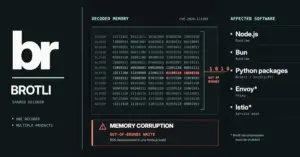
Critical Memory Corruption Vulnerability in Google’s Brotli Decoder Impacts Node.js, Bun, and Enterprise Infrastructure
A pervasive memory-corruption vulnerability has been identified within Google’s Brotli compression library,...
 Cybersecurity Basics & Security News
GMO Internet Group Launches $1 Million Global Bounty After Refusing $50 Million Cyber-Extortion Demand
In a decisive counter-offensive against cyber-extortionists, the Japanese technology conglomerate GMO Internet...
 Cybersecurity Basics & Security News
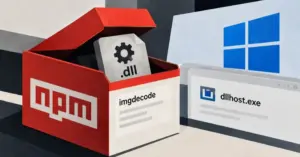
MALFEX Campaign Escalates: New Malicious ‘imgdecode’ Package Discovered Targeting Windows Systems via npm Registry
The landscape of software supply chain security has faced a persistent and...







