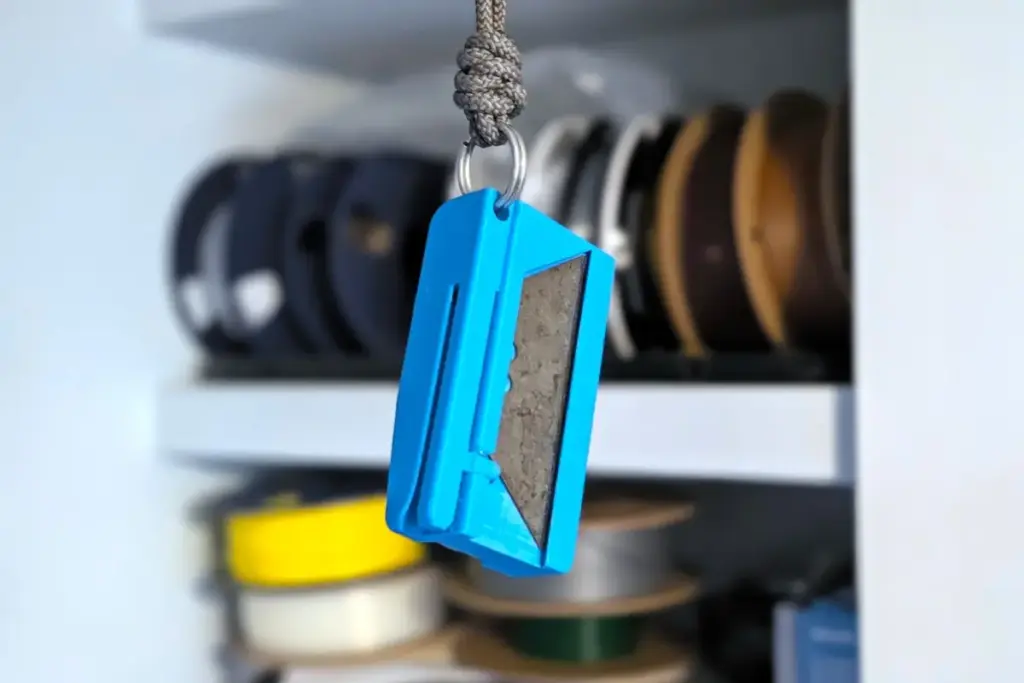
Much Better, But Still Too Cumbersome
Refusing to abandon the project, Fedewa returned to the drawing board for a second iteration. This phase was defined by the "kill your darlings" philosophy of design. He scrutinized his tool list and began stripping away anything that wasn’t strictly necessary for immediate, daily tasks. The tape measure and the pencil—items that are useful but perhaps not vital for a sudden, on-the-go repair—were the first to go.
The second prototype focused on a core quartet: a screwdriver, two bits, tweezers, and a utility knife. This version was significantly slimmer and abandoned the MagSafe magnets in favor of a more traditional pocket-slip design. By removing the magnetic interface, Fedewa was able to reduce the thickness of the housing even further, bringing the model closer to the dimensions of a standard minimalist wallet.
Despite these improvements, a new issue emerged: friction of use. The design utilized a hinged lid to secure the tools. While this kept the items safe and organized, it added a layer of complexity to their deployment. In the world of EDC, the "speed to task" is a critical metric. If a user has to pull a container out of their pocket, unlatch a lid, and then extract a tool, they are less likely to use it for quick tasks. The "toolbox" feel, while organized, felt more like a miniature version of a bag-carried kit rather than a true pocket essential. Fedewa eventually shared this model on MakerWorld, allowing other enthusiasts to download and print it, but for his own personal needs, the search for the "winner" continued.

Attempt #3: The Winner
Simplest Is Best
The breakthrough came when Fedewa stopped trying to build a "box" and started building a "holder." After weeks of carrying various prototypes, he realized that his actual daily needs were much narrower than his theoretical needs. The two tools he reached for most frequently were the compact utility knife and the screwdriver.
By focusing solely on these two items, the design constraints changed. Instead of creating a hollow space to house tools, he could design a solid, ergonomic frame that the tools integrated into directly. This third and final version utilized a 3D-printed utility knife design as the foundation. He then engineered a custom slot on the side to accommodate a standard keychain-style screwdriver.
The result was a masterpiece of minimalist utility. On one side, the screwdriver slides into a snug, form-fitting channel. To ensure the tool wouldn’t slide out during movement, Fedewa integrated a small magnet—not for mounting the device to a phone, but as a safety catch for the tool itself. On the opposite side, the utility knife is held in place by a mechanical catch. By pressing down on the lever, the blade carrier can be slid out for immediate use.
 Tech Tutorials & How-To Guides
The DIY iPod: How a Forgotten Smart Home Remote Resurrected Apple’s Iconic Cover Flow
In the annals of personal technology, few interfaces have evoked as much...
 Tech Tutorials & How-To Guides
Battle of the Store Brands: How Ryobi, Craftsman, and Hyper Tough Reshape the DIY Power Tool Market
In the modern landscape of home improvement, the barrier to entry for...
 Tech Tutorials & How-To Guides
The Fedora Paradox: Why the Industry’s Favorite Linux Distribution Still Feels Like an Unfinished Product
Fedora has long occupied a prestigious, if somewhat contradictory, position within the...