
As the global landscape for artificial intelligence continues to shift toward practical application and accessibility, the Korean AI sector has reached a significant milestone in its open-source distribution strategy. A comprehensive analysis of model download data from Hugging Face, the world’s leading AI repository, reveals that the success of a model in 2026 is no longer defined solely by its raw parameter count or benchmark scores. Instead, the "usability" of a model—specifically its availability in compressed, ready-to-run formats—has become the primary driver of adoption.
According to data compiled on November 16, 2026, 11 major South Korean AI developers have collectively released 174 language models on Hugging Face since the beginning of the year. The study encompasses a diverse group of industry leaders and specialized innovators, including LG AI Research, SK Telecom, Upstage, Motif Technologies, VIDraft, Naver, Kakao, NCSoft (NC AI), KT, Krafton, and Trillion Labs.
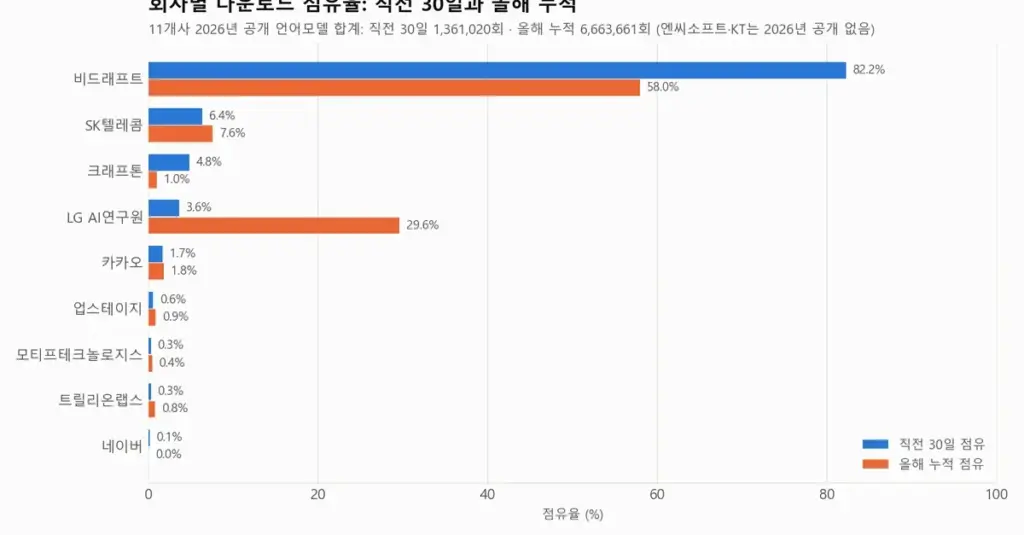
The findings paint a picture of a market that is both highly concentrated and rapidly evolving. Over the last 30 days, these companies recorded a total of 1,361,020 downloads. When looking at the cumulative performance for the year, the total reaches 6,663,661 downloads. However, the distribution of these downloads is far from equal, signaling a "winner-takes-most" dynamic in the open-source ecosystem.
Market Concentration and the HHI Threshold
One of the most striking revelations in the 2026 data is the extreme concentration of market share among a few key players. To measure this, the analysis utilized the Herfindahl-Hirschman Index (HHI), a commonly accepted measure of market concentration used by regulatory bodies like the U.S. Department of Justice. An HHI value above 1,800 typically indicates a highly concentrated market.
In the Korean open-source AI sector, the HHI for the last 30 days of downloads reached a staggering ,6842. The cumulative HHI for the year stood at 4,298. Both figures far exceed the threshold for high concentration, suggesting that the "long tail" of AI models is struggling to gain traction while a select few architectures dominate the developer community’s attention.

This concentration is further evidenced by the Concentration Ratio (CR). The top three companies (CR3) accounted for 93.4% of all downloads over the past month and 95.1% of cumulative downloads for the year. Furthermore, the top five specific models were responsible for 89.5% of all download activity in the last 30 days. This indicates that while 174 models were released, the vast majority of developer interest is focused on less than 3% of the available inventory.
The Rise of VIDraft and the Persistence of LG AI Research
Leading the charge in 2026 is VIDraft, which has secured a dominant position in the marketplace. For the 30-day period ending November 16, VIDraft captured an overwhelming 82.2% market share, with 1,119,177 downloads. On a cumulative basis, the company holds a 58.0% share of the year’s total downloads.
The engine behind VIDraft’s success is its "POCKET" and "Darwin" series. The POCKET-35B-GGUF model remains the most downloaded Korean model of the year, boasting over 2 million cumulative downloads. More recently, the POCKET-Darwin-180B-GGUF has taken the top spot for monthly activity, recording over 528,000 downloads in just 30 days.
LG AI Research maintains a strong second place, particularly in cumulative performance. Their EXAONE-4.5-33B model, released in April 2026, was a significant milestone for the company and has garnered 1,620,676 downloads to date. While its recent momentum has slowed compared to the newer POCKET releases, LG’s 29.6% cumulative market share underscores its long-term influence in the sector.
SK Telecom and Krafton have also emerged as significant players in the latter half of the year. SK Telecom’s A.X-K2-NVFP4 model has shown consistent performance, securing a 6.4% share of recent downloads. Meanwhile, Krafton, a company traditionally known for its gaming prowess, has made a surprising and successful entry into the AI space with its "Raon" series. The Raon-1-mini-preview-gguf model, released in late October, has already amassed over 47,000 downloads, propelling Krafton to the third spot in the 30-day rankings.
The Format Revolution: Why GGUF and NVFP4 Matter

The most significant technical trend identified in the 2026 analysis is the total dominance of compressed or "quantized" model formats. In the early days of Large Language Models (LLMs), developers typically downloaded "raw" weights, which required massive amounts of VRAM and specialized hardware to run. By late 2026, the paradigm has shifted.
Of the top 30 most-downloaded Korean models, 92.8% were in compressed formats such as GGUF and NVFP4. GGUF, in particular, has become the industry standard for local execution, accounting for 85.7% of the top 30 downloads. NVFP4 followed with 6.4%, while other compression methods accounted for 0.8%. Raw, uncompressed weights represented only 7.2% of the total.
This data suggests that the "usability gap" is the primary factor in model adoption. Developers are no longer willing to spend hours converting and optimizing models for their specific hardware. Instead, they are flocking to developers who provide high-quality, pre-quantized files that can run immediately on consumer-grade laptops or edge servers.
The success of VIDraft’s POCKET series is a testament to this trend. By focusing on the GGUF format, they have made even their massive 180-billion parameter models accessible to a wider audience. The data shows that the demand for running giant models on personal hardware is much higher than previously thought, provided those models are delivered in an efficient format.
Momentum and Lifecycle: A Tale of Two Strategies
By comparing the average daily downloads since a model’s release with the average daily downloads over the last 30 days, the analysis provides insight into the "momentum" of various AI projects.
Models like LG’s EXAONE-4.5-33B follow a traditional lifecycle: a massive surge of interest upon release followed by a steady decline as newer models enter the market. The EXAONE-4.5 averaged over 7,000 downloads per day over its lifetime but has dropped to approximately 744 downloads per day in the last month.

In contrast, VIDraft’s POCKET-Darwin-180B-GGUF is exhibiting "reverse momentum." Its daily average over the last 30 days (17,605) is actually higher than its lifetime daily average (14,893), indicating that the model is gaining popularity as word of its performance spreads through the developer community.
SK Telecom’s A.X-K2 and Krafton’s Raon-1 are also showing signs of "steady-state" popularity. The gap between their lifetime averages and recent 30-day averages is relatively small, suggesting a loyal user base and consistent utility in specific developer workflows.
The Competitive Landscape: Incumbents vs. Specialized Firms
The 2026 data also highlights a divergence between Korea’s traditional tech giants and specialized AI firms. While Naver and Kakao remain dominant in the domestic consumer web space, their footprint on the global open-source repository Hugging Face is relatively small compared to firms like VIDraft or LG AI Research.
Naver, for instance, released 14 models in 2026, but these models have garnered only 1,919 cumulative downloads, representing a market share of nearly 0%. Kakao has seen better results with its "Kanana" series, particularly the 3B and 30B versions, which have cumulative downloads in the tens of thousands. However, even Kakao’s 1.8% cumulative share is dwarfed by the specialized AI research divisions and startups.
Traditional telecommunications and software giants like NCSoft (NC AI) and KT have been notably absent from the 2026 Hugging Face release charts. This suggests that these firms may be pivoting toward proprietary, enterprise-facing solutions rather than participating in the open-source community, or they are focusing their research on internal applications that do not require public weight releases.
Conclusion: The Future of the Korean AI Ecosystem

The analysis of the 174 models released by 11 Korean companies in 2026 leads to a clear conclusion: the battle for AI supremacy has moved beyond the training room and into the distribution channel. The "Efficiency Era" is here, and it is defined by how easily a global developer can integrate a model into their existing hardware environment.
The dominance of the GGUF format and the high market concentration indices suggest that the community has already "voted" with its bandwidth. While many companies can train a model, only those who prioritize accessibility, quantization, and developer-friendly formats are seeing their work truly enter the global AI bloodstream.
As 2026 draws to a close, the question for the Korean AI industry is no longer just "who has the best model," but "whose model is actually running on the world’s devices." For now, that answer is increasingly found in the compressed, high-performance architectures provided by a few standout leaders.
 Software Development & Scripting for IT
"Outside in 20" Redefines Digital Wellness with Local AI-Driven Outdoor Encouragement
In an era where digital connectivity often feels inescapable, a new open-source...
 Software Development & Scripting for IT
Re-evaluating the Enterprise Test Automation Stack: Why Past Decisions Require New Scrutiny in the Age of AI
In the fast-moving world of enterprise software, a test automation tool that...
 Software Development & Scripting for IT
Unlocking Digital Visibility: How Website Owners Can Ensure Inclusion in ChatGPT Search Results
As the digital landscape undergoes a seismic shift toward artificial intelligence-driven discovery,...






