
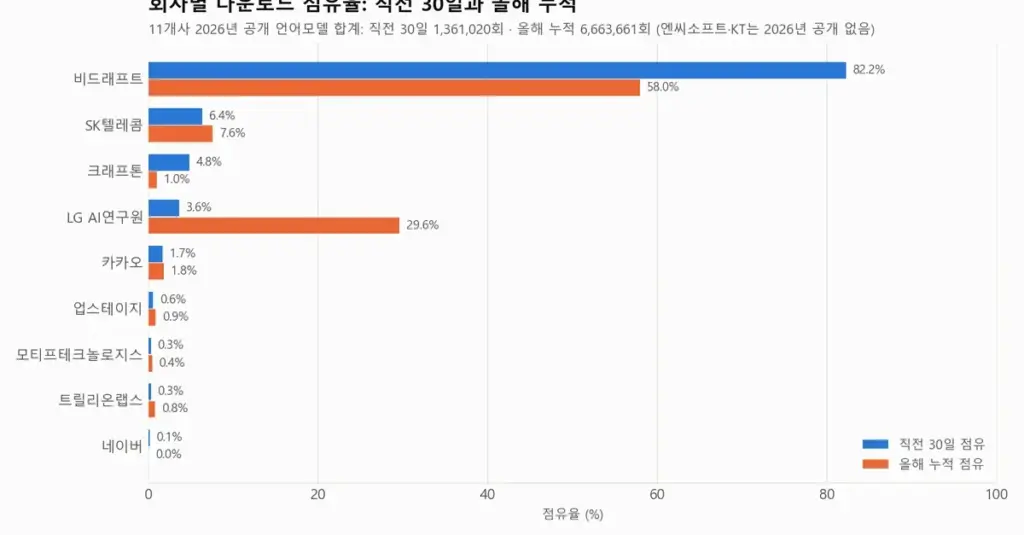

In contrast, VIDraft’s POCKET-Darwin-180B-GGUF is exhibiting "reverse momentum." Its daily average over the last 30 days (17,605) is actually higher than its lifetime daily average (14,893), indicating that the model is gaining popularity as word of its performance spreads through the developer community.
SK Telecom’s A.X-K2 and Krafton’s Raon-1 are also showing signs of "steady-state" popularity. The gap between their lifetime averages and recent 30-day averages is relatively small, suggesting a loyal user base and consistent utility in specific developer workflows.
The Competitive Landscape: Incumbents vs. Specialized Firms
The 2026 data also highlights a divergence between Korea’s traditional tech giants and specialized AI firms. While Naver and Kakao remain dominant in the domestic consumer web space, their footprint on the global open-source repository Hugging Face is relatively small compared to firms like VIDraft or LG AI Research.
Naver, for instance, released 14 models in 2026, but these models have garnered only 1,919 cumulative downloads, representing a market share of nearly 0%. Kakao has seen better results with its "Kanana" series, particularly the 3B and 30B versions, which have cumulative downloads in the tens of thousands. However, even Kakao’s 1.8% cumulative share is dwarfed by the specialized AI research divisions and startups.
Traditional telecommunications and software giants like NCSoft (NC AI) and KT have been notably absent from the 2026 Hugging Face release charts. This suggests that these firms may be pivoting toward proprietary, enterprise-facing solutions rather than participating in the open-source community, or they are focusing their research on internal applications that do not require public weight releases.
Conclusion: The Future of the Korean AI Ecosystem

The analysis of the 174 models released by 11 Korean companies in 2026 leads to a clear conclusion: the battle for AI supremacy has moved beyond the training room and into the distribution channel. The "Efficiency Era" is here, and it is defined by how easily a global developer can integrate a model into their existing hardware environment.
The dominance of the GGUF format and the high market concentration indices suggest that the community has already "voted" with its bandwidth. While many companies can train a model, only those who prioritize accessibility, quantization, and developer-friendly formats are seeing their work truly enter the global AI bloodstream.
As 2026 draws to a close, the question for the Korean AI industry is no longer just "who has the best model," but "whose model is actually running on the world’s devices." For now, that answer is increasingly found in the compressed, high-performance architectures provided by a few standout leaders.
 Software Development & Scripting for IT
Decoding the Silent Failure: Why WordPress Image Uploads Trigger the Persistent HTTP Error
In the modern landscape of digital publishing, WordPress remains the dominant force,...
 Software Development & Scripting for IT
From Hawaii to the Modern Web: How the ALOHA Protocols Defined the Efficiency of Digital Communication
The history of the modern internet is often told through the lens...
 Software Development & Scripting for IT
Bridging the Command Line and the Desktop: How Multimeter is Transforming macOS Productivity Through Script-Based Monitoring
In the modern digital workspace, the ability to monitor real-time data without...







