In the modern digital workspace, the ability to monitor real-time data without breaking focus has become a primary objective for developers, system administrators, and power users alike. While the macOS menu bar has long served as a repository for system clocks and battery percentages, a specialized utility known as Multimeter is expanding the utility of this interface. By allowing users to turn virtually any command-line output into a live, glanceable meter, the app is bridging the gap between the technical depth of the Terminal and the visual convenience of the graphical user interface.
The core of this functionality lies in the "Script meter," a feature designed to execute shell commands at regular intervals and display the resulting data directly in the menu bar. As digital workflows become increasingly complex, moving away from a "pull" model of information—where a user must manually check a dashboard—to a "push" model—where data is always visible—represents a significant shift in how professionals manage their daily operations.
The Mechanics of Script-Based Monitoring
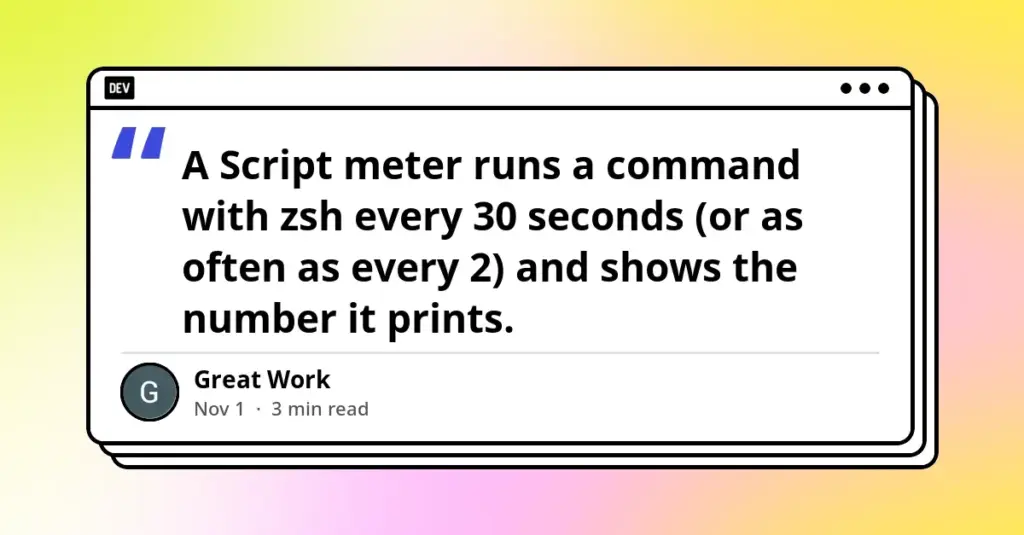
At its technical foundation, a Script meter in Multimeter functions by invoking the zsh shell to run a user-defined command. By default, these scripts execute every 30 seconds, though the application offers the flexibility to increase this frequency to as often as every two seconds for time-sensitive metrics. The philosophy behind the tool is straightforward: if a piece of information can be retrieved as a numerical value within the Terminal, it can be elevated to the macOS menu bar.
This capability transforms the menu bar from a static display into a dynamic command center. For a developer, this might mean tracking the number of open pull requests; for a system administrator, it could mean monitoring active Docker containers or server load averages. The versatility of the zsh integration ensures that any tool accessible via the command line—ranging from standard Unix utilities like curl and awk to specialized CLI tools like the GitHub CLI or Docker—can serve as a data source.
Navigating the Mac App Store Sandbox Limitations
A critical distinction in the deployment of Multimeter concerns the environment in which the application runs. Due to Apple’s stringent security protocols, the version of Multimeter available on the Mac App Store operates within a "sandbox." This security layer, while protective, prevents the application from executing arbitrary scripts on the user’s behalf.
To provide the full functionality of Script meters, the developers offer a direct-download version of the app. This version bypasses the sandbox restrictions, allowing the application to interface directly with the shell and execute user-defined commands. For users who prefer to remain within the App Store ecosystem, the developers have implemented alternative workflows. These include using URL schemes to send data to the app or employing "File meters," which monitor a specific file on the disk for changes. However, for those seeking the most seamless integration, the direct version remains the primary choice for script-heavy workflows.
Data Parsing and the Flexibility of JSON
One of the most robust aspects of the Multimeter ecosystem is its approach to data interpretation. The application is designed to be "input agnostic," meaning it can process raw text or structured data with equal efficiency. When a script prints a result, Multimeter scans the output for the first available number. It is intelligent enough to ignore thousands separators, ensuring that a string like "1,284 stars" is correctly interpreted as the integer 1284.
Beyond simple numerical strings, Multimeter offers deep support for JSON (JavaScript Object Notation), the industry-standard format for data exchange. This allows users to pass more than just a single value. A script can return a JSON object containing a variety of parameters, including minimum and maximum values, custom labels, units of measurement, and specific formatting instructions.
 Software Development & Scripting for IT
Bridging the Gap Between Logic and Instruction: An In-Depth Look at the Runbook Repair Lab
In the rapidly evolving landscape of software engineering, the "runbook"—a routine set...
 Software Development & Scripting for IT
The Connectivity Gap: Why Your Smart Lock Fails and the Technical Realities of the Three-Hop System
In the rapidly evolving landscape of the modern smart home, few devices...
 Software Development & Scripting for IT
Navigating the Choice Between Legged and Wheeled Robotics for Industrial Inspection
In the rapidly evolving landscape of industrial automation, the deployment of autonomous...