
As artificial intelligence agents and large language models increasingly become the primary consumers of web content, a new frontier in technical search engine optimization and site architecture has emerged. Central to this shift is the "llms.txt" proposal, a machine-readable format designed to provide AI crawlers with a concise, structured map of a website’s most relevant information. However, recent data suggests that while the adoption of this standard is beginning to take root, the vast majority of implementations are technically flawed.
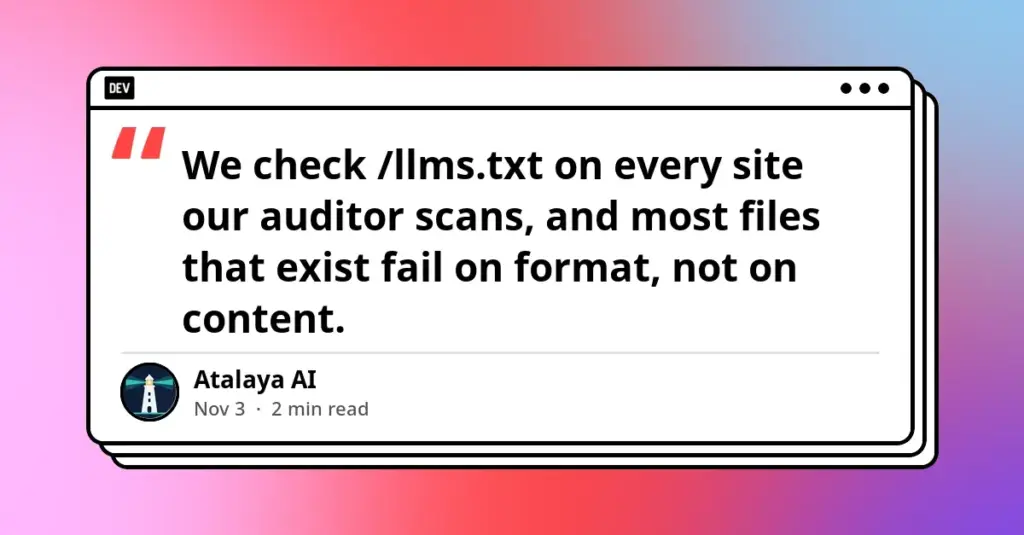
Atalaya AI, a firm specializing in AI auditing and web discovery, recently released a comprehensive report and a new suite of free validation tools aimed at addressing these widespread formatting issues. According to the firm’s latest audit, which scrutinized 751 popular websites across North America, the primary hurdle for webmasters is not the content itself, but rather a failure to adhere to the strict Markdown-based syntax required for AI tools to successfully parse the files.
The findings have led to the launch of a new browser-based validator and generator. This tool allows developers to either generate a compliant file by filling out specific fields or paste an existing file to check for structural errors. Notably, the utility operates entirely within the user’s browser, ensuring that no sensitive data or proprietary site structures are transmitted to external servers during the validation process.
The Rise of the llms.txt Standard
The llms.txt format is a proposal currently hosted at llmstxt.org. It functions similarly to a robots.txt file but serves a different purpose. While robots.txt tells a crawler where it is allowed to go, llms.txt provides a high-quality summary and a curated list of links to help an AI agent understand the site’s context without having to crawl thousands of individual pages. This is particularly crucial for AI models that operate within limited context windows, where every token of information must be as high-value as possible.
The format follows a specific hierarchical order. It begins with a mandatory primary heading, followed by a brief summary of the site. Subsequent sections can include detailed information and links, organized into specific categories. One of the more nuanced features of the proposal is the "Optional" section. By labeling a section with the H2 heading "Optional," developers signal to an AI agent that these links can be skipped if the agent is operating under tight context constraints or needs to prioritize brevity.
Despite the relative simplicity of the format, Atalaya AI’s audit found that many early adopters are struggling with the specific Markdown requirements. The firm noted that on almost every site their auditor scans, existing files frequently fail on format rather than the quality of the information provided.
Identifying the Eight Most Common Formatting Mistakes
Through their research, Atalaya AI identified eight recurring structural errors that prevent AI tools from correctly interpreting llms.txt files. These errors range from simple heading mistakes to more complex issues regarding how links are presented.
A foundational requirement for the file is the presence of a top-level Markdown heading, or H1. The audit found that many files completely omit a line starting with a single hash symbol, which is the basic trigger for a validator to recognize the site name. Perhaps more common is the "H1-not-first" error. In many instances, developers attempt to include front matter, comments, or introductory text before the primary heading. According to the standard, the H1 must reside on the very first line of the file to ensure immediate identification by the parser.
Furthermore, the standard dictates a strict hierarchy. Some sites mistakenly include multiple H1 tags, whereas the protocol requires a single primary title, with all subsequent sections using H2 headings. This hierarchy ensures that the AI understands the relationship between the site’s identity and its various content sub-sections.
The summary section is another frequent point of failure. The proposal requires a summary line beginning with a "greater than" symbol, placed immediately after the H1 but before the first H2 section. This provides a "block quote" style overview of the site. Atalaya AI also warned against using H3 through H6 headings within the initial details area; any such structural information should either be converted into standard paragraphs or promoted to a full H2 section.

The final set of common errors involves how links and sections are managed. A valid llms.txt file must contain sections that actually hold links. The firm found numerous instances of "no-link-sections" or "empty-sections," where headings existed without any supporting data. Furthermore, the syntax for list items is highly specific. A common mistake is providing a bare URL or plain text in a section list. The validator flags these unless they follow the precise Markdown pattern of a bullet point followed by a bracketed name, a parenthetical URL, and an optional colon-separated note.
The Invisible Barrier: Server Response Issues
Beyond the internal structure of the file, Atalaya AI highlighted a significant technical hurdle that most automated validators cannot see: the way web servers handle requests for missing files. This "hidden failure" is often rooted in the default configuration of modern content management systems and hosting providers.
Many hosts are configured to answer any request for an unknown path with a custom 404 error page that actually returns a "200 OK" status code. When an AI tool attempts to fetch /llms.txt and receives a full HTML home page or a stylized error page with a 200 status, it treats the file as absent or corrupted. Because the tool expects a plain text or Markdown response, receiving a heavy HTML file causes the discovery process to fail.
To combat this, Atalaya AI recommends that developers manually verify their files using command-line tools like curl. By running a specific command to inspect the headers, site owners can ensure that the server is not only returning a 200 status but also serving the correct "Content-Type." If the server identifies the file as text/html instead of text/markdown or text/plain, AI agents may ignore it entirely.
Current Adoption Rates and Regional Trends
The utility of llms.txt remains a subject of debate within the web development community, primarily because it is a proposal rather than a formal standard recognized by bodies like the IETF or W3C. There is currently no legal or technical obligation for AI companies to respect or read the file. Furthermore, the file does not act as a security measure; it does not grant or block access to a site, a task that remains the responsibility of robots.txt and Content Delivery Network (CDN) settings.
Nevertheless, the audit conducted in October 2026 provides a snapshot of how the industry is reacting to the rise of AI agents. Out of the 751 popular sites sampled, approximately one in ten had published a valid llms.txt file. The data showed slight regional variations in adoption and compliance. In the United States sample, 11.3% of sites had a valid file, while Canada followed at 8.3%. In Mexico, the rate stood at 9.1%.
These figures suggest a growing recognition that providing "cheap documentation" for AI is a worthwhile endeavor. As AI models become more autonomous in how they browse the web, having a structured guide can influence how a site’s information is summarized and presented to users of AI-powered search engines and personal assistants.
Strategic Recommendations for Site Owners
While the llms.txt validator provides a path toward better AI integration, Atalaya AI emphasizes that it should not be the first priority for every site owner. The firm suggests that developers should ensure their robots.txt files and general SEO foundations are solid before worrying about the nuances of llms.txt.
For those who do choose to implement the file, the move toward full URLs is strongly encouraged. While relative links may work within the context of a browser, AI tools often read these files in isolation. Using absolute URLs ensures that the file remains functional and its links remains reachable regardless of how or where the tool is processing the data.
The llms.txt format represents a shift toward a more cooperative relationship between web publishers and AI consumers. While still in its proposal stage, the effort to standardize how sites introduce themselves to machines highlights the changing nature of the internet. For now, the focus for many will be on the basics: ensuring that when an AI knocks on the door of /llms.txt, it finds a file that it can actually read.
 Software Development & Scripting for IT
Data Modeling Uncertainty: A New Architectural Approach to Live-Service Game Guides
In the rapidly evolving landscape of live-service gaming, information is the most...
 Software Development & Scripting for IT
Navigating the Choice Between Legged and Wheeled Robotics for Industrial Inspection
In the rapidly evolving landscape of industrial automation, the deployment of autonomous...
 Software Development & Scripting for IT
The Invisible Battlefield: Analyzing the Technical Architecture of PUBG Anti-Cheat Systems
In the contemporary landscape of online multiplayer gaming, the complexity of the...







