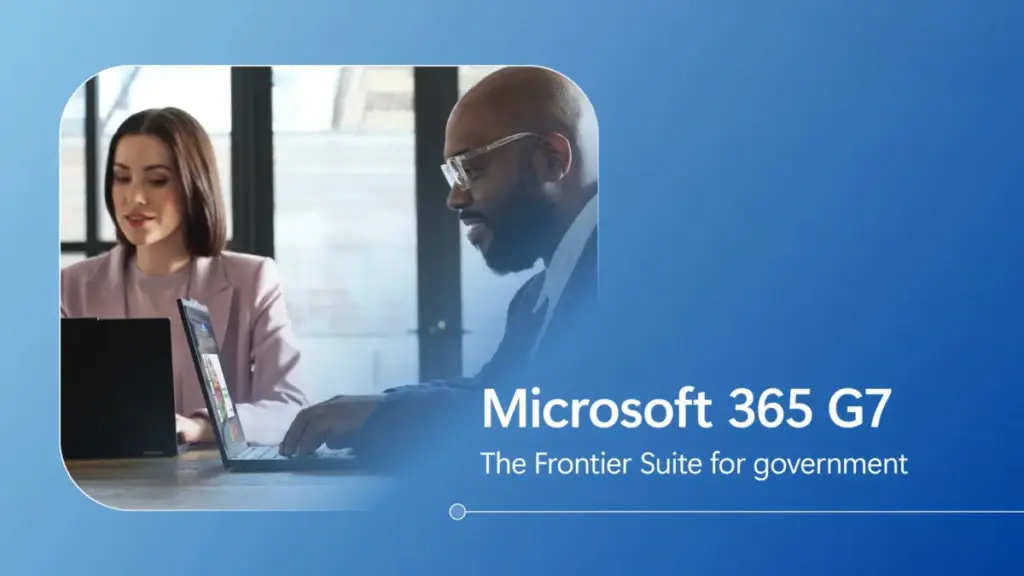
In an era where public sector leaders are increasingly pressured to modernize service delivery while navigating a landscape of sophisticated cybersecurity threats, Microsoft has announced a significant leap forward for its government-specific cloud offerings. The tech giant today unveiled Microsoft 365 G7, designated as the "Frontier Suite for government," specifically tailored for organizations operating within Government Community Cloud (GCC) environments.
The launch marks a pivotal moment in the evolution of federal, state, and local government technology. By integrating advanced productivity tools with generative AI, autonomous agents, and a robust security and governance framework, Microsoft aims to provide a unified platform that addresses the unique regulatory and operational requirements of the public sector. The suite is designed to move agencies beyond isolated AI experimentation toward a future of governed, large-scale adoption that can accelerate mission outcomes.
The Strategic Vision: Intelligence and Trust
The introduction of Microsoft 365 G7 is the public sector equivalent of the "Intelligence + Trust" vision recently introduced for commercial enterprises with Microsoft 365 E7. For government agencies, however, the stakes are notably higher. Innovation cannot come at the expense of security or public trust, and technology must be grounded in the specific contexts of government work.
Leaders across the public sector are currently facing a "triple threat": the need to modernize legacy systems, the requirement to defend against evolving cyber-attacks, and the demand to meet the rising expectations of constituents—all while managing limited resources. Microsoft’s new suite addresses these challenges by providing not just tools, but an integrated control plane. This ensures that as agencies adopt AI and autonomous agents, they do so within a framework that prioritizes identity protection, data compliance, and rigorous governance.
Phased Availability and Authorization Milestones
Recognizing the complexity of government procurement and the necessity of strict compliance, Microsoft has outlined a phased rollout for the new suite. Both Microsoft 365 G7 and the accompanying Agent 365 will be available for GCC customers to purchase starting October 1. Additional purchasing options are scheduled to follow on November 1.
Because government missions demand a higher level of rigor than the commercial sector, the rollout of specific capabilities will be iterative. While customers can begin licensing and planning for the new experiences at launch, additional workloads will be deployed as they complete the required GCC authorization milestones. This approach ensures that every tool within the G7 suite meets the necessary federal security standards before being integrated into sensitive agency environments, allowing for innovation to proceed at a pace that does not compromise safety.
Built on the Trusted Foundation of Microsoft 365 for Government
Microsoft 365 G7 does not replace the existing infrastructure that agencies have spent years implementing; rather, it extends it. The suite builds upon the established foundation of Microsoft 365 G5, which already provides essential productivity and collaboration tools alongside information protection and compliance features.
A critical component of this new extension is the Microsoft Entra Suite. In the G7 environment, Entra provides advanced identity management, access governance, and network security. This is particularly important in an era of "agentic" workflows, where it is no longer just human users accessing data, but also autonomous AI agents. By securing the identity of both people and agents, G7 provides the necessary guardrails for what Microsoft calls "Frontier Transformation"—the shift from experimental AI use cases to a fully integrated, enterprise-wide digital strategy.
AI Embedded Directly in the Flow of Work
One of the primary goals of Microsoft 365 G7 is to ensure that AI becomes an invisible, supportive layer within the applications government employees use every day, rather than a separate destination or a distracting new tool. By embedding Microsoft Copilot directly into the Microsoft 365 ecosystem, G7 allows public servants to leverage AI within Word, Excel, PowerPoint, and Teams.
Central to this experience is "Work IQ." This capability grounds the AI’s intelligence in the specific data, context, and permissions of the organization. For a government agency, this means that Copilot is not just providing generic assistance; it is providing assistance informed by the agency’s specific mission, internal documents, and historical data. Crucially, these experiences are designed to operate in strict accordance with existing permissions, ensuring that sensitive data is only accessible to those with the proper authorization.
At general availability, government teams will be able to use Copilot for a wide range of tasks, including synthesizing vast amounts of organizational knowledge, conducting research, and drafting policy documents. In the months following the initial launch, the G7 suite will see a surge of additional capabilities. These will include the integration of the latest commercially available GPT models, personalized "memory" for Work IQ, and "Copilot Cowork," a feature designed to assist with longer-running, multi-step projects that require sustained collaboration between humans and AI.
The Rise of Agents at the Mission’s Edge
While Copilot acts as a personal assistant, the G7 suite also introduces the concept of "agents" designed for specialized government functions. These agents are intended to handle complex, repetitive, or data-intensive tasks such as policy analysis, case management, grant processing, and constituent service.
The G7 suite provides an "agentic foundation," allowing agencies to deploy pre-built agents like "Researcher" and "Analyst" within the GCC environment. Furthermore, agencies can use "Agent Builder" to tailor these experiences to their specific needs. For more specialized or high-stakes missions, teams can utilize Microsoft Copilot Studio to build custom agents from scratch.
To ensure these agents are effective, Microsoft 365 Copilot Connectors allow them to tap into agency knowledge stored in other systems and line-of-business applications. This creates a bridge between disparate data silos, allowing an agent to pull relevant information from across an entire department to provide a comprehensive answer or complete a complex task. All of this is managed through secure connections, keeping the deployment aligned with stringent agency standards.
Agent 365: The New Control Plane for AI Governance
The rapid adoption of AI agents presents a significant management challenge for IT and security leaders. Without proper oversight, the proliferation of agents could lead to "shadow AI," where unauthorized or unmonitored tools operate within the network, creating security vulnerabilities and data leaks.
To mitigate these risks, Microsoft is introducing Agent 365 as part of the G7 suite. Agent 365 serves as a centralized control plane, giving leaders the visibility they need to manage the lifecycle of AI agents. Through this interface, administrators can see which agents exist, who owns them, what data they are accessing, and whether they are functioning as intended.
At its launch, Agent 365 will provide the unified foundation required to discover and identify agents across an organization. It will offer core controls to deploy, block, or remove agents as necessary. Over time, Microsoft expects these capabilities to expand into more granular areas of risk management and security, ensuring that as the use of AI grows, the agency’s ability to govern that growth remains equally robust.
Advancing the Mission with Confidence
The ultimate goal of Microsoft 365 G7 is to empower the public sector workforce to respond more effectively to the needs of the communities they serve. By combining AI-driven productivity with a focus on "Frontier Transformation," Microsoft is betting that government agencies can build greater resilience and capacity.
However, the company emphasizes that technology is only one part of the equation. Realizing the full potential of G7 will require strong leadership, a focus on workforce readiness, and a commitment to responsible governance. The suite is designed to provide the technical controls necessary to support these human efforts, allowing agencies to scale their AI ambitions without losing sight of their security obligations.
As public sector organizations begin to navigate the transition to G7, the focus will remain on how these tools can be applied to real-world national missions. From improving the speed of emergency response to streamlining the delivery of social services, the integration of intelligence and trust marks a new chapter in the partnership between the technology sector and the government. With the October 1 launch date approaching, the public sector is poised to enter a new era of digital maturity, supported by a platform built to handle the complexities of modern governance.
 Productivity Software & Office Suites
Microsoft Reports 30 Million Paid Copilot Seats as Enterprise AI Shifts from Assistance to Autonomy
In a recent earnings call that signaled a pivotal moment for the...
 Productivity Software & Office Suites
Microsoft Announces General Availability of Work IQ APIs, Ushering in the Era of Agentic Software
REDMOND, Wash. — In a move that signals a fundamental transformation in...
 Productivity Software & Office Suites
Microsoft Reimagines Copilot as a Central Hub for AI-Driven Enterprise Productivity
In a significant move to redefine the landscape of modern work, Microsoft...