
The evolution of modern computing has historically followed a predictable trajectory, moving in successive waves from the emergence of the personal computer to the rise of relational databases and the eventual dominance of the cloud. In each of these eras, technology has tended to reach two groups of professionals before anyone else: developers and finance teams. For those in finance, a technological edge is not a luxury; it is a necessity. The core of the profession involves modeling reality with ever-increasing precision, and for decades, the primary tool for this task has been Microsoft Excel. It is the environment where quarters are closed, forecasts are debated, and every single digit is expected to be traceable back to its original source.
As artificial intelligence begins to permeate the financial sector, it faces a uniquely high bar for entry. Unlike creative or general administrative tasks where a margin of error might be tolerated, financial operations demand absolute transparency and rigor. Microsoft is addressing this challenge by introducing a suite of new capabilities for Copilot in Excel, specifically designed to meet the exacting standards of financial planning and analysis (FP&A), accounting, tax, compliance, and treasury departments.
These updates represent more than just incremental improvements; they signal a shift toward AI that can handle multi-step workflows, connect to trusted third-party data sources, and provide a verifiable audit trail for every calculation it performs.
The Standard of Precision: Internal Testing and the FMI Partnership
The development of these new features did not happen in a vacuum. Microsoft has utilized its own global finance organization as a primary testing ground. Microsoft Finance, a massive operation responsible for the fiscal health of one of the world’s largest corporations, has integrated Copilot in Excel into its daily workflows. By using the tool in real-world scenarios—ranging from hunting for specific data points to rebuilding complex analyses—the team has acted as a feedback loop for the product’s developers.
This "pressure-testing" at the frontier of corporate finance ensures that by the time these features reach the general public, they have already been refined by professionals who demand perfection. The internal teams at Microsoft have pushed the AI to move beyond completing single tasks, forcing it to adapt to the complexity of multi-step financial processes.
To further solidify the tool’s credibility, Microsoft has collaborated with the Financial Modeling Institute (FMI), a premier global body that provides credentials to the industry’s most skilled modelers. The FMI’s extensive library of real-world financial modeling cases has been used as a benchmark to evaluate Copilot’s performance. This partnership ensures that the AI’s logic aligns with the rigorous methodologies used by top-tier financial analysts, ensuring that the outputs are not just mathematically correct but also structurally sound according to industry standards.
Introducing ‘Skills’ for Repeatable Financial Workflows
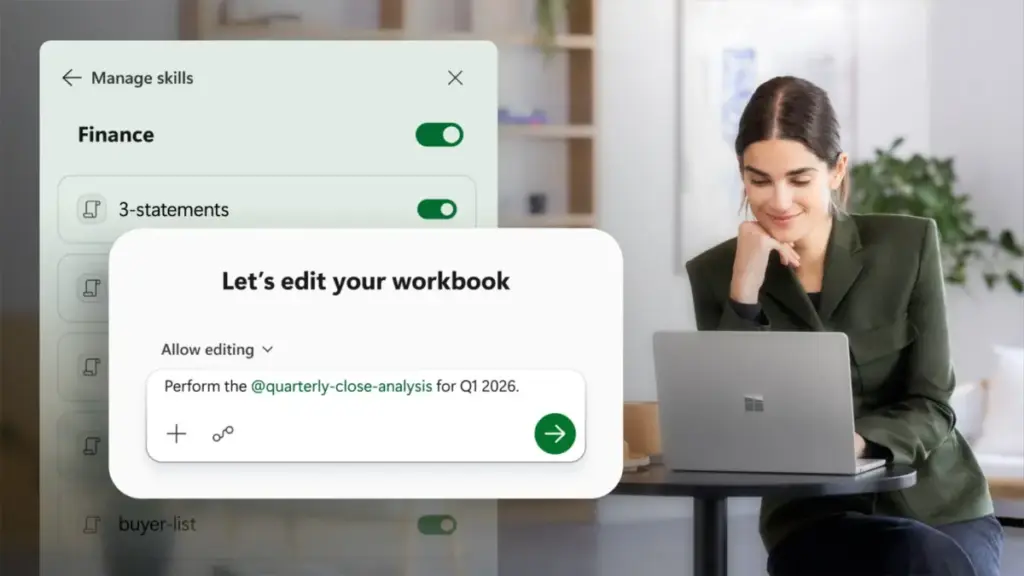
One of the most significant hurdles for AI in a professional setting is the "blank page" problem—the need to repeatedly prompt a tool to perform the same complex task. To solve this, Microsoft is introducing "skills," a feature that allows finance teams to define exactly how Copilot should execute common, repeatable processes.
These skills act as a guided framework for Copilot. Instead of starting from scratch every time a professional needs to build a Discounted Cash Flow (DCF) model, refresh a monthly reporting package, or conduct a variance analysis, they can utilize a skill that directs the AI through the necessary steps. This ensures that the resulting output follows the specific structure, formatting, and logic required by the organization, making the final product easier to review and trust.
Microsoft has made this system highly customizable. While a library of sample finance skills is being made available, organizations can also build their own custom skills using an open-standard markdown file (SKILL.md). By saving these files to a shared OneDrive, a finance team can ensure that every member of the department is using the same logic for a three-statement model or a board package. This level of standardization is critical in finance, where consistency across different spreadsheets and teams is paramount for accurate reporting.
The ecosystem for these skills is also expanding to third-party developers. Microsoft has announced that partners will soon be able to deploy specialized skills through the Microsoft Marketplace and the Microsoft 365 Admin Center. Early collaborators in this space include prominent names in the finance and ERP software world, such as LSEG, Ramp, Rogo, Samaya AI, Velixo, and Vena. This opens the door for a future where a company’s specific financial software can "teach" Copilot how to interact with its data more effectively.

Grounding AI in Trusted Financial Data
A common critique of general-purpose AI is its tendency to produce "hallucinations" or rely on outdated information. In the context of a billion-dollar quarterly forecast, such errors are unacceptable. Microsoft is addressing this by expanding the range of financial connectors available in Excel, allowing Copilot to pull data directly from the world’s most trusted market sources.
Earlier this year, Microsoft released connectors for LSEG and Moody’s. Building on that foundation, the company is now introducing more financial data connectors that bring both public and private market data directly into the Excel environment. This allows professionals to start their analysis with the latest fundamentals and research without the need for manual data pulls, which are often prone to human error.
Among the new additions is a connector for FactSet, which is currently in preview and scheduled for general availability in July. By grounding Copilot’s logic in real-time, verified data from these providers, Microsoft is ensuring that the AI functions as a sophisticated research assistant rather than just a calculator. This integration allows for more complex prompts, such as asking the AI to compare a company’s performance against its peers using live market data, or to identify trends in sector-specific fundamentals over several years.
Enhancing Control and Traceability in the Spreadsheet
In the world of finance, the "how" is often just as important as the "what." A final number on a balance sheet is meaningless if the auditor or the CFO cannot trace the formulas and assumptions that led to it. Microsoft has introduced several features to ensure that Copilot remains a "glass box" rather than a "black box."
A new feature called "Plan with Copilot" allows users to see a roadmap of the AI’s intended actions before they are executed. When a user asks Copilot to update a forecast or adjust a reporting model, the tool outlines which cell ranges, worksheets, and formulas it intends to modify. It can even ask clarifying questions to ensure its assumptions align with the user’s intent. This pre-action review gives the finance professional the final say, maintaining the human-in-the-loop requirement that is essential for financial accountability.
Once changes are made, the traceability continues. Microsoft has integrated Copilot attribution into the "Show Changes" pane in Excel. Every edit made by the AI is tagged as such, appearing alongside the edits made by human collaborators. This provides a clear audit trail, allowing reviewers to see exactly what the AI changed and why. Furthermore, every calculation remains linked back to its source cells, ensuring that the logic is always transparent and verifiable.
To further personalize the experience, Microsoft is also rolling out "Personalization" and "Workbook Rules." Personalization allows users to set specific preferences that Copilot will remember and apply consistently across different files. Workbook Rules allow a team to capture specific naming conventions and formula structures as a hidden sheet within the workbook, ensuring that the AI adheres to the internal "house style" of the organization’s financial modeling.
Availability and the Road Ahead
The rollout of these features marks a significant milestone in Microsoft’s strategy to make AI an indispensable part of the professional toolkit. Most of the core features—including personalization, workbook rules, pre-built skills, and the LSEG and Moody’s connectors—are now generally available for Microsoft 365 Copilot customers across Excel for Web, Windows, and Mac.
The more advanced custom skills features are currently available via the Insiders channel for Windows and Mac, with a broader rollout to general availability expected next month. Looking further ahead, the launch of partner-built skills in the Microsoft Marketplace is slated for the third quarter of 2026, which will likely trigger a new wave of industry-specific AI tools.
By focusing on the specific needs of the finance professional—precision, traceability, and trusted data—Microsoft is attempting to redefine the relationship between the spreadsheet and the analyst. Rather than replacing the judgment of a seasoned finance professional, these tools are designed to automate the drudgery of data gathering and structural formatting, freeing up time for the high-level analysis and decision-making that define the profession. In doing so, Excel continues its decades-long reign as the foundational tool of global finance, now augmented by an AI that is finally beginning to speak the language of the auditor.
 Productivity Software & Office Suites
Microsoft Announces Fifth Annual Power Platform Community Conference in Las Vegas to Address the Future of AI-Driven Business Processes
As modern enterprises continue to navigate an era defined by rapid digital...
 Productivity Software & Office Suites
Microsoft Reports 30 Million Copilot Seats as Enterprise AI Shifts from Assistance to Autonomous Agents
In its most recent earnings report, Microsoft announced a significant milestone in...
 Productivity Software & Office Suites
Microsoft Announces Global Launch of Copilot Cowork, Introducing Agentic AI to the Modern Enterprise
In a move that signals a significant shift in the landscape of...






