
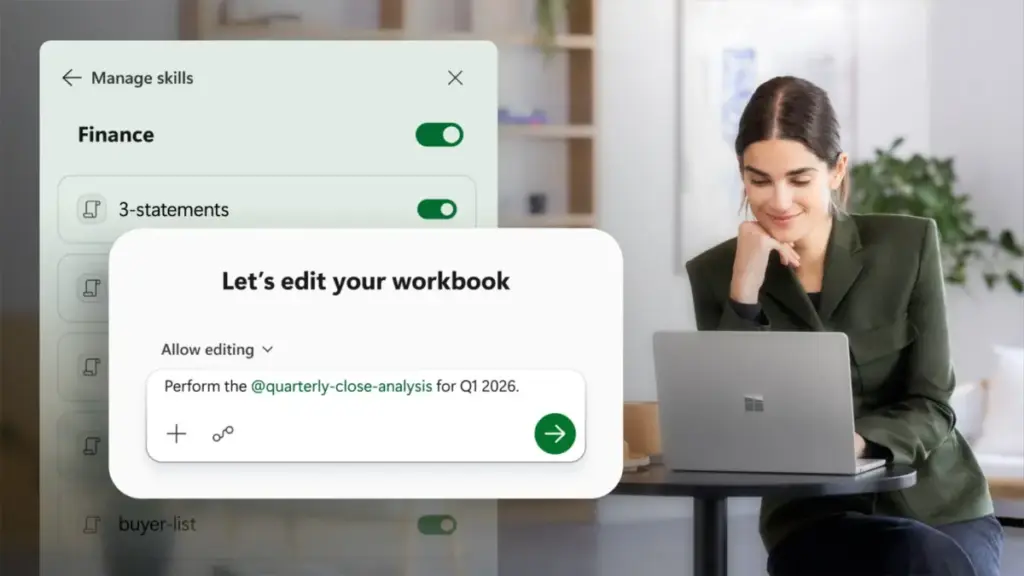
A new feature called "Plan with Copilot" allows users to see a roadmap of the AI’s intended actions before they are executed. When a user asks Copilot to update a forecast or adjust a reporting model, the tool outlines which cell ranges, worksheets, and formulas it intends to modify. It can even ask clarifying questions to ensure its assumptions align with the user’s intent. This pre-action review gives the finance professional the final say, maintaining the human-in-the-loop requirement that is essential for financial accountability.
Once changes are made, the traceability continues. Microsoft has integrated Copilot attribution into the "Show Changes" pane in Excel. Every edit made by the AI is tagged as such, appearing alongside the edits made by human collaborators. This provides a clear audit trail, allowing reviewers to see exactly what the AI changed and why. Furthermore, every calculation remains linked back to its source cells, ensuring that the logic is always transparent and verifiable.
To further personalize the experience, Microsoft is also rolling out "Personalization" and "Workbook Rules." Personalization allows users to set specific preferences that Copilot will remember and apply consistently across different files. Workbook Rules allow a team to capture specific naming conventions and formula structures as a hidden sheet within the workbook, ensuring that the AI adheres to the internal "house style" of the organization’s financial modeling.
Availability and the Road Ahead
The rollout of these features marks a significant milestone in Microsoft’s strategy to make AI an indispensable part of the professional toolkit. Most of the core features—including personalization, workbook rules, pre-built skills, and the LSEG and Moody’s connectors—are now generally available for Microsoft 365 Copilot customers across Excel for Web, Windows, and Mac.
The more advanced custom skills features are currently available via the Insiders channel for Windows and Mac, with a broader rollout to general availability expected next month. Looking further ahead, the launch of partner-built skills in the Microsoft Marketplace is slated for the third quarter of 2026, which will likely trigger a new wave of industry-specific AI tools.
By focusing on the specific needs of the finance professional—precision, traceability, and trusted data—Microsoft is attempting to redefine the relationship between the spreadsheet and the analyst. Rather than replacing the judgment of a seasoned finance professional, these tools are designed to automate the drudgery of data gathering and structural formatting, freeing up time for the high-level analysis and decision-making that define the profession. In doing so, Excel continues its decades-long reign as the foundational tool of global finance, now augmented by an AI that is finally beginning to speak the language of the auditor.
 Productivity Software & Office Suites
Microsoft Reimagines Copilot: New "Autopilot" and "Code" Features Lead a Major Shift Toward Agentic Work
In a significant pivot toward the next era of enterprise productivity, Microsoft...
 Productivity Software & Office Suites
Microsoft Reports 30 Million Copilot Seats as Enterprise AI Shifts from Assistance to Autonomous Agents
In its most recent earnings report, Microsoft announced a significant milestone in...
 Productivity Software & Office Suites
Microsoft Announces New AI-Integrated Office Suites to Streamline Small Business Operations
In the demanding ecosystem of small business management, success is often measured...







