
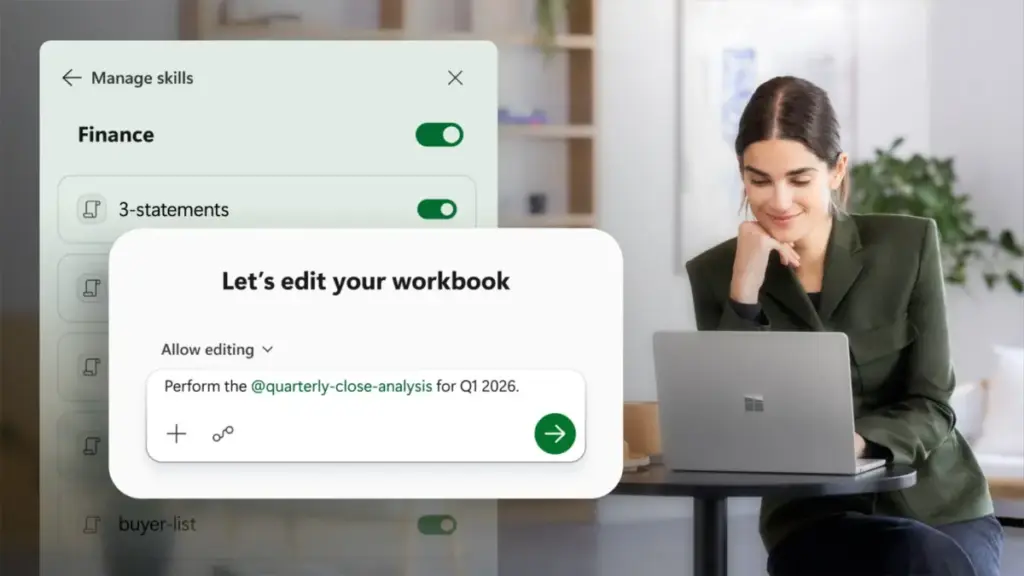
These skills act as a guided framework for Copilot. Instead of starting from scratch every time a professional needs to build a Discounted Cash Flow (DCF) model, refresh a monthly reporting package, or conduct a variance analysis, they can utilize a skill that directs the AI through the necessary steps. This ensures that the resulting output follows the specific structure, formatting, and logic required by the organization, making the final product easier to review and trust.
Microsoft has made this system highly customizable. While a library of sample finance skills is being made available, organizations can also build their own custom skills using an open-standard markdown file (SKILL.md). By saving these files to a shared OneDrive, a finance team can ensure that every member of the department is using the same logic for a three-statement model or a board package. This level of standardization is critical in finance, where consistency across different spreadsheets and teams is paramount for accurate reporting.
The ecosystem for these skills is also expanding to third-party developers. Microsoft has announced that partners will soon be able to deploy specialized skills through the Microsoft Marketplace and the Microsoft 365 Admin Center. Early collaborators in this space include prominent names in the finance and ERP software world, such as LSEG, Ramp, Rogo, Samaya AI, Velixo, and Vena. This opens the door for a future where a company’s specific financial software can "teach" Copilot how to interact with its data more effectively.

Grounding AI in Trusted Financial Data
A common critique of general-purpose AI is its tendency to produce "hallucinations" or rely on outdated information. In the context of a billion-dollar quarterly forecast, such errors are unacceptable. Microsoft is addressing this by expanding the range of financial connectors available in Excel, allowing Copilot to pull data directly from the world’s most trusted market sources.
Earlier this year, Microsoft released connectors for LSEG and Moody’s. Building on that foundation, the company is now introducing more financial data connectors that bring both public and private market data directly into the Excel environment. This allows professionals to start their analysis with the latest fundamentals and research without the need for manual data pulls, which are often prone to human error.
Among the new additions is a connector for FactSet, which is currently in preview and scheduled for general availability in July. By grounding Copilot’s logic in real-time, verified data from these providers, Microsoft is ensuring that the AI functions as a sophisticated research assistant rather than just a calculator. This integration allows for more complex prompts, such as asking the AI to compare a company’s performance against its peers using live market data, or to identify trends in sector-specific fundamentals over several years.
Enhancing Control and Traceability in the Spreadsheet
In the world of finance, the "how" is often just as important as the "what." A final number on a balance sheet is meaningless if the auditor or the CFO cannot trace the formulas and assumptions that led to it. Microsoft has introduced several features to ensure that Copilot remains a "glass box" rather than a "black box."
 Productivity Software & Office Suites
Microsoft Announces New AI-Integrated Office Suites to Streamline Small Business Operations
In the demanding ecosystem of small business management, success is often measured...
 Productivity Software & Office Suites
Microsoft Launches Copilot Cowork Globally, Bringing Agentic AI to the Fortune 500
Microsoft has officially announced the general availability of Copilot Cowork, marking a...
 Productivity Software & Office Suites
Microsoft Reimagines Copilot as a Central Hub for Autonomous AI and Agentic Work
Microsoft has announced a significant evolution of its AI strategy, unveiling what...







