
The evolution of enterprise technology has historically followed a predictable trajectory. From the introduction of the first personal computers to the rise of relational databases and the eventual migration to the cloud, innovation typically arrives in waves. These waves almost always break first upon the shores of the developer community before quickly flowing into the finance department. For finance professionals, technology is more than a convenience; it is a competitive edge. The core objective of the role has remained unchanged for decades: to model reality with a level of precision that was impossible the day before.
For the better part of forty years, the primary vehicle for this modeling has been Microsoft Excel. It is the environment where quarterly books are closed, where multi-year forecasts are debated line by line, and where every figure must be traceable to a verifiable source. As artificial intelligence begins to permeate the financial sector, it faces a rigorous set of requirements. To be useful in a professional financial context, AI cannot simply provide an answer; it must show its work, utilize trusted data, and maintain a clear audit trail for every calculation.
Microsoft is addressing these specific demands with a significant expansion of Microsoft 365 Copilot in Excel. The company is introducing a suite of new features designed to meet the high bar of professional finance work, focusing on repeatable workflows, deep data integration, and enhanced transparency. These updates are intended to move AI beyond simple task completion and into the realm of complex, multi-step financial logic.
Built for the Complexity of Finance Work
The challenge of integrating AI into finance lies in the intolerance for error. Unlike creative fields where a "hallucination" might be seen as a spark of inspiration, a misplaced decimal or a faulty logic chain in a financial model can have catastrophic consequences for a corporation. Recognizing this, Microsoft has shifted its development focus toward ensuring that Copilot can handle the inherent complexity of financial workflows rather than just completing isolated tasks.
Before any new Copilot capability is released to the public, it undergoes a rigorous evaluation process. Microsoft utilizes a framework of graded task complexity and benchmarks that are specifically designed to mirror the daily responsibilities of finance teams. This ensures that the AI can manage multi-step processes—such as reconciling disparate data sets or building complex projections—while delivering a result that is both trusted and verifiable.
This commitment to professional standards has led to a strategic partnership with the Financial Modeling Institute (FMI). As the global body responsible for credentialing the industry’s most proficient modelers, the FMI provides a level of domain expertise that is difficult to replicate. By incorporating the FMI’s library of real-world financial modeling cases into its testing protocols, Microsoft has grounded Copilot’s development in the actual rigors of the profession. This collaboration ensures that the AI understands the nuances of financial logic, from the structure of a three-statement model to the intricacies of debt sculpting and sensitivity analysis.
Furthermore, the development of these tools has been "pressure-tested" by Microsoft’s own internal finance organization. Across departments such as Financial Planning and Analysis (FP&A), Accounting, Tax, Compliance, and Treasury, Microsoft Finance has integrated Copilot into its live workflows. By using the tool to hunt for information and rebuild analyses, the internal teams have acted as the first line of feedback, pushing the product to meet the standards required by a global enterprise. This internal "dogfooding" ensures that by the time the technology reaches the broader market, it has already survived the demands of a frontier-level finance operation.
Tuned to Your Standards
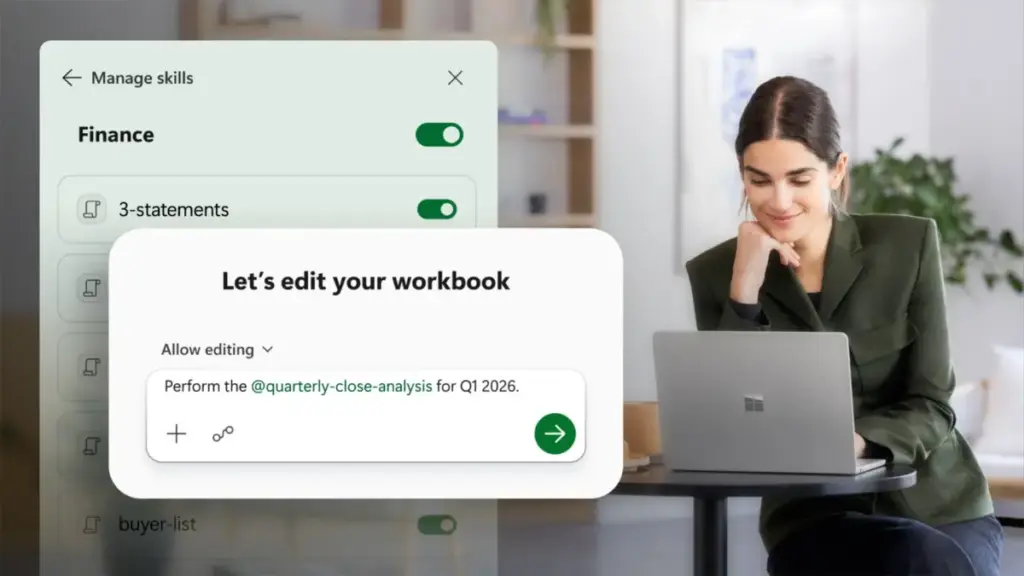
One of the primary hurdles for AI adoption in finance has been the "blank slate" problem. While generative AI is excellent at starting from a prompt, finance professionals often have established methodologies and "house styles" that must be followed. To bridge this gap, Microsoft is introducing "skills"—a feature that allows finance teams to define exactly how Copilot should execute common, repeatable processes.
These skills act as a roadmap for the AI. Whether a team is building a Discounted Cash Flow (DCF) analysis, closing the monthly books, refreshing a reporting model, or conducting a variance analysis, a skill guides Copilot through the necessary steps. This ensures that the output adheres to the correct structure and formatting, making the final product easier to review and reuse. It effectively transforms the AI from a general assistant into a specialized analyst that understands the specific procedural requirements of a firm.
Microsoft is providing a library of sample finance skills to get users started, but the true power of the feature lies in customization. Users can create their own skills using an open-standard markdown file, known as a SKILL.md file. By saving this file in OneDrive, Copilot can ingest the instructions to build specific outputs, such as a board package or a three-statement model, following the exact process defined by the user. This move toward an open standard suggests a future where financial methodologies can be codified and shared across organizations or even the broader industry.
The ecosystem for these skills is also expanding. Developers and partners will soon be able to deploy specialized skills through the Microsoft Marketplace and Microsoft 365 Admin Center. Microsoft has already partnered with several key players in the finance and ERP space—including LSEG, Ramp, Rogo, Samaya AI, Velixo, and Vena—to create a first wave of industry-specific skills.
In addition to these procedural skills, Microsoft is introducing "Personalization" and "workbook rules." Personalization allows users to set their individual preferences once, which Copilot then applies consistently across its tasks. Workbook rules go a step further by capturing specific naming conventions, formula structures, and organizational standards within a dedicated sheet in the workbook. This ensures that the AI’s contributions remain consistent with the existing logic and aesthetic of the file, regardless of who is interacting with it.

Grounded in Data You Trust
A financial model is only as reliable as the data that feeds it. Historically, one of the most time-consuming and error-prone aspects of finance work has been the manual extraction of data from various external terminals and databases into Excel. To eliminate this friction, Copilot in Excel is expanding its range of financial connectors.
These connectors allow Copilot to pull market data, fundamental financial information, and research directly into the workbook. This grounding in "Work IQ" ensures that analyses begin with the most recent and accurate sources, rather than relying on outdated manual pulls. Building on the previously released connectors for LSEG and Moody’s, Microsoft is now incorporating more financial data providers to cover both public and private market data.
The inclusion of FactSet, which is currently in preview and slated for general availability in July, represents a significant addition for investment professionals and corporate researchers. By integrating these high-tier data sources directly into the Copilot interface, Microsoft is positioning Excel not just as a place to calculate data, but as a comprehensive research and analysis hub. This integration reduces the "alt-tab" fatigue often associated with financial research and minimizes the risk of transcription errors that occur when moving data between platforms.
Unlocking Finance Workflows
The combination of custom skills, trusted data connectors, and the broader "Work IQ" context allows Copilot to tackle scenarios that were previously too complex for AI. In a practical sense, this means finance teams can move from gathering data to interpreting it much faster.
For instance, an analyst can now prompt the AI to compare a company’s recent performance against its peers using live market data, or ask it to identify the primary drivers of a budget variance based on internal ledger data. Because the AI is grounded in the specific context of the organization’s work, it can provide insights that are relevant and actionable. This shift frees up senior finance professionals to spend less time on the mechanics of spreadsheet construction and more time applying professional judgment to strategic decisions.
Controllable by Design
Perhaps the most critical update for the finance community is the improvement in traceability and control. In the world of auditing and compliance, an answer without a "trail" is essentially useless. Finance professionals need to see what changed, why it changed, and what logic was used to arrive at a conclusion.
To address this, Microsoft is introducing "Plan with Copilot." Before the AI takes any action on a spreadsheet, it can now outline its intended path. It will specify which ranges, worksheets, and formulas it plans to update, and list the assumptions it is making. This allows the user to vet the AI’s logic before it is applied, serving as a crucial checkpoint for accuracy.
Once the changes are implemented, they are no longer opaque. Every edit made by the AI remains traceable, with direct links back to the affected cells. Furthermore, these edits are now explicitly attributed to Copilot in the "Show Changes" pane, appearing alongside the edits made by human collaborators. This level of transparency ensures that the AI functions as a "trusted analyst"—one that proposes a methodology, explains its reasoning, and leaves a clear record for review.
Availability
The rollout of these features follows a phased approach to ensure stability and refine the user experience. Currently, features such as Personalization, workbook rules, pre-built skills, federated Copilot connectors, Plan with Copilot, and Copilot attribution in Show Changes are generally available for Microsoft 365 Copilot customers using Excel on Web, Windows, and Mac.
Custom skills are available today via the Insiders channel for Windows and Mac users, with general availability expected to reach Web, Windows, and Mac platforms next month. Looking further ahead, partner-built skills from organizations like LSEG and Ramp are scheduled for release in the third quarter of 2026.
By systematically addressing the requirements of accuracy, data integrity, and auditability, Microsoft is attempting to cement Excel’s position as the indispensable tool for the next generation of finance. The introduction of these features marks a significant step in the transition of AI from a novelty into a core component of professional financial infrastructure.
 Productivity Software & Office Suites
Microsoft Unveils Microsoft 365 G7: A New AI-Driven Frontier Suite for Government Organizations
In an era where the public sector faces a dual mandate of...
 Productivity Software & Office Suites
Microsoft Announces Fifth Annual Power Platform Community Conference to Address the Future of AI-Driven Business Processes
The modern enterprise is defined by its processes. From the simplest internal...
 Productivity Software & Office Suites
Microsoft Unveils Advanced AI ‘Skills’ and Data Connectors to Transform Excel for Finance Professionals
The evolution of modern computing has historically followed a predictable trajectory, moving...







