
To support this surge in user-generated software, the company is launching the Microsoft Copilot Managed Runtime. This hosting infrastructure ensures that the code generated by Copilot runs safely within an organization’s existing Microsoft 365 environment. While it is designed to be easily accessible for non-technical employees, it remains fully governed by IT departments. This foundation supports apps built in Cowork, Code, and Copilot Studio, and Microsoft is eventually opening the runtime to third-party and professional developers as well.
The Rise of the Autonomous Digital Teammate
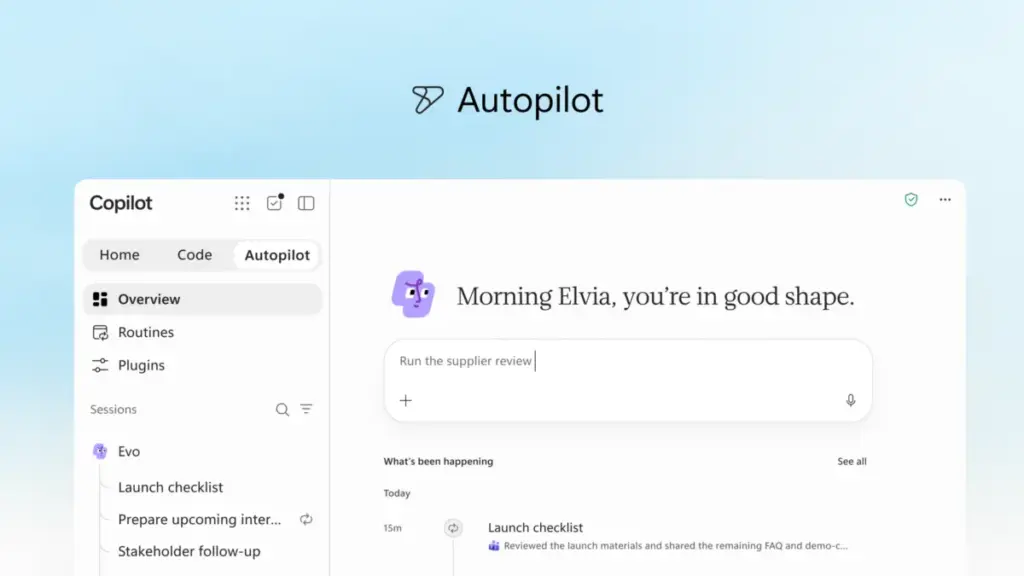
Perhaps the most forward-looking element of the announcement is Autopilot, an evolution of the technology previously known as Scout. Unlike traditional AI assistants that wait for a user to initiate a command, Autopilot is a persistent, proactive agent. Users can assign the agent a name, a specific role, and a long-term goal, allowing it to work independently in the background.
Autopilot is designed to handle recurring and complex processes, such as managing a full supplier review. In this scenario, the agent can build a schedule, handle preparation, attend to follow-ups, and even reach out to human stakeholders for updates without constant monitoring. Because it is cloud-hosted, Autopilot continues to function even when the user is offline.

To ensure it operates as a true member of the team, Autopilot possesses its own identity, memory, and workspace within the organization’s tenant. It is integrated into the tools teams already use, such as Microsoft Teams and Outlook, where it can be @mentioned like any other colleague. Despite its autonomy, the system is built with strict permissions and audit trails, ensuring that human users remain in control of the objectives and boundaries.
Expanding Grounding and Business Context
For an AI to be effective in a corporate setting, it must understand the specific context of the business it serves. Microsoft is addressing this through Microsoft IQ, a unified intelligence platform that connects an organization’s operational data with the knowledge held across the Microsoft stack.
The company is expanding the data available to Copilot by integrating Fabric IQ, which brings context from over 20 million semantic models in Power BI into the AI’s reasoning engine. Additionally, Copilot is now being grounded in data and workflows from Dynamics 365 and the Power Platform. This means a salesperson drafting a proposal can have Copilot automatically incorporate deal histories and customer support tickets directly into the document, removing the need for manual lookups.
To further extend these capabilities, Microsoft is launching a new plugin registry. This centralized catalog allows IT departments to discover, approve, and manage plugins from Microsoft, third-party partners, and custom internal builds. This unified registry ensures that specialized AI skills can be introduced at scale while maintaining the necessary security and governance controls.
A New Framework for Managing AI Investment
As AI usage scales, organizations are increasingly focused on managing costs and measuring value—a discipline Microsoft refers to as FinOps for AI. To address this, the company is evolving its pricing and management models.
 Productivity Software & Office Suites
Microsoft Reimagines the Future of Productivity with a New Generation of Copilot and Autonomous Agents
Microsoft has announced a significant evolution of its artificial intelligence strategy, unveiling...
 Productivity Software & Office Suites
Microsoft Reimagines Copilot as a Centralized Hub for Autonomous Work and Agentic Productivity
In a significant move to redefine the landscape of digital productivity, Microsoft...
 Productivity Software & Office Suites
Microsoft Announces Fifth Annual Power Platform Community Conference to Address the Future of AI-Driven Business Processes
The modern enterprise is defined by its processes. From the simplest internal...







