
In a significant move to redefine the landscape of digital productivity, Microsoft has announced a comprehensive reimagining of its Copilot platform. The technology giant is transitioning Copilot from a series of disparate AI assistants into a unified, next-generation experience designed to integrate seamlessly into the "flow of human ambition." This evolution aims to provide individuals and organizations with the tools necessary to build, customize, and scale artificial intelligence across every facet of professional life, effectively turning the AI into a central nervous system for workplace operations.
The announcement marks a shift in how Microsoft views the role of AI in the enterprise. Rather than simply being a conversational interface for answering questions or drafting emails, the "new Copilot" is being positioned as a comprehensive environment where work comes together. By connecting the traditional tools that professionals rely on with advanced agentic capabilities, Microsoft is attempting to solve the fragmentation that often occurs when users must jump between different applications and AI interfaces to complete complex tasks.
A New Experience for Every Mode of Work
At the heart of this transformation is the introduction of a new starting point called "Home." As professional environments become increasingly cluttered with meetings, chat threads, documents, and various specialized applications, Microsoft identified a need for a centralized "grounding" space. Home serves as a digital command center where two primary modes of interaction—Chat and Cowork—converge. This allows users to maintain their bearings in a fast-moving work stream, offering a view of recent activities and intelligent suggestions on where Copilot can provide the most immediate value.
The distinction between Chat and Cowork represents a fundamental change in AI interaction. While Chat remains the go-to for instant, conversational needs—such as quick lookups, drafting brief responses, or staying updated on a project’s status—Cowork is designed for delegation. In the Cowork mode, users define a complex task, and the AI takes over to execute it end-to-end. This could range from generating a comprehensive Request for Proposal (RFP) response to assembling a full financial close package. Microsoft’s vision is that, eventually, users will not even need to choose between these modes; they will simply state their objective, and Copilot will intelligently route the request to the most appropriate capability, whether it be Chat, Cowork, or the newly introduced Code.

Parallel to this structural shift is the deep integration of "Office in Copilot." This feature brings the full functionality of Word, Excel, and PowerPoint directly into the Copilot experience. The goal is to eliminate the friction of broken formatting and version control issues that often occur when moving content between an AI chat and a standalone document. Within the Copilot app, users can now draft launch briefs or model budgets that exist as real, editable files. These documents remain in sync with the standalone Office applications, allowing for side-by-side refinement and real-time collaboration with human teammates.
The individual Office applications are also receiving targeted AI enhancements. PowerPoint can now automatically maintain brand consistency while fine-tuning images or applying custom templates. Excel has been updated to provide greater transparency; when Copilot or a colleague makes an edit, the system explains exactly what was changed and why. Furthermore, the introduction of "Skills" allows for specialized industry expertise—such as legal or financial workflows—to be scaled across an organization through reusable, role-specific templates.
Expanding Capabilities: From Low-Code to Persistent Agents
One of the most ambitious additions to the ecosystem is "Code," a feature that moves solution-building beyond the exclusive domain of software developers. Historically, the primary units of knowledge work have been files—documents, spreadsheets, and presentations. Microsoft is now introducing a fourth unit: small, purpose-built digital solutions. Through Code, which is powered by the same underlying technology as GitHub Copilot, any user can describe an application, an automation workflow, or an interactive dashboard in natural language, and the AI will build it.
These solutions are not just conceptual; they are functional tools that run in a secure, sandboxed environment within the organization’s tenant. To support this, Microsoft is launching the "Copilot Managed Runtime." This hosting infrastructure allows these custom-built apps to run safely within the Microsoft 365 environment, governed by IT but accessible to everyone. This democratizes the creation of internal tools, allowing teams to build persistent desktop widgets or cloud-hosted apps that are grounded in the specific context of their work via Microsoft IQ.
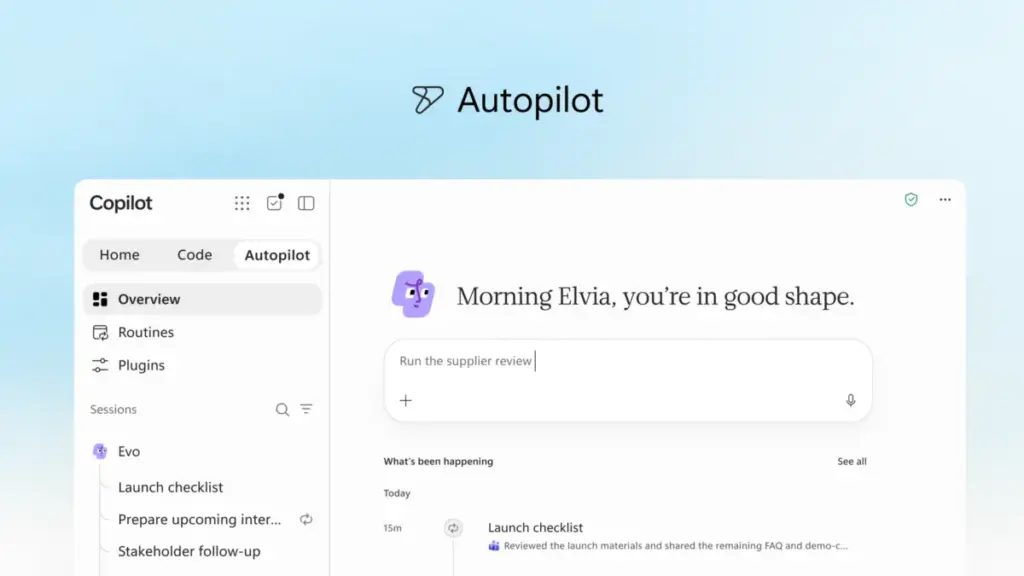
While Code focuses on creation, the new "Autopilot" feature—previously known by the internal codename Scout—focuses on persistence. Autopilot is described as a "digital teammate" that operates proactively. Unlike standard AI assistants that wait for a prompt, Autopilot can be assigned a name, a role, and a specific goal. It then works independently, monitoring communication channels, following up on threads, and managing recurring processes such as supplier reviews or project schedules. Because it is cloud-hosted and possesses its own identity and memory within the tenant, it continues to work even when the user is offline. Microsoft emphasizes that while Autopilot handles the "heavy lifting," it operates within strict boundaries set by the user, providing regular updates to ensure human oversight.

Expanding Your Business Context
For an AI to be truly effective in a corporate setting, it must understand the unique data and relationships that define a business. Microsoft is addressing this through "Fabric IQ," a unified intelligence platform that connects Copilot to an organization’s broader data estate. This includes the integration of over 20 million semantic models from Power BI, ensuring that the AI’s responses are grounded in the most accurate and up-to-date business metrics.
Furthermore, Copilot is being integrated with Dynamics 365 and the Power Platform. This means that a salesperson drafting a proposal can have Copilot automatically pull in deal history or relevant customer support tickets without ever leaving the document. To further extend these capabilities, Microsoft has introduced a new unified "Plugin Registry." This catalog allows IT departments to centrally approve and manage plugins from Microsoft, third-party partners, and internal developers, providing a streamlined way to introduce new, trusted AI skills at scale.
Managing AI Spend and Infrastructure
As AI capabilities expand, so does the complexity of managing the associated costs. Microsoft is addressing this through a dual-pronged pricing and management strategy known as "FinOps for AI." For everyday tasks like drafting and summarization, the company offers a fixed-cost User Subscription License (USL). This model utilizes an "Auto" routing system that balances accuracy, speed, and cost to select the best model for a given request.
However, more complex, "agentic" work—such as the long-running tasks performed by Autopilot or Cowork—will move toward a usage-based billing (UBB) model. This allows organizations to match their spending directly to the value generated by high-end frontier models. To help businesses navigate this, new cost management capabilities are being introduced in "Agent 365." Admins will be able to set spending policies, manage credit requests, and analyze which AI tasks are generating the highest return on investment. Even end-users will have visibility into their credit usage, promoting a culture of responsible AI consumption within the organization.
A Sneak Peek at What’s Next
Microsoft’s roadmap for the coming months suggests an even deeper level of personalization. In October, a new feature called "Today" will enter private preview. Positioned as a proactive command center, Today will aggregate information from mail, calendars, and Teams to show users exactly what needs their attention. Rather than just listing tasks, it will prepare the work in advance—having drafts ready for review or schedule changes proposed—before the user even asks.

Additionally, the company is testing "@Copilot in Teams," which allows the AI to participate in group chats and channels with the shared context of the entire team. This feature is designed to eliminate the need for "re-explaining" project history, as the AI can pull background information from past conversations to help resolve cross-functional dependencies and keep projects moving forward.
These updates are currently rolling out through Microsoft’s Frontier program, with broader availability expected in the coming weeks and months. As the company prepares for its Ignite conference in November, the focus remains on transforming Copilot from a novelty into an essential, governed, and cost-effective engine for business transformation. By providing a single place to ask, delegate, build, and automate, Microsoft is betting that the future of work will not just be assisted by AI, but defined by it.
 Productivity Software & Office Suites
Microsoft Surpasses 30 Million Copilot Seats as Enterprise AI Shifts from Assistants to Autonomous Agents
In a significant update regarding the trajectory of enterprise artificial intelligence, Microsoft...
 Productivity Software & Office Suites
Microsoft Unveils Natural Language App Creation Tools, Merging Agentic Coding with Enterprise Governance
The landscape of software development is undergoing a fundamental transformation as artificial...
 Productivity Software & Office Suites
Microsoft Reimagines Copilot as a Proactive AI Ecosystem for the Enterprise
Microsoft has announced a comprehensive overhaul of its Copilot platform, signaling a...







