Managing AI Spend and Infrastructure
As AI capabilities expand, so does the complexity of managing the associated costs. Microsoft is addressing this through a dual-pronged pricing and management strategy known as "FinOps for AI." For everyday tasks like drafting and summarization, the company offers a fixed-cost User Subscription License (USL). This model utilizes an "Auto" routing system that balances accuracy, speed, and cost to select the best model for a given request.
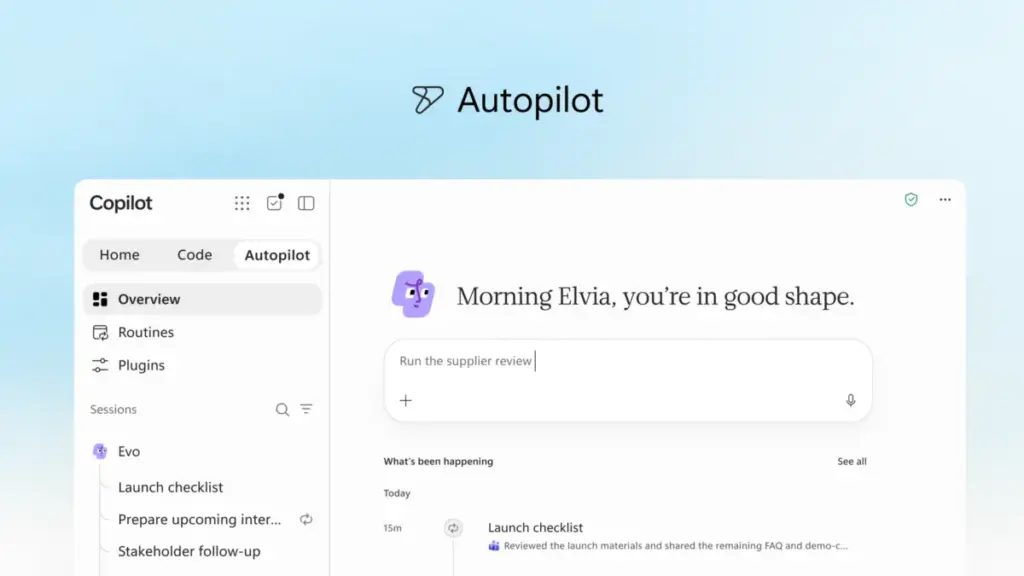
However, more complex, "agentic" work—such as the long-running tasks performed by Autopilot or Cowork—will move toward a usage-based billing (UBB) model. This allows organizations to match their spending directly to the value generated by high-end frontier models. To help businesses navigate this, new cost management capabilities are being introduced in "Agent 365." Admins will be able to set spending policies, manage credit requests, and analyze which AI tasks are generating the highest return on investment. Even end-users will have visibility into their credit usage, promoting a culture of responsible AI consumption within the organization.
A Sneak Peek at What’s Next
Microsoft’s roadmap for the coming months suggests an even deeper level of personalization. In October, a new feature called "Today" will enter private preview. Positioned as a proactive command center, Today will aggregate information from mail, calendars, and Teams to show users exactly what needs their attention. Rather than just listing tasks, it will prepare the work in advance—having drafts ready for review or schedule changes proposed—before the user even asks.

Additionally, the company is testing "@Copilot in Teams," which allows the AI to participate in group chats and channels with the shared context of the entire team. This feature is designed to eliminate the need for "re-explaining" project history, as the AI can pull background information from past conversations to help resolve cross-functional dependencies and keep projects moving forward.
These updates are currently rolling out through Microsoft’s Frontier program, with broader availability expected in the coming weeks and months. As the company prepares for its Ignite conference in November, the focus remains on transforming Copilot from a novelty into an essential, governed, and cost-effective engine for business transformation. By providing a single place to ask, delegate, build, and automate, Microsoft is betting that the future of work will not just be assisted by AI, but defined by it.
 Productivity Software & Office Suites
Microsoft Launches Copilot Cowork Globally, Bringing Agentic AI to the Fortune 500
Microsoft has officially announced the general availability of Copilot Cowork, marking a...
 Productivity Software & Office Suites
Microsoft Unveils ‘Autopilots’ and Microsoft Scout: The Next Evolution of Autonomous AI Agents for the Enterprise
The landscape of digital productivity is undergoing a fundamental shift, moving away...
 Productivity Software & Office Suites
Microsoft Reimagines Copilot as a Central Hub for AI-Driven Enterprise Productivity
In a significant move to redefine the landscape of modern work, Microsoft...