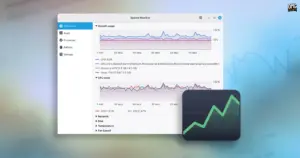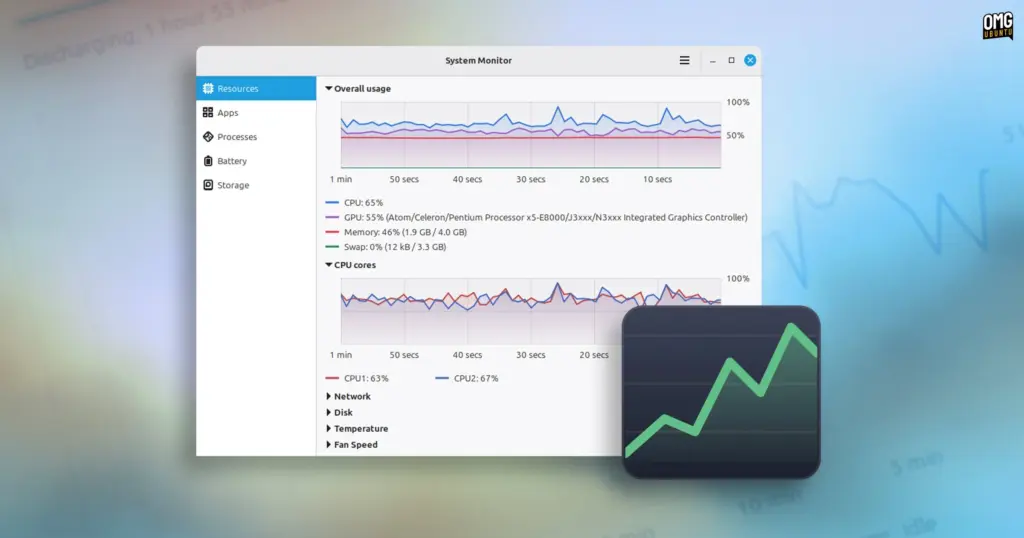
For deeper technical diagnostics, the Processes view offers a lower-level environment equipped with dynamic search filtering by name. Users can toggle the display between all processes, user-owned processes, or underlying root and system processes. Critically, the view includes a full hierarchical tree mode, allowing administrators to visually trace parent-child process dependencies. This capability makes it straightforward to pinpoint runaway child processes, isolate background daemons, or understand the cascading execution paths of multi-threaded Linux software.
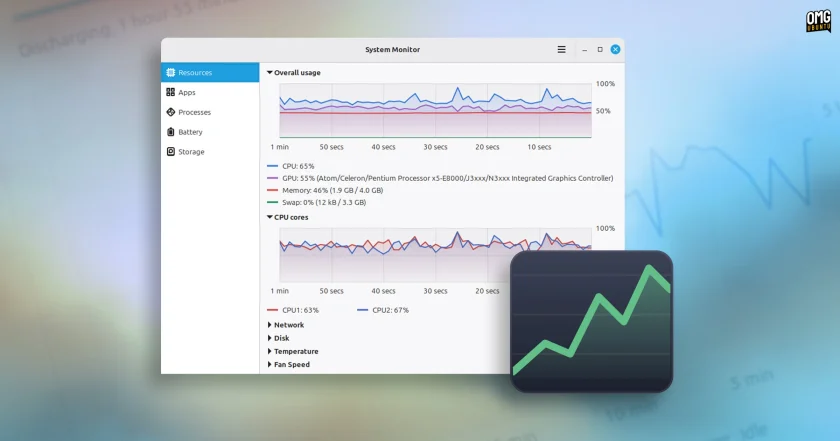
On portable hardware, Superlight introduces an extensive battery and power telemetry panel that outpaces traditional desktop monitoring tools. Rather than simply relaying an estimated percentage remaining in the system tray, the new application plots power draw over time on a dedicated timeline. The interface surfaces real-time estimates for both active discharge rates and remaining charge durations.
Furthermore, the battery diagnostics inspect the underlying hardware directly, exposing manufacturer identity, hardware model specifications, cell chemistry, overall capacity thresholds, lifetime charge cycles, and calculated battery health metrics. For mobile users relying on Linux Mint on older or refurbished notebooks, having immediate access to physical cell degradation data removes the need to drop into the terminal to parse hardware states manually.
Rounding out the application’s capabilities is a dedicated Storage section, which integrates core functionality traditionally reserved for standalone disk usage analyzers. The utility maps out local and mounted external drives, providing an intuitive, interactive breakdown of which folders and files are claiming the largest shares of storage capacity.
In addition to visual inspection, the storage panel incorporates basic drive-maintenance capabilities. A built-in cache-clearing mechanism allows users to reclaim disk space with a single click. In preliminary testing conducted on constrained systems—such as repurposed Chromebook hardware equipped with modest 32GB eMMC internal flash memory—the integrated cleaner successfully purged roughly 900MB of unnecessary cached files without requiring third-party cleaning scripts or terminal commands.
Performance and the Shift Away from Legacy Utilities
Despite its expansive functional footprint, early testing indicates that Superlight achieves a favorable performance balance on desktop hardware. The application does not feel noticeably heavier than the long-standing GNOME System Monitor it is slated to replace, handling standard process polling and interactive sorting smoothly.
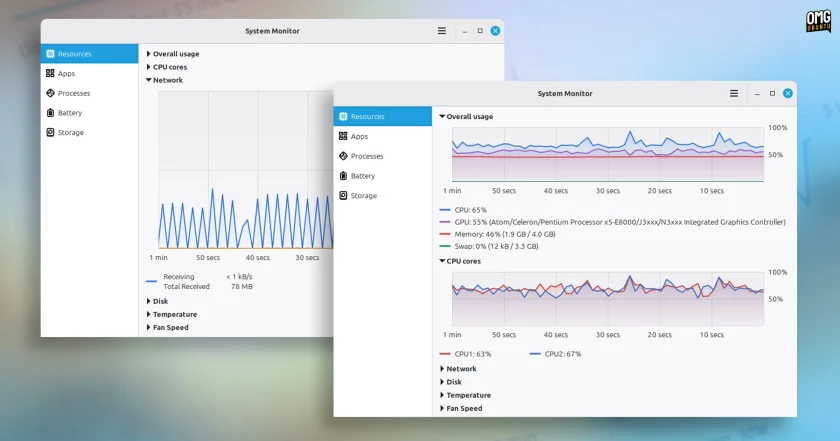
When users actively inspect the Resources page with every hardware graph and sensor metric expanded simultaneously, minor resource consumption spikes can be observed as the interface continuously renders dynamic data plots. However, these localized spikes remain typical for real-time telemetry visualizers and do not impede general system responsiveness.
The decision by the Linux Mint project to construct an entirely new system monitor reflects a broader shift across the modern open-source landscape. GNOME System Monitor, while functionally reliable and historically ubiquitous, has increasingly come to look and feel anachronistic alongside modern desktop environments and streamlined application stacks.
 Linux & Open Source Solutions
Ubuntu 26.10 Introduces Top-Screen Layout Picker to Streamline Window Tiling
Ubuntu 26.10 is introducing a new way for users to organize their...
 Linux & Open Source Solutions
ONLYOFFICE Desktop Editors 10.0 Released as Fully Rebuilt App With Decoupled AI Tools and Over 1,000 Bug Fixes
The developers behind ONLYOFFICE have officially released version 10.0 of ONLYOFFICE Desktop...
 Linux & Open Source Solutions
Ubuntu 26.10 Flavours Arrive with Updated Desktops, System Modernization, and the Return of Ubuntu MATE
The launch of the Ubuntu 26.10 operating system cycle extends well beyond...