

The integration of Classiq is intended to transform Intel into a full-stack quantum powerhouse, capable of competing with established giants like IBM and Google. As the quantum market is projected to reach a valuation of up to $20 billion in the coming years, Intel’s Chief Technology Officer, Pushkar Ranade, emphasized that the timing is right for this transition. Ranade noted that for the past ten years, Intel’s quantum group operated primarily as a research-and-development project, isolated from the company’s commercial activities. However, the maturity of the marketplace and the progress made in quantum hardware have convinced Intel’s leadership that the technology is ready for commercialization. Ranade told journalists that the Classiq acquisition is the catalyst that moves the group from the lab to the market, preparing Intel for the next major wave of global computing.
Nir Minerbi, the co-founder and CEO of Classiq, echoed this sentiment during a joint call with Intel executives. Minerbi, whose company reportedly received an investment from Lip-Bu Tan four years ago, observed that while the quantum hardware sector had seen significant progress across various modalities, the software stack remained severely underdeveloped. He compared the state of quantum programming prior to Classiq to the early days of classical computing, where developers had to design chips at the transistor level. Classiq was founded to solve this problem by creating what Minerbi describes as an operating system for quantum computing—an environment that provides compilers and development tools that allow non-experts to create software for quantum machines.
To ensure its platform remains relevant in a fragmented market, Classiq built its software to be hardware-agnostic. This required the company to adopt methodologies from classical computing, such as Electronic Design Automation (EDA), synthesis, and sophisticated modeling. Minerbi pointed out that every major computing revolution in history has required both capable hardware and the software necessary to unlock its value. By combining Intel’s hardware assets—including its QPUs, control electronics, and foundry services—with Classiq’s software environment, Intel is positioning itself to serve a broad range of clients, from government agencies and universities to large-scale enterprises.
The acquisition also brings a significant roster of high-profile customers to Intel’s door. Classiq currently serves more than four dozen enterprise clients, including telecommunications leaders like AT&T and Comcast, automotive manufacturers BMW and Rolls-Royce, and major research institutions such as Oak Ridge National Laboratory. Other notable clients include Wells Fargo, Lufthansa, and global IT firms like NTT Data and Mphasis. Once the deal is finalized, these organizations will become Intel customers, providing the chipmaker with an immediate and established commercial presence in the quantum space. Ranade admitted that Intel had previously done very little in terms of direct customer engagement within its quantum group, making the influx of Classiq’s clientele a vital asset for the new business unit.
 Enterprise Tech & Infrastructure
The Shift to Software-Defined Excellence: Understanding the Rise and Impact of Hyperconverged Storage
The landscape of enterprise data management is undergoing a fundamental transformation as...
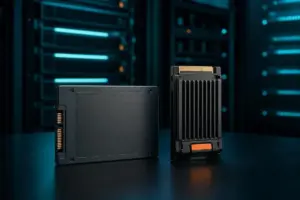 Enterprise Tech & Infrastructure
Understanding the Architecture of Modern Storage: Why the ‘Flash vs. SSD’ Debate Misses the Point
In the rapidly evolving landscape of enterprise data management, the terminology used...
 Enterprise Tech & Infrastructure
Arista Networks Signals AI Inflection Point as Ethernet Challenges Proprietary Dominance
The evolution of computing architecture is rarely a linear progression; it is...







