

Financially, Classiq appears to be on a strong trajectory. Minerbi claimed the company generated healthy revenue over the past year and expects a robust compound annual growth rate in the future. Since its inception, Classiq has raised approximately $200 million across several funding rounds, with its valuation estimated to be between $400 million and $600 million as of last year. For Intel, the acquisition also provides a degree of strategic flexibility. While Intel has focused its internal hardware development on spin-qubits, the broader quantum field is currently split between several competing modalities, such as superconducting qubits (favored by IBM and Google), neutral atoms, trapped ions, and photonics. Because Classiq’s platform can accommodate any of these modalities, Intel can remain a central player in the quantum ecosystem regardless of which hardware technology eventually becomes the industry standard.
Beyond the software and system sales, Intel is also looking to leverage its manufacturing expertise. Ranade highlighted that Intel is open to acting as a quantum foundry, producing discrete components for other players in the industry. The company has already developed specialized versions of its logic technology, known as 18A-Q for quantum chips and 18A-C for control chips, at its fabrication facility in Oregon. This dual approach—aspiring to be both a provider of complete quantum systems and a manufacturer for the wider ecosystem—allows Intel to maximize the utility of its existing capital investments in fab technology.
Despite the optimism surrounding the $2.3 billion deal, both Intel and Classiq executives have tempered expectations regarding immediate financial returns. Ranade cautioned that quantum computing remains a long-term play and is not expected to be a high-margin business in its initial stages. He described the move as a necessary bet on the future, one that must be made in parallel with Intel’s efforts to stabilize its mainstream businesses. The synergy between Classiq’s software platform and Intel’s hardware is expected to attract more customers and drive innovation, but the road to a fully realized quantum economy is still being paved. As Intel navigates its current financial recovery, this acquisition serves as a clear indicator that the company is unwilling to cede the next era of computing to its rivals, choosing instead to invest deeply in the tools that may one day define the industry.
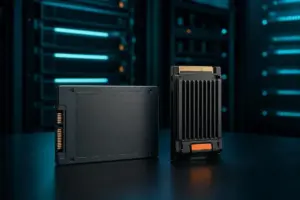 Enterprise Tech & Infrastructure
Understanding the Architecture of Modern Storage: The Nuances Between Flash Memory and Solid-State Drives
In the rapidly evolving landscape of data management, the terminology used to...
 Enterprise Tech & Infrastructure
The Convergence of Storage and Networking: A Deep Dive into Fibre Channel over Ethernet (FCoE) Technology
In the rapidly evolving landscape of enterprise data centers, the demand for...
 Enterprise Tech & Infrastructure
The Security Landscape of Enterprise Storage: Analyzing the Vulnerabilities and Protections of DAS and NAS Systems
In an era defined by the exponential growth of digital information, the...







