
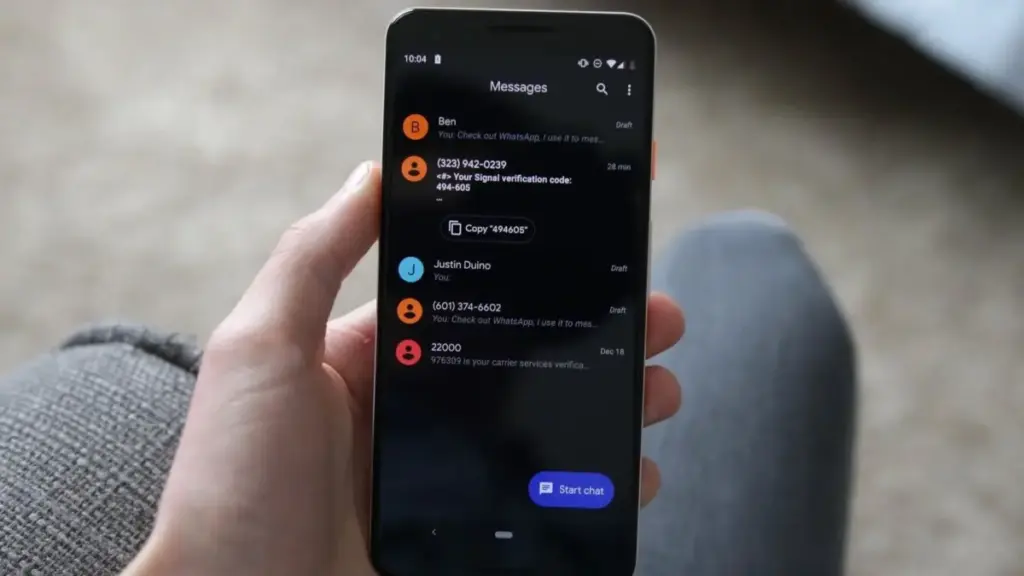
The timing of these updates is significant. As RCS (Rich Communication Services) becomes the global standard for text messaging, the "client" app—in this case, Google Messages—must evolve to handle more than just simple SMS. Modern conversations are a mix of high-definition media, interactive links, and encrypted data. By moving the interface elements closer to the user’s thumb and providing better tools for data extraction, Google is optimizing the app for the way people actually communicate in 2024.
The decision to blur the background when a menu is active and to use floating elements reflects a broader trend in mobile UI design toward "non-modal" interactions. These are designs that don’t take the user completely out of their current context but instead layer information on top of it. This keeps the user grounded in the conversation while they perform administrative tasks like deleting or forwarding messages.
Furthermore, the emphasis on showing encryption status via a simple gesture highlights Google’s commitment to privacy as a marketable feature. In an era where data security is a primary concern for consumers, making the "locked" status of a conversation easily verifiable is a strategic move to build trust and retain users who might otherwise migrate to third-party encrypted messaging apps.
Rollout Details and Availability
As is standard for major Google updates, these changes are being deployed via a server-side switch. This means that even if a user has the latest version of the Google Messages app installed from the Play Store, they may not see the new features immediately. Google typically uses this method to monitor for bugs and ensure stability before a global release.
The new behaviors have been most frequently spotted in recent builds, specifically those following the version string 20260910_03_RC02. However, because the rollout is controlled on the server side, there is no manual way for users to force the update to appear. It is expected to reach the majority of the Android install base over the coming weeks, appearing first for those enrolled in the Google Messages beta program before reaching the stable channel.
As these changes become standard, they represent a significant step in the maturation of Google Messages. By refining the "basics"—how we copy text, how we check the time, and how we interact with menus—Google is ensuring that its flagship messaging app remains a competitive and user-friendly tool in an increasingly crowded communication landscape. For the average user, the result is an app that feels faster, looks cleaner, and requires less effort to navigate, even if it takes a few days to forget the old swiping habits of the past.
 Mobile Device Management (MDM) & Mobile OS
RayNeo GT Arrives to Shake Up the Competitive $300 Smart Glasses Market with Enhanced Ergonomics and 3DoF Tracking
The landscape of augmented reality and wearable displays is moving at a...
 Mobile Device Management (MDM) & Mobile OS
Samsung Accelerates Exynos 2700 Production Amid Strategic Shifts for the Galaxy S27 Series
Samsung’s semiconductor division is reportedly entering a critical phase of its roadmap...
 Mobile Device Management (MDM) & Mobile OS
Nimble SharePower Redefines Portable Charging by Splitting the Difference for Modern Travelers
In the modern era of high-performance smartphones and power-hungry mobile applications, the...







