
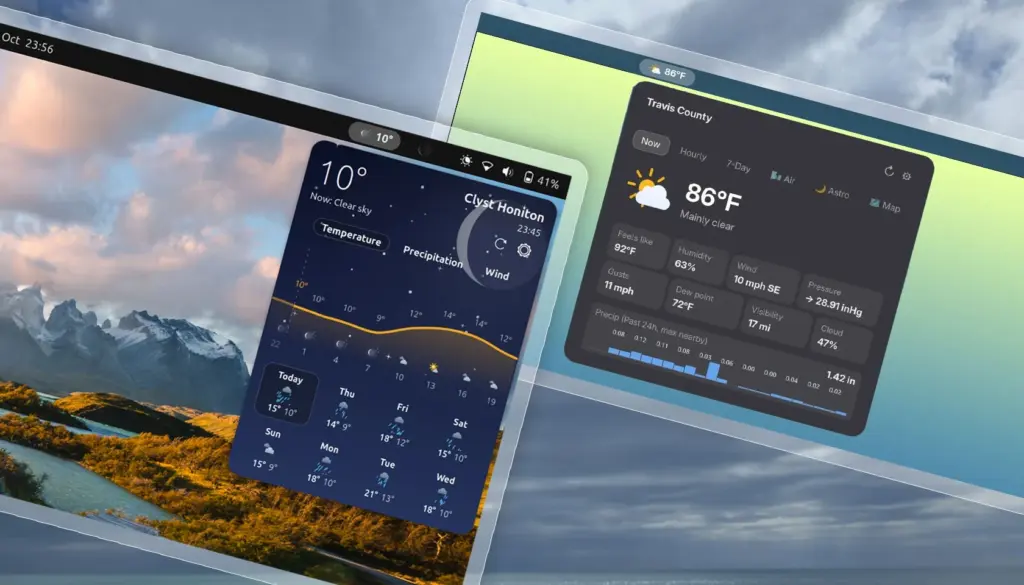
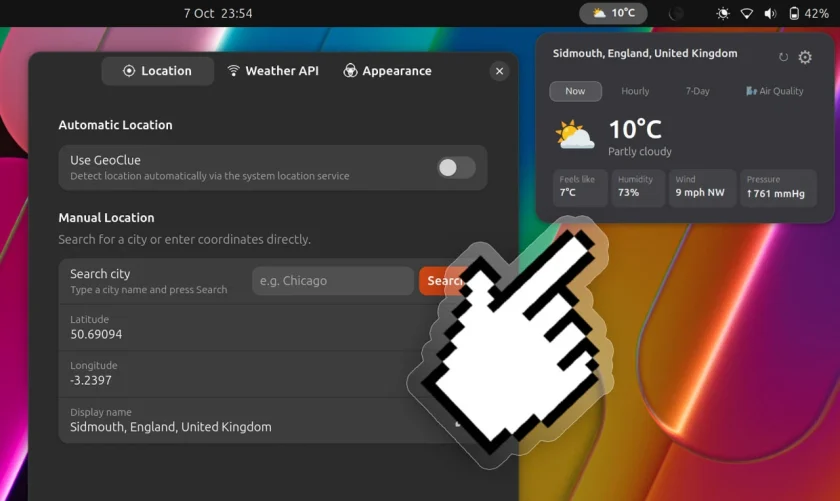
Despite that strong visual premise, real-world testing reveals a measurable gap between the extension’s promotional presentation and its actual day-to-day output. Depending on the user’s geographical location or the selected data source, the information delivered within the drop-down did not consistently match the depth shown in the official store previews. Features highlighted in project materials, such as integrated live radar mapping and specialized astronomical indicators—encompassing tide schedules, moon phases, and precise solar tracking—were absent during practical evaluation.
While the resulting drop-down remains visually pleasant and clean to look at, it falls short of functioning as an embedded, panel-based replacement for a full-featured desktop client like Mousam, which remains a benchmark for dedicated weather software on the Linux platform.
On the connectivity front, WeatherPrime offers a remarkably low barrier to entry by using Open-Meteo as its default, preconfigured data provider. Users are not required to register for developer accounts or configure personal API tokens to get the extension up and running. The software does include settings to switch to WeatherAPI.com for those who wish to supply their own access key, though attempts to utilize that secondary service encountered connection failures during testing, making the default Open-Meteo pipeline the only dependable route.
Users interested in testing Weather Prime can find it hosted on the GNOME Extensions directory, where it is verified for GNOME 50 installations under Ubuntu 26.04 LTS. The project also maintains a presence on GitHub under the Catalyx-Prime repository for those who prefer manual installation. However, the repository has seen a lull in development activity, with no commits recorded over a four-month period. Given the rapid progression of the GNOME desktop environment and the frequent architectural adjustments between Shell releases, an extended pause in maintenance suggests that compatibility updates for future releases like GNOME 51 may be slow to materialize.
 Linux & Open Source Solutions
Canonical Releases Official Ubuntu Desktop Images for RISC-V Hardware Ahead of Ubuntu 26.10
Installing Ubuntu on RISC-V hardware is poised to become significantly more straightforward...
 Linux & Open Source Solutions
Ubuntu 26.10 Introduces Restricted Media Codec Installation to App Center’s Add-Ons Hub
Ubuntu 26.10 has expanded the functionality of its modern App Center by...
 Linux & Open Source Solutions
NexPhone Multi-OS Smartphone Delayed to March 2027 as Hardware Challenges and Price Adjustments Emerge
The NexPhone, an ambitious multi-operating system smartphone designed to bridge the divide...







