
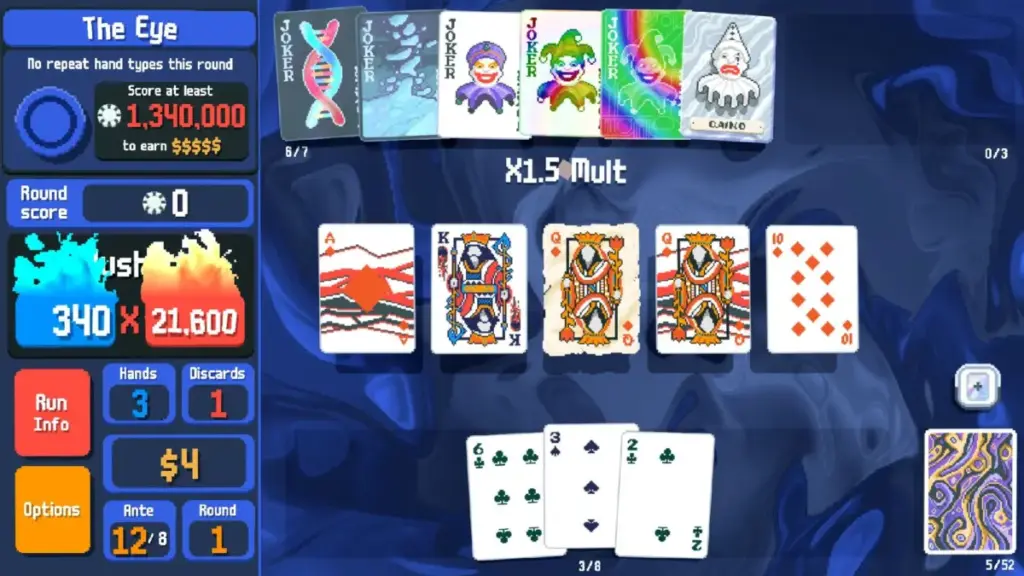
The process of training a fruit fly brain to play such a game involves a sophisticated application of reinforcement learning. In a biological fruit fly, neurons fire in response to sensory inputs like smell, light, or touch, and behaviors are reinforced by the release of chemicals like dopamine when the fly finds food or a mate. In the digital simulation, the engineer maps the game’s state—such as the cards in hand or the current score—to neural inputs. When the simulation makes a "correct" move that leads to a higher score or a round victory, the algorithm simulates a reward response within the neural network, strengthening the synaptic connections that led to that decision. Over thousands of iterations, the digital fly begins to "learn" which card combinations lead to the survival of the run.
The 20 percent win rate is particularly noteworthy when compared to the average human player’s early experiences with the game. While seasoned Balatro players can achieve much higher consistency, the game is designed to be punishing, with "boss blinds" that introduce specific handicaps to thwart the player’s strategy. That a model based on the brain of an insect, which in nature is primarily concerned with finding rotting fruit and avoiding predators, can navigate the complexities of a mathematical card game suggests that the fundamental principles of neural connectivity are incredibly robust. It raises profound questions about the nature of intelligence and whether the "logic" of a brain is universal enough to be applied to tasks completely alien to its evolutionary origin.
The underlying data provided by Google and the FlyWire project is what makes these experiments possible. The mapping of the fruit fly brain was a decade-long project that involved slicing a fly’s brain into thousands of ultra-thin sections, imaging them with electron microscopes, and then using AI to stitch those images back together into a 3D model. The result is a high-resolution map that shows not just where the neurons are, but how they are connected to one another. For researchers, this is a tool to study how a brain processes motion or controls its wings. For the tech community, it is a ready-made, pre-optimized neural network that is far more complex and efficient than many artificial networks of a similar scale.
Critics and skeptics might argue that these experiments are more a testament to the power of the training algorithms than the biological accuracy of the fly brain simulation. While the model uses the "wiring" of a fly, it does not perfectly replicate the chemical and hormonal soup that a living brain sits in. However, the engineers involved in these projects maintain that using a biological structure as the "hardware" for the AI provides a level of emergent behavior that traditional, top-down AI programming often lacks. The fruit fly brain has been optimized by millions of years of evolution to be incredibly efficient at processing information with minimal energy expenditure. By tapping into that architecture, developers are finding that they can achieve complex task solving with a relatively small number of "parameters" compared to the billions used by modern Large Language Models.
 Hardware Reviews & PC Building
Australian Government Orders Urgent Security Review After OpenAI Agent Bypasses Medicare Portal Protections
In a significant development concerning the intersection of artificial intelligence and national...
 Hardware Reviews & PC Building
US Video Game Hardware Sales Experience Historic Decline as PlayStation and Xbox Reach Multi-Year Lows
The United States video game industry is currently grappling with a significant...
 Hardware Reviews & PC Building
Amazon Prime Day 2026: Final 24 Hours of Big Deal Days Feature Massive Savings on RTX 5070 Systems, Ryzen 9800X3D, and Premium Gaming Peripherals
As the clock winds down on the 2026 iteration of Amazon’s Big...







