
The rapid evolution of artificial intelligence has introduced a new era of volatility to the global cybersecurity landscape. According to the latest findings from Verizon’s Data Breach Investigations Report (DBIR), threat actors are increasingly leaning on AI to accelerate their operations, contributing to a staggering 34% increase in vulnerability exploitation over the past year. As organizations struggle to keep pace with this shifting tide, research and advisory firm Gartner has issued a sobering forecast: the discovery of new vulnerabilities is expected to "skyrocket" in the coming years as automated tools become more proficient at probing digital defenses.
However, the narrative of an impending AI-driven catastrophe may be missing a critical perspective. While the rise of "dark AI"—the weaponization of large language models and generative tools for malicious purposes—presents a formidable challenge for Chief Information Officers (CIOs), some experts suggest that the technological shift may actually offer a greater advantage to defenders than to attackers.
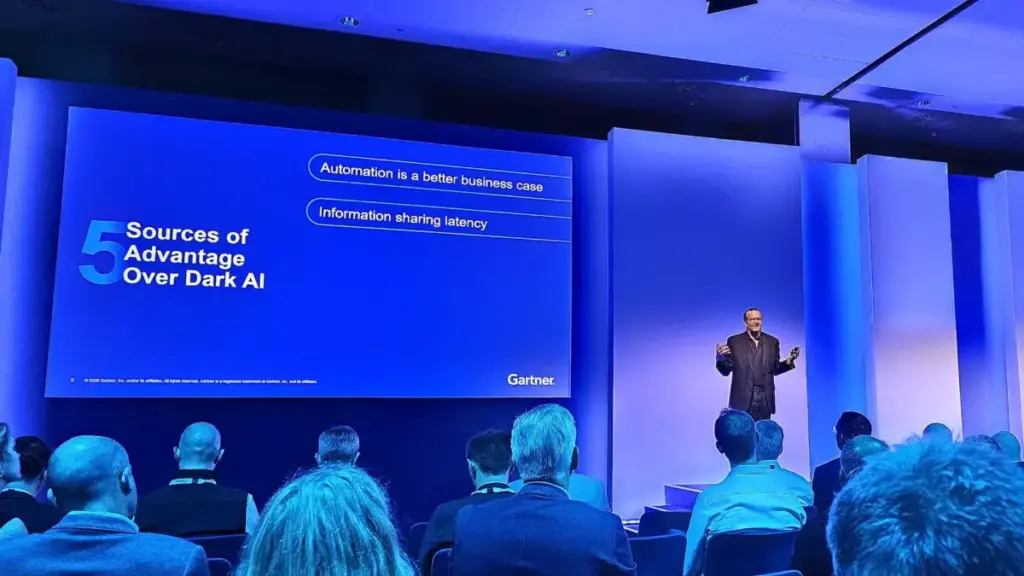
Speaking at the Gartner IT Symposium/Xpo 2026 in Barcelona, Leigh McMullen, a distinguished VP analyst and Gartner Fellow, challenged the prevailing sense of dread permeating the industry. McMullen argued that while the "AI apocalypse" is a popular talking point in boardrooms, the reality is that AI is ultimately a tool. For the strategic CIO, it is a tool that can be leveraged to reclaim the initiative from cybercriminals. To navigate this uncertain future, McMullen suggested that leadership must move beyond reacting to headlines and start answering the fundamental questions that boards are now demanding: how does the enterprise turn the speed of AI into a defensive moat?
The Catalyst of the "Anthropic Apocalypse"
The current anxiety surrounding AI in cybersecurity reached a fever pitch in April, following Anthropic’s release of its Mythos Preview. The tool demonstrated an unprecedented capability to identify zero-day vulnerabilities—flaws unknown even to the software’s creators—that had eluded every other traditional security tool on the market. The release sent shockwaves through the tech sector, prompting a wave of concern among IT leaders who feared that the barriers to high-level cyber espionage had been permanently lowered.
McMullen recalled the immediate aftermath of the Mythos release, noting that his phone was inundated with calls from tech leaders seeking clarity. The central question was whether this marked the beginning of a true cybersecurity apocalypse or if the industry was simply witnessing a high-stakes marketing moment. Referencing Gil Scott-Heron’s iconic poem, The Revolution Will Not Be Televised, McMullen quipped that many were wondering if they were watching an "apocalypse in four parts sponsored by Anthropic with no commercial interruptions."
Ultimately, McMullen argued that the distinction between a marketing event and a genuine paradigm shift is secondary. The fundamental nature of the threat remains the same: AI is a tool in a chain of events. The outcome is determined not by the tool itself, but by the intent of the user and the effectiveness of the response. By de-mystifying "dark AI," organizations can begin to see the specific areas where the defensive position is naturally stronger than the offensive one.
The Shift from Innovation to Automation
Historically, the cybersecurity industry has attempted to combat threat actors through a cycle of constant innovation. However, McMullen suggested that this strategy is inherently flawed because "you can’t out-innovate a crowd." The decentralized, global nature of the hacking community means they will always have more collective "man-hours" to dedicate to creative exploitation than any single corporate security team.
The solution, according to McMullen, is to pivot from innovation to automation. While AI is undeniably making attackers faster, there is evidence that it is also making them more fragile. Threat actors are becoming increasingly reliant on AI-assisted kill chains and automated attack pathways. This reliance creates a paradox: as they become more dependent on these systems, their manual skills may atrophy, and their operations become more predictable.
For cybersecurity professionals, automation is not a new concept—it is the core of the profession. Unlike many technology investments that lose value over time, McMullen argued that investments in cybersecurity automation often appreciate. A dollar spent on a robust, automated response system today covers a larger attack surface tomorrow and protects a growing revenue stream. By scaling defensive operations through AI, organizations can finally match the "digital speed" of their adversaries, turning a reactive struggle into a scalable business advantage.
Exploiting Information and Weaponization Latency
One of the most significant advantages held by defenders is the structured way in which the security community shares information. CSOs and CISOs generally operate within a culture of transparency, contributing to the Common Vulnerabilities and Exposures (CVE) list and the Common Attack Pattern (CAP) list. In contrast, threat actors operate in a transactional environment where information is a commodity to be sold, not shared for the common good.
McMullen noted that defenders almost always discover vulnerabilities before threat actors do, simply because of the sheer scale of the global research community. By banding together across industry lines and casting aside traditional competition, companies can use this "information latency" to their advantage. When a community of practice shares insights rapidly, the window of opportunity for a threat actor to use a new exploit narrows significantly.
Furthermore, there is a "weaponization latency" that favors the defender. Even if an attacker uses AI to distill a new exploit, the defensive side typically has access to more sophisticated AI models first. Whether the defensive lead is measured in months or minutes, it remains an advantage. McMullen emphasized that the primary hurdle for CIOs is not the sophistication of the AI, but the basics of patching and vulnerability management. AI is already simplifying these tasks through software reverse engineering and the creation of "digital twins."
By using AI to create digital twins of their operational technology (OT) and hybrid cloud environments, companies can comprehensively test patches in a simulated space before deployment. This allows for a level of continuous integration and continuous delivery (CI/CD) that was previously impossible in complex, legacy-heavy environments.
The Advantage of Terrain and Economic Realities
The concept of "knowing the terrain" is a classic military principle that applies directly to the digital battlefield. While tools like Mythos are terrifyingly efficient at finding vulnerabilities, they still require access to source code or specific environmental data to be truly effective. Most cyberattacks currently target the open-source world because it is visible and accessible.
For a CIO, the advantage lies in the closed-source stack. An organization is the only entity that truly understands its internal, proprietary architecture. McMullen encouraged leaders to leverage this home-field advantage by using "dark AI" on themselves. By employing AI-assisted penetration testing and red teaming, companies can identify the unknown vulnerabilities within their specific terrain before an outsider does.
Finally, the economic reality of AI favors the defender. While AI can help a threat actor "imagine" complex, seven-part kill chains, these attacks are difficult to execute at scale. They must be customized to a specific target and a specific environment, which requires a significant "token burn" or computational cost. McMullen pointed out that as an attack becomes larger and more complex, it becomes noisier and easier to detect.
Large-scale, AI-driven spam attacks across the internet are detectable and interdictable. The more a threat actor relies on massive automated systems, the more likely they are to trip the digital wires set by sophisticated defensive monitors. In this sense, the "AI apocalypse" may actually be directed at the threat actors themselves, as their traditional methods of flying under the radar become obsolete.
Resilience as the Ultimate Offensive Strategy
The final piece of the puzzle for the modern CIO is a shift in mindset regarding the inevitability of an attack. McMullen argued that the goal should not be the impossible standard of 100% protection, but rather a focus on resilience. Gartner’s data suggests that six months after a breach, most companies see little to no impact on their earnings per share (EPS). While this is not a justification for lax security, it does suggest that the business impact of a breach is often tied more to the recovery time than the initial entry.
"We need to be playing offense," McMullen stated, defining offense in this context as the ability to mitigate harm so effectively that it is functionally equivalent to preventing the attack in the first place. This requires what he calls "recovery rehearsals."
McMullen urged CIOs and CISOs to move beyond theoretical disaster recovery plans and into the realm of routine, automated rehearsals. This includes the regular creation of deployment and test environments from immutable backups and the frequent testing of Bitlocker keys and access protocols. If a team can demonstrate that they can rebuild their entire production environment or migrate a codebase using AI-assisted tools like Claude, they can stand before their board with genuine confidence.
The ability to look at a ransomware demand and realize it is irrelevant because the system can be restored in hours is the ultimate defensive victory. By focusing on continuous improvement in resilience—a metric that can actually be measured and proven—CIOs can provide the stability and assurance that boards of directors are looking for in an increasingly automated world. In the battle of AI versus AI, the winner will not be the one with the most innovative exploit, but the one with the most resilient foundation.
 Helpdesk & IT Service Management (ITSM)
Snowflake World Tour London: Moving Beyond AI Hype to the Era of the Agentic Enterprise
LONDON — The conversation surrounding artificial intelligence has reached a critical inflection...
 Helpdesk & IT Service Management (ITSM)
Hammer Distribution and Acronis Announce Strategic UK Partnership to Address Growing MSP Complexity and Cyber Threats
Hammer Distribution has officially announced a significant new strategic partnership with Acronis,...
 Helpdesk & IT Service Management (ITSM)
Anthropic and Akamai Ink Landmark $11.6 Billion Compute Partnership to Fuel Long-Term AI Infrastructure Growth
In a move that underscores the staggering capital requirements of the generative...







