
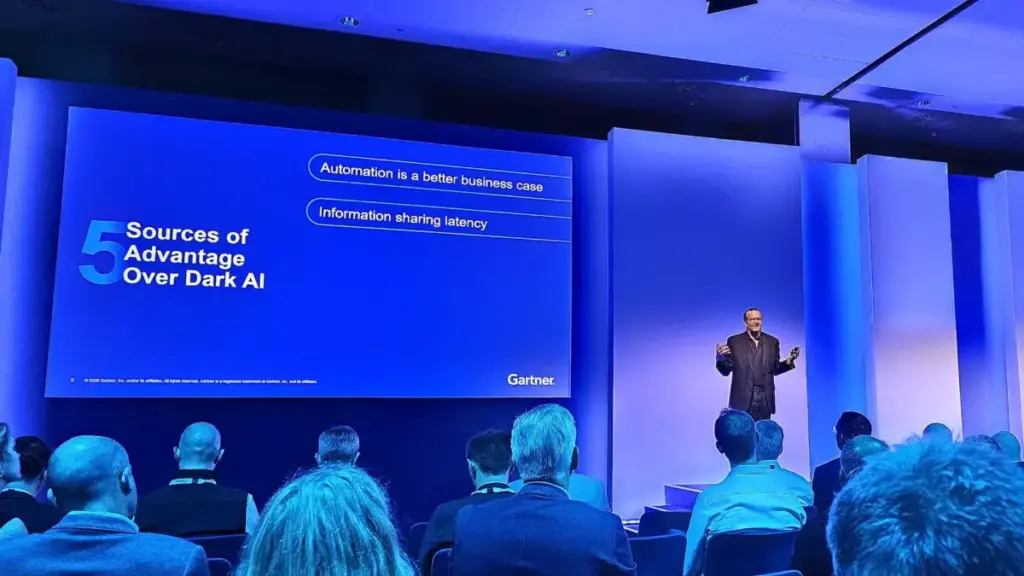
For a CIO, the advantage lies in the closed-source stack. An organization is the only entity that truly understands its internal, proprietary architecture. McMullen encouraged leaders to leverage this home-field advantage by using "dark AI" on themselves. By employing AI-assisted penetration testing and red teaming, companies can identify the unknown vulnerabilities within their specific terrain before an outsider does.
Finally, the economic reality of AI favors the defender. While AI can help a threat actor "imagine" complex, seven-part kill chains, these attacks are difficult to execute at scale. They must be customized to a specific target and a specific environment, which requires a significant "token burn" or computational cost. McMullen pointed out that as an attack becomes larger and more complex, it becomes noisier and easier to detect.
Large-scale, AI-driven spam attacks across the internet are detectable and interdictable. The more a threat actor relies on massive automated systems, the more likely they are to trip the digital wires set by sophisticated defensive monitors. In this sense, the "AI apocalypse" may actually be directed at the threat actors themselves, as their traditional methods of flying under the radar become obsolete.
Resilience as the Ultimate Offensive Strategy
The final piece of the puzzle for the modern CIO is a shift in mindset regarding the inevitability of an attack. McMullen argued that the goal should not be the impossible standard of 100% protection, but rather a focus on resilience. Gartner’s data suggests that six months after a breach, most companies see little to no impact on their earnings per share (EPS). While this is not a justification for lax security, it does suggest that the business impact of a breach is often tied more to the recovery time than the initial entry.
"We need to be playing offense," McMullen stated, defining offense in this context as the ability to mitigate harm so effectively that it is functionally equivalent to preventing the attack in the first place. This requires what he calls "recovery rehearsals."
McMullen urged CIOs and CISOs to move beyond theoretical disaster recovery plans and into the realm of routine, automated rehearsals. This includes the regular creation of deployment and test environments from immutable backups and the frequent testing of Bitlocker keys and access protocols. If a team can demonstrate that they can rebuild their entire production environment or migrate a codebase using AI-assisted tools like Claude, they can stand before their board with genuine confidence.
The ability to look at a ransomware demand and realize it is irrelevant because the system can be restored in hours is the ultimate defensive victory. By focusing on continuous improvement in resilience—a metric that can actually be measured and proven—CIOs can provide the stability and assurance that boards of directors are looking for in an increasingly automated world. In the battle of AI versus AI, the winner will not be the one with the most innovative exploit, but the one with the most resilient foundation.
 Helpdesk & IT Service Management (ITSM)
The Evolution of Service Delivery: Understanding the Strategic Shift Toward Enterprise Service Management
In the modern corporate landscape, the efficiency of an organization is often...
 Helpdesk & IT Service Management (ITSM)
UK Tech Leaders Demand £20 Billion Investment to Secure National AI Sovereignty
A coalition of the United Kingdom’s most prominent technology leaders has issued...
 Helpdesk & IT Service Management (ITSM)
SolarWinds Service Desk September Update Introduces Advanced Process Integrations and Microsoft Teams Automation
As IT environments become increasingly complex and distributed, the demand for more...







