
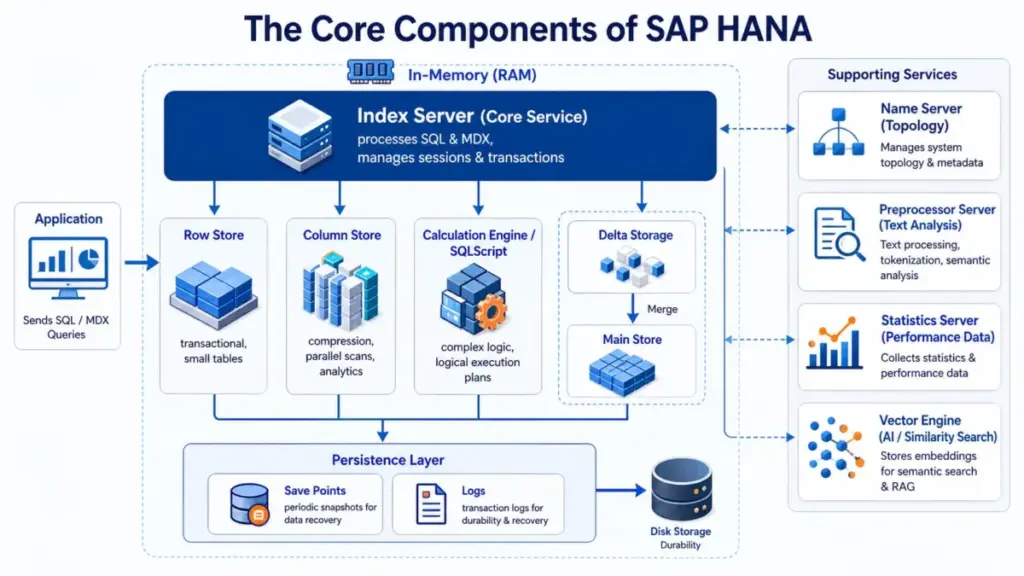
In the rapidly evolving landscape of enterprise resource planning and data management, SAP HANA has emerged as more than just a database; it is a foundational platform that has redefined how organizations process, analyze, and leverage their most critical information. At its core, SAP HANA—short for High-Performance Analytic Appliance—is a multi-model, in-memory, column-oriented database management system. Its primary distinction lies in its ability to support both high-volume transactional processing (OLTP) and complex analytical processing (OLAP) within a single, unified system.
When enterprise architects and database administrators (DBAs) discuss SAP HANA architecture, they are typically examining the structural design that allows the platform to bypass the limitations of traditional disk-based systems. This architecture determines how the platform stores vast amounts of data, processes intricate queries, scales to meet global demand, and ensures a rapid recovery in the event of a system failure. By keeping active data in RAM rather than on spinning disks, SAP HANA facilitates real-time insights that were previously impossible under older paradigms.
The Core Components of the SAP HANA Index Server
The heartbeat of the SAP HANA environment is the index server. This is the primary service responsible for the heavy lifting within the database. It houses the actual data stores and the engines that process that data. Every time a user or an application interacts with the system, the index server manages the session, handles transaction controls, and coordinates the various engines required to execute the work.
Beyond simple data retrieval, the index server is a sophisticated orchestrator. It processes both SQL (Structured Query Language) for relational data and MDX (Multi-Dimensional eXpressions) for OLAP-style cubes. By managing these requests centrally, the index server ensures that data integrity is maintained through ACID (Atomicity, Consistency, Isolation, Durability) compliance while maximizing the hardware’s throughput.
Balancing Row and Column Stores
A defining characteristic of SAP HANA is its dual-approach storage model. While most traditional databases are either row-oriented or column-oriented, SAP HANA includes both, allowing it to adapt to the specific needs of different workloads.
The column store is where the majority of SAP HANA’s performance reputation is built. By storing data in columns rather than rows, the system can achieve massive compression ratios. This is particularly beneficial for analytical processing, where queries often need to scan a few columns across millions or billions of records. Columnar storage allows for parallel scans and high-speed aggregations, making it the engine of choice for large-scale reporting.
Conversely, the row store remains a vital component of the architecture. It is optimized for highly transactional workloads where the system needs to access all fields of a single record quickly—such as looking up a specific customer’s details or processing a single sales order. It is also the home for many system tables. The architectural brilliance of SAP HANA lies in its ability to let the workload dictate the storage choice, rather than forcing a one-size-fits-all approach.
The Calculation Engine and Advanced Logic Execution
To handle more complex business logic, SAP HANA employs a dedicated calculation engine. This component is essential when simple SQL queries are insufficient to represent the intricacy of modern business rules. Through the use of SQLScript—a collection of extensions to SQL—and calculation models, developers can push complex logic directly into the database layer.
This "code-to-data" philosophy is a departure from traditional application design, where data was often pulled from the database into an application server for processing. By transforming advanced requests into a logical execution plan, the calculation engine can optimize the work and execute it in parallel across multiple CPU cores. This means that query performance is not merely a product of raw hardware power, but a result of how effectively the engine can parallelize processing and minimize the movement of data between different layers of the system.
The Persistence Layer: Ensuring Durability in an In-Memory World
One of the most common misconceptions about in-memory databases is that they are volatile and risk losing data during a power loss or system crash. SAP HANA addresses this through its robust persistence layer. While the active data set resides in memory for speed, the system maintains a durable copy of the data on disk.
This is achieved through a combination of "save points" and transaction logs. Save points are periodic snapshots where the current state of the database is written from memory to the data volumes on disk. Meanwhile, every committed transaction is recorded in a redo log. If a restart occurs, the system loads the last save point and then "replays" the logs to bring the database back to its most recent committed state. This architecture ensures that SAP HANA provides the speed of RAM with the reliability of traditional disk-based storage.
Supporting Services in Distributed Environments
As an SAP HANA environment grows from a single server to a distributed landscape, several supporting services become critical. The Name Server acts as the librarian of the system, tracking the topology of the environment and knowing exactly where data is located across multiple nodes.

Other specialized services include the Preprocessor Server, which handles text analysis and unstructured data processing, and the Statistics Server, which monitors the health and resource consumption of the database. These services work in tandem with the index server to support large-scale production environments, ensuring that the architecture remains stable even as the data estate expands in both size and complexity.
How SAP HANA Processes Workloads
The lifecycle of a request in SAP HANA is a study in optimization. When an application sends a query, the system first creates a session and applies necessary transaction controls. The request is then parsed, and a query optimizer builds an execution plan.
For write-heavy activities, SAP HANA utilizes a multi-stage approach. New records initially land in a "delta storage" area, which is optimized for fast write operations. Because reorganizing a highly compressed columnar table for every single write would be inefficient, the system waits for an opportune moment to perform a "delta merge." During this operation, the new records are moved from the delta store into the read-optimized "main store." This design allows SAP HANA to support high-speed data entry without sacrificing the performance of analytical queries.
Distinguishing SAP HANA from Traditional Databases
The fundamental difference between SAP HANA and traditional databases lies in the "disk-first" versus "memory-first" philosophy. Traditional systems often suffer from high latency because the CPU must wait for data to be fetched from slow mechanical or even solid-state disks. SAP HANA eliminates this bottleneck by keeping the data in-memory, where it can be accessed almost instantaneously.
However, this design does not eliminate all trade-offs. The cost of memory is significantly higher than disk storage, necessitating careful data volume management. Architects must still account for partitioning, query design, and concurrency. While SAP HANA reduces the need for data movement between separate transactional and analytical systems, it requires a higher level of architectural planning to manage the associated memory costs and sizing requirements.
Scaling, Uptime, and High Availability
Scaling an SAP HANA environment can be approached in two ways: scaling up or scaling out. Scaling up involves moving the database to a larger server with more RAM and CPU cores. Scaling out involves distributing the database across multiple nodes in a "shared-nothing" architecture. In scale-out scenarios, the Name Server’s role in topology awareness becomes paramount to ensure that queries are routed to the correct node with minimal overhead.
High availability is another core architectural pillar. Depending on the organization’s requirements, SAP HANA can be configured in various ways, including system replication and multitenant database containers (MDC). These configurations allow for tenant isolation and ensure that if one component fails, the impact on the overall business operation is minimized.
Security and Advanced Analytics
Security in SAP HANA is integrated into the architecture rather than being an afterthought. The platform supports robust tenant isolation, secure client-server communication via SSL/TLS, and sophisticated certificate validation. For modern enterprises, the "least-privilege" access model is encouraged, particularly for monitoring tasks. By using dedicated, read-only monitoring users, organizations can gain visibility into system performance without exposing sensitive administrative functions.
Looking forward, SAP HANA continues to evolve with advanced analytics capabilities. It now includes functional libraries for predictive analytics, spatial data processing, and graph analysis. With the rise of AI, SAP HANA Cloud is expanding to support vector data and retrieval-augmented generation (RAG) use cases, allowing businesses to keep their analytical logic close to their data.
The Necessity of Architectural Monitoring
For the database administrator, the shift to SAP HANA means that traditional host metrics like CPU and disk usage are no longer sufficient to understand system health. A system might show low CPU usage while still suffering from significant performance bottlenecks within the index server or during a delta merge.
This is why monitoring tools, such as SolarWinds Database Performance Analyzer, focus on "wait-time analysis." By investigating why a query is waiting—whether it’s due to blocking, inefficient SQL plans, or resource pressure within a specific engine—teams can identify the root cause of slowdowns. Understanding the nuances of the persistence layer, the calculation engine, and execution plans allows DBAs to move beyond simple "up/down" monitoring and into the realm of proactive performance optimization.
Ultimately, the architecture of SAP HANA is a sophisticated balance of speed, durability, and flexibility. By understanding how its components interact—from the in-memory column store to the disk-based persistence layer—organizations can make more informed decisions about their capacity, recovery planning, and long-term digital strategy.
 Helpdesk & IT Service Management (ITSM)
OpenSSF and Tech Giants Call for Sustainable Funding to Secure Global Software Supply Chain
The OpenSSF (Open Source Security Foundation) Governing Board has issued an urgent...
 Helpdesk & IT Service Management (ITSM)
Omdia Research Highlights Significant Cost Savings and Operational Gains for MSPs and IT Teams Adopting Unified Management Platforms
In an era defined by tightening budgets and an explosion of digital...
 Helpdesk & IT Service Management (ITSM)
SolarWinds Announces Comprehensive September Webinar Series to Address Evolving Database Challenges and AI Integration
The landscape of modern data management is undergoing a period of rapid...







