
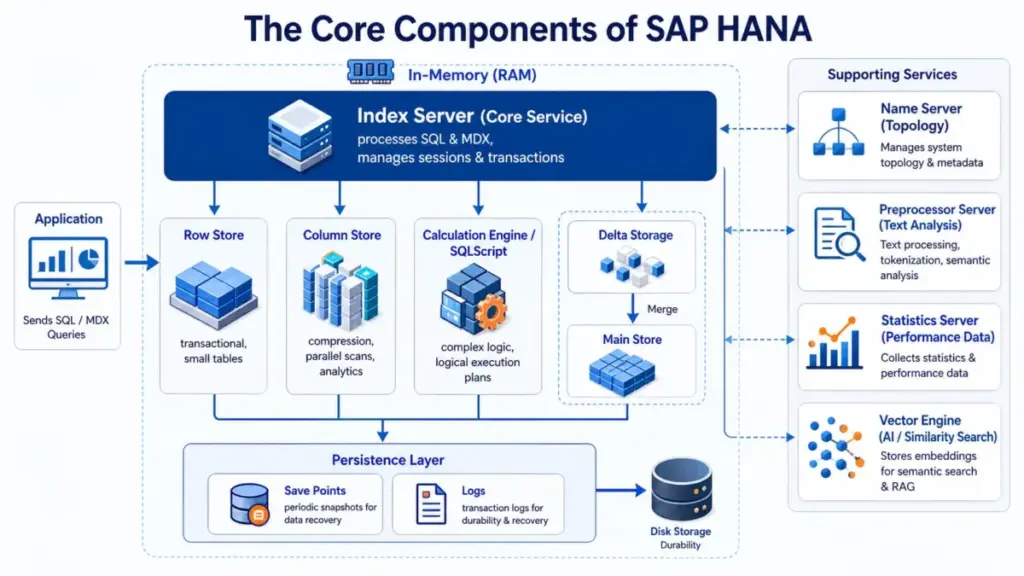
This "code-to-data" philosophy is a departure from traditional application design, where data was often pulled from the database into an application server for processing. By transforming advanced requests into a logical execution plan, the calculation engine can optimize the work and execute it in parallel across multiple CPU cores. This means that query performance is not merely a product of raw hardware power, but a result of how effectively the engine can parallelize processing and minimize the movement of data between different layers of the system.
The Persistence Layer: Ensuring Durability in an In-Memory World
One of the most common misconceptions about in-memory databases is that they are volatile and risk losing data during a power loss or system crash. SAP HANA addresses this through its robust persistence layer. While the active data set resides in memory for speed, the system maintains a durable copy of the data on disk.
This is achieved through a combination of "save points" and transaction logs. Save points are periodic snapshots where the current state of the database is written from memory to the data volumes on disk. Meanwhile, every committed transaction is recorded in a redo log. If a restart occurs, the system loads the last save point and then "replays" the logs to bring the database back to its most recent committed state. This architecture ensures that SAP HANA provides the speed of RAM with the reliability of traditional disk-based storage.
Supporting Services in Distributed Environments
As an SAP HANA environment grows from a single server to a distributed landscape, several supporting services become critical. The Name Server acts as the librarian of the system, tracking the topology of the environment and knowing exactly where data is located across multiple nodes.

Other specialized services include the Preprocessor Server, which handles text analysis and unstructured data processing, and the Statistics Server, which monitors the health and resource consumption of the database. These services work in tandem with the index server to support large-scale production environments, ensuring that the architecture remains stable even as the data estate expands in both size and complexity.
How SAP HANA Processes Workloads
The lifecycle of a request in SAP HANA is a study in optimization. When an application sends a query, the system first creates a session and applies necessary transaction controls. The request is then parsed, and a query optimizer builds an execution plan.
For write-heavy activities, SAP HANA utilizes a multi-stage approach. New records initially land in a "delta storage" area, which is optimized for fast write operations. Because reorganizing a highly compressed columnar table for every single write would be inefficient, the system waits for an opportune moment to perform a "delta merge." During this operation, the new records are moved from the delta store into the read-optimized "main store." This design allows SAP HANA to support high-speed data entry without sacrificing the performance of analytical queries.
Distinguishing SAP HANA from Traditional Databases
The fundamental difference between SAP HANA and traditional databases lies in the "disk-first" versus "memory-first" philosophy. Traditional systems often suffer from high latency because the CPU must wait for data to be fetched from slow mechanical or even solid-state disks. SAP HANA eliminates this bottleneck by keeping the data in-memory, where it can be accessed almost instantaneously.
 Helpdesk & IT Service Management (ITSM)
Anthropic and Akamai Ink Landmark $11.6 Billion Compute Partnership to Fuel Long-Term AI Infrastructure Growth
In a move that underscores the staggering capital requirements of the generative...
 Helpdesk & IT Service Management (ITSM)
The Trillion-Dollar ROI Challenge: Why AI Infrastructure Spending Must Spark a Global Innovation Revolution
As the global technology sector pivots toward an era defined by generative...
 Helpdesk & IT Service Management (ITSM)
International Law Enforcement Operation Dismantles KillSec Ransomware Group and Arrests Teenage Mastermind
In a sweeping international law enforcement operation coordinated across multiple borders, authorities...







