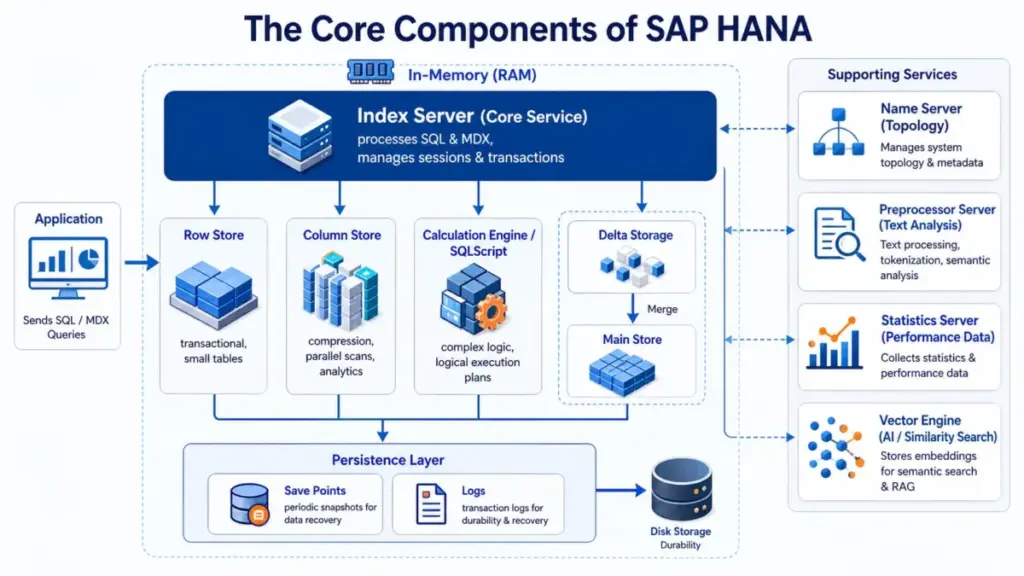
However, this design does not eliminate all trade-offs. The cost of memory is significantly higher than disk storage, necessitating careful data volume management. Architects must still account for partitioning, query design, and concurrency. While SAP HANA reduces the need for data movement between separate transactional and analytical systems, it requires a higher level of architectural planning to manage the associated memory costs and sizing requirements.
Scaling, Uptime, and High Availability
Scaling an SAP HANA environment can be approached in two ways: scaling up or scaling out. Scaling up involves moving the database to a larger server with more RAM and CPU cores. Scaling out involves distributing the database across multiple nodes in a "shared-nothing" architecture. In scale-out scenarios, the Name Server’s role in topology awareness becomes paramount to ensure that queries are routed to the correct node with minimal overhead.
High availability is another core architectural pillar. Depending on the organization’s requirements, SAP HANA can be configured in various ways, including system replication and multitenant database containers (MDC). These configurations allow for tenant isolation and ensure that if one component fails, the impact on the overall business operation is minimized.
Security and Advanced Analytics
Security in SAP HANA is integrated into the architecture rather than being an afterthought. The platform supports robust tenant isolation, secure client-server communication via SSL/TLS, and sophisticated certificate validation. For modern enterprises, the "least-privilege" access model is encouraged, particularly for monitoring tasks. By using dedicated, read-only monitoring users, organizations can gain visibility into system performance without exposing sensitive administrative functions.
Looking forward, SAP HANA continues to evolve with advanced analytics capabilities. It now includes functional libraries for predictive analytics, spatial data processing, and graph analysis. With the rise of AI, SAP HANA Cloud is expanding to support vector data and retrieval-augmented generation (RAG) use cases, allowing businesses to keep their analytical logic close to their data.
The Necessity of Architectural Monitoring
For the database administrator, the shift to SAP HANA means that traditional host metrics like CPU and disk usage are no longer sufficient to understand system health. A system might show low CPU usage while still suffering from significant performance bottlenecks within the index server or during a delta merge.
This is why monitoring tools, such as SolarWinds Database Performance Analyzer, focus on "wait-time analysis." By investigating why a query is waiting—whether it’s due to blocking, inefficient SQL plans, or resource pressure within a specific engine—teams can identify the root cause of slowdowns. Understanding the nuances of the persistence layer, the calculation engine, and execution plans allows DBAs to move beyond simple "up/down" monitoring and into the realm of proactive performance optimization.
Ultimately, the architecture of SAP HANA is a sophisticated balance of speed, durability, and flexibility. By understanding how its components interact—from the in-memory column store to the disk-based persistence layer—organizations can make more informed decisions about their capacity, recovery planning, and long-term digital strategy.
 Helpdesk & IT Service Management (ITSM)
The Shift Toward Pre-emptive Cybersecurity: Why "Detect and Respond" is No Longer Enough in the Age of AI
The cybersecurity landscape has long been characterized by a perpetual game of...
 Helpdesk & IT Service Management (ITSM)
Overe Appoints Former Sophos CSO Simon Reed as Strategic Advisor to Accelerate MSP Security Growth
In a significant move aimed at strengthening its leadership and deepening its...
 Helpdesk & IT Service Management (ITSM)
Bridging the Divide: Report Finds Significant Visibility and Governance Gaps in Federal AI Readiness
As federal and defense agencies accelerate their adoption of artificial intelligence, a...