
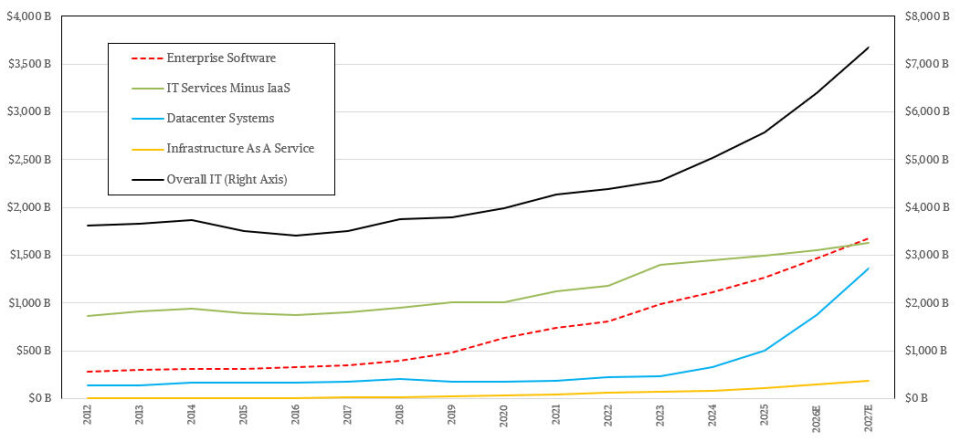
The scale of this shift is difficult to overstate. In 2012, Core IT spending accounted for just over a third of the total global IT budget. By the end of 2027, it is projected to account for more than two-thirds. The gap between global GDP growth and Core IT spending has also widened to an extraordinary degree. Instead of the traditional 2X multiplier, Core IT is expected to grow at 8X the rate of GDP in 2026 and 7.3X in 2027. These are not normal economic conditions; they represent a fundamental reordering of how capital is allocated in the modern world.
However, a critical question remains: how much of this record-breaking spending is driven by actual capacity expansion, and how much is simply the result of inflation? When adjusting datacenter spending figures for currency inflation, it becomes clear that while real growth is occurring, it is being amplified by rising costs. There is also the matter of price inflation driven by supply and demand imbalances. Much like the shortage of building materials during the height of the pandemic, the demand for high-end silicon and datacenter components is far outstripping the industry’s ability to supply them.
It is estimated that roughly half of the growth in datacenter systems spending this year can be attributed to these supply-chain pressures, which have allowed manufacturers to command significant price premiums. The other half represents the actual increase in physical capacity that chipmakers and system integrators have been able to deliver. This "plywood and two-by-fours" dynamic creates a challenging environment for IT procurement officers, who are forced to pay premium prices for hardware that may have multi-month or even multi-year lead times.
The current environment is a study in extremes. On one hand, the technological potential of AI is driving a level of investment that the industry has never seen before. On the other hand, the physical and political constraints of the real world—power grids, land use, and supply chains—are beginning to push back. We are living in an era where the digital world’s expansion is being checked by the physical world’s limitations. As we look toward 2027 and the uncertain horizon of 2028, it is clear that the datacenter business has moved from the periphery of the economy to its very center, bringing with it a new set of risks and rewards that will define the next decade of global commerce.
 Enterprise Tech & Infrastructure
The Architecture of Data: Understanding the Critical Hierarchy of Computer Memory Systems
In the modern digital landscape, the term "computer memory" serves as a...
 Enterprise Tech & Infrastructure
Strategic Navigation of Amazon S3 Economics: Beyond the Per-Gigabyte Price Point
In the landscape of modern enterprise cloud architecture, Amazon S3 has long...
 Enterprise Tech & Infrastructure
The Physical Limits of Artificial Intelligence: Why Infrastructure Constraints Are Throttling the Generative AI Boom
The prevailing narrative surrounding the generative artificial intelligence revolution often focuses on...







