In the days immediately preceding the election, market researchers and analysts finalized revisions to their IT spending forecasts for 2026 and offered their inaugural projections for 2027. The data suggests that 2027 is shaping up to be a landmark year for the technology sector, characterized by unprecedented levels of investment. While the immediate future looks lucrative, a growing number of prognosticators suggest that the market may be approaching a peak. This potential plateau is not attributed to a lack of demand—which remains at historic highs—but rather to a brewing "perfect storm" of political and physical constraints.
There is a rising tide of political opposition directed at the world’s largest technology titans, specifically concerning the land, water, and energy requirements of their massive datacenter campuses. Simultaneously, a sobering reality is setting in regarding the global energy grid. It is becoming increasingly doubtful that electricity generation and distribution infrastructure can be expanded quickly enough to satisfy the projected needs of the datacenter industry by the end of the decade. While 2030 is often cited as the critical breaking point, some analysts believe the friction will become palpable as early as 2028.
Predicting the landscape of 2028 remains a fraught exercise. The current economic and geopolitical data is characterized by a high degree of volatility, making any forecast extending beyond the next twelve to eighteen months inherently speculative. Nevertheless, these long-range projections from firms like Gartner and IDC serve as the foundational blueprints upon which global enterprises base their annual IT budgets. Understanding how these forecasts evolve and how growth is distributed across different market segments is essential for grasping the current state of the global economy.
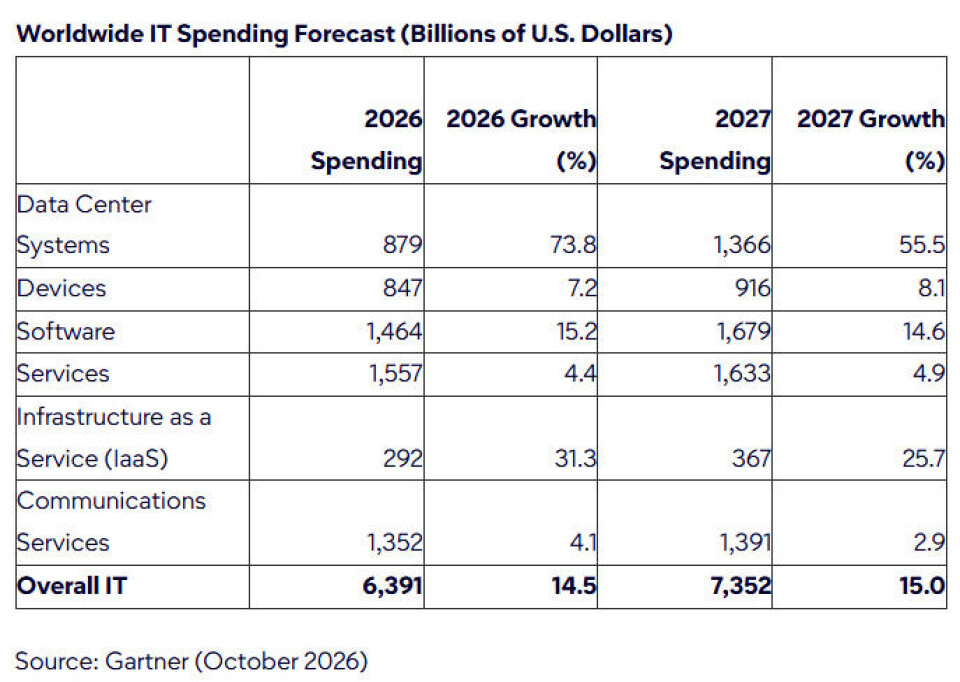
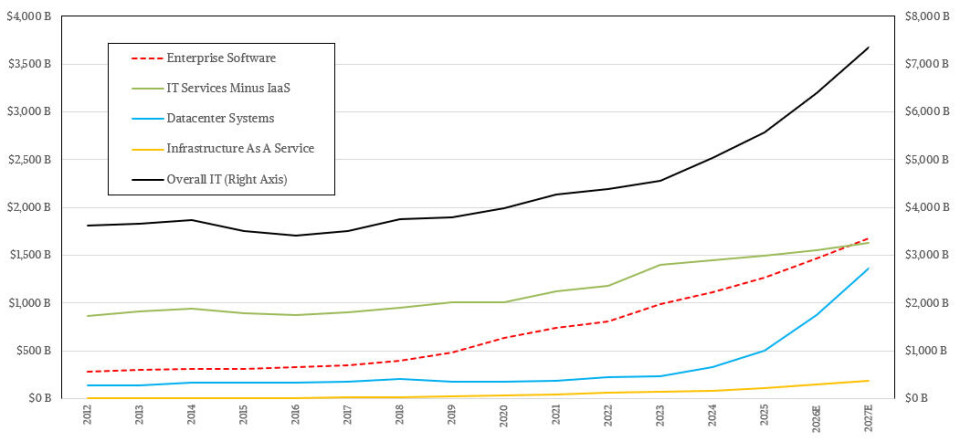
A significant refinement in the latest Gartner forecast for November 2026 is the isolation of Infrastructure as a Service (IaaS) from the broader IT services category. This adjustment allows for a much clearer view of the "cloudy" side of the ledger, specifically the rental of compute, storage, and networking capacity. By separating these rentals from traditional consulting and support services, analysts can now perform a more accurate comparison between the sale of physical datacenter systems—comprising servers, storage, and networking hardware—and the leasing of that same capacity through cloud providers.
This granular view reveals a dramatic shift in spending patterns. For over a decade, enterprise software revenues typically doubled or tripled the amount spent on datacenter systems. However, the emergence of generative artificial intelligence has fundamentally altered this ratio. The sheer cost of AI-specialized hardware, combined with the massive investment required to upgrade the transactional back-office and data-intensive front-office systems that feed AI models, has pushed hardware spending to a new frontier.
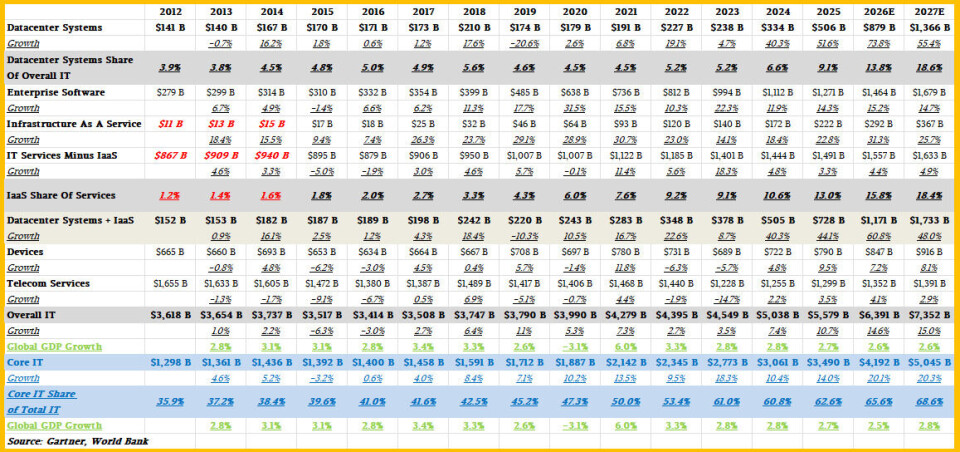
According to current projections, the combined expenditure on physical datacenter systems and IaaS rentals is set to eclipse enterprise software spending as early as next year. This represents a seismic shift in the industry’s financial structure. Hardware-related spending is expected to reach approximately $1.73 trillion, marking a staggering 48 percent increase year-over-year. In contrast, enterprise software is projected to reach $1.68 trillion, representing a more modest, though still healthy, growth rate of 14.7 percent.
The remaining portion of the IT services sector—those services excluding IaaS—is also expected to grow, albeit at a more measured pace. Gartner forecasts a 4.9 percent increase in this segment next year. While this growth appears anemic compared to the hardware explosion, it is still nearly double the projected growth rate of the global gross domestic product (GDP). Historically, mature technology markets have tended to grow at roughly twice the rate of the broader economy, a trend that held steady for decades until the current AI-driven disruption.
When examining the historical data of "Core IT"—which includes systems, software, and services—the current era stands out as a radical departure from the norm. Throughout the 2010s, the industry narrative was dominated by "Softwaremageddon" or the idea that software was "eating the world." During this period, datacenter systems were essentially the neglected child of the IT budget. Between 2013 and 2021, the average annual growth rate for datacenter systems revenue was a mere 2.3 percent. This was actually lower than the average global GDP growth of 2.7 percent during the same period, indicating a market that was beyond mature and essentially stagnant.
In those years, enterprise software and IT services were the primary drivers of growth, while hardware budgets were kept on a tight leash. Companies were stingy with their physical infrastructure spending, preferring to squeeze every possible cycle out of existing assets or shift the burden to service providers. The datacenter systems market was, in a sense, a prisoner of its own efficiency.
The arrival of the global pandemic in 2020 began to change this trajectory, but the true catalyst was the explosion of generative AI in late 2022. Suddenly, the "stingy" approach to hardware became a strategic liability. To compete in the new AI landscape, enterprises realized they could not afford to miss the wave, leading to a frantic reinvestment in physical infrastructure. In many ways, the current boom mirrors the Dot Com era of the late 1990s, with one major distinction: the primary beneficiaries and drivers are the established hyperscalers and cloud builders who already dominate the landscape. These giants are currently consuming the vast majority of available GPU and XPU allocations, leaving smaller players to scramble for what remains.
The scale of this shift is difficult to overstate. In 2012, Core IT spending accounted for just over a third of the total global IT budget. By the end of 2027, it is projected to account for more than two-thirds. The gap between global GDP growth and Core IT spending has also widened to an extraordinary degree. Instead of the traditional 2X multiplier, Core IT is expected to grow at 8X the rate of GDP in 2026 and 7.3X in 2027. These are not normal economic conditions; they represent a fundamental reordering of how capital is allocated in the modern world.
However, a critical question remains: how much of this record-breaking spending is driven by actual capacity expansion, and how much is simply the result of inflation? When adjusting datacenter spending figures for currency inflation, it becomes clear that while real growth is occurring, it is being amplified by rising costs. There is also the matter of price inflation driven by supply and demand imbalances. Much like the shortage of building materials during the height of the pandemic, the demand for high-end silicon and datacenter components is far outstripping the industry’s ability to supply them.
It is estimated that roughly half of the growth in datacenter systems spending this year can be attributed to these supply-chain pressures, which have allowed manufacturers to command significant price premiums. The other half represents the actual increase in physical capacity that chipmakers and system integrators have been able to deliver. This "plywood and two-by-fours" dynamic creates a challenging environment for IT procurement officers, who are forced to pay premium prices for hardware that may have multi-month or even multi-year lead times.
The current environment is a study in extremes. On one hand, the technological potential of AI is driving a level of investment that the industry has never seen before. On the other hand, the physical and political constraints of the real world—power grids, land use, and supply chains—are beginning to push back. We are living in an era where the digital world’s expansion is being checked by the physical world’s limitations. As we look toward 2027 and the uncertain horizon of 2028, it is clear that the datacenter business has moved from the periphery of the economy to its very center, bringing with it a new set of risks and rewards that will define the next decade of global commerce.
 Enterprise Tech & Infrastructure
Bridging the Gap: The Role of Fibre Channel over Ethernet (FCoE) in Modern Data Center Storage
In the complex landscape of enterprise data management, the quest for a...
 Enterprise Tech & Infrastructure
Optimizing Amazon S3: How Enterprise Storage Leaders Can Navigate the Hidden Complexities of Cloud Cost Management
In the landscape of modern enterprise cloud architecture, Amazon S3 has long...
 Enterprise Tech & Infrastructure
Quantinuum Charts a Full-Stack Course Toward Fault-Tolerant Quantum Computing
The cadence of breakthroughs in the quantum computing sector has reached a...