
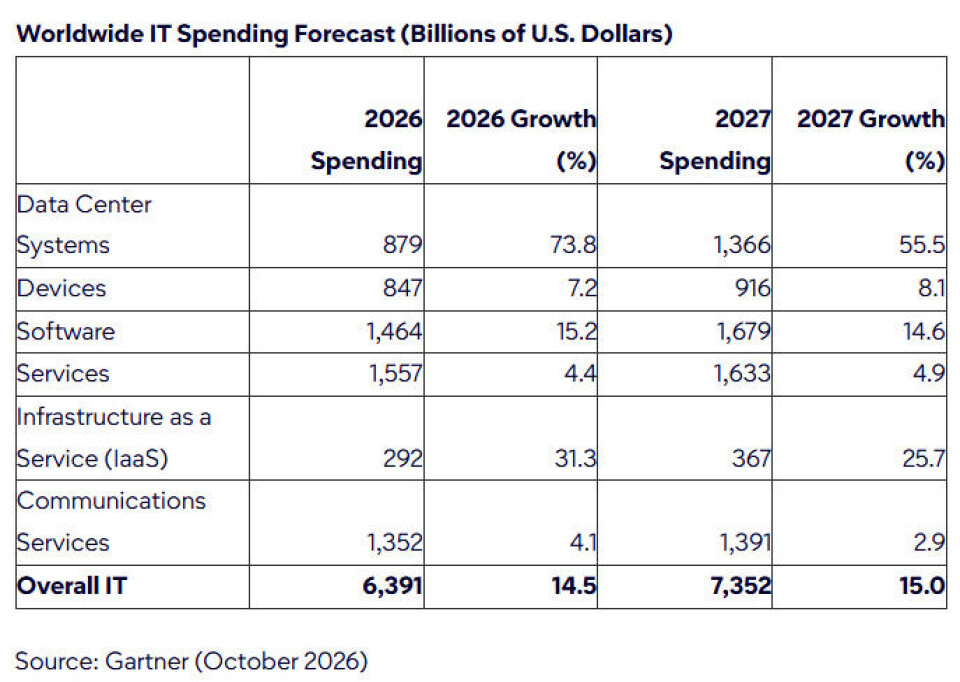
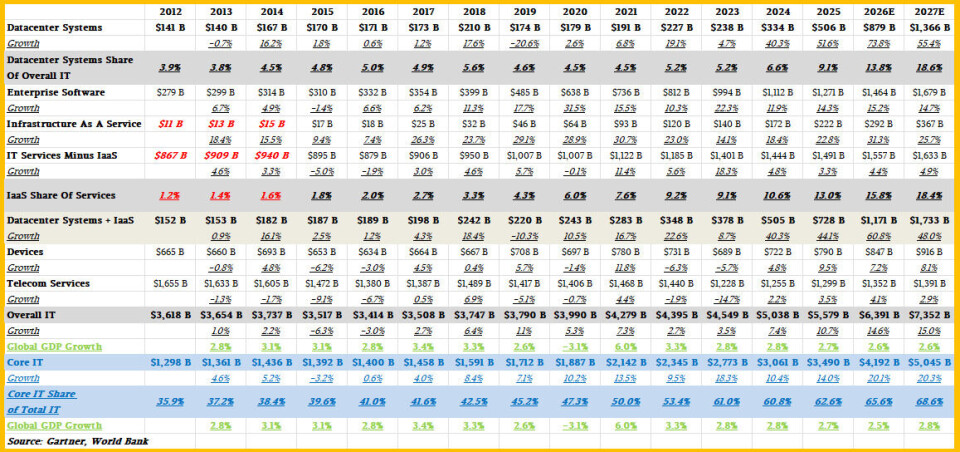
According to current projections, the combined expenditure on physical datacenter systems and IaaS rentals is set to eclipse enterprise software spending as early as next year. This represents a seismic shift in the industry’s financial structure. Hardware-related spending is expected to reach approximately $1.73 trillion, marking a staggering 48 percent increase year-over-year. In contrast, enterprise software is projected to reach $1.68 trillion, representing a more modest, though still healthy, growth rate of 14.7 percent.
The remaining portion of the IT services sector—those services excluding IaaS—is also expected to grow, albeit at a more measured pace. Gartner forecasts a 4.9 percent increase in this segment next year. While this growth appears anemic compared to the hardware explosion, it is still nearly double the projected growth rate of the global gross domestic product (GDP). Historically, mature technology markets have tended to grow at roughly twice the rate of the broader economy, a trend that held steady for decades until the current AI-driven disruption.
When examining the historical data of "Core IT"—which includes systems, software, and services—the current era stands out as a radical departure from the norm. Throughout the 2010s, the industry narrative was dominated by "Softwaremageddon" or the idea that software was "eating the world." During this period, datacenter systems were essentially the neglected child of the IT budget. Between 2013 and 2021, the average annual growth rate for datacenter systems revenue was a mere 2.3 percent. This was actually lower than the average global GDP growth of 2.7 percent during the same period, indicating a market that was beyond mature and essentially stagnant.
In those years, enterprise software and IT services were the primary drivers of growth, while hardware budgets were kept on a tight leash. Companies were stingy with their physical infrastructure spending, preferring to squeeze every possible cycle out of existing assets or shift the burden to service providers. The datacenter systems market was, in a sense, a prisoner of its own efficiency.
The arrival of the global pandemic in 2020 began to change this trajectory, but the true catalyst was the explosion of generative AI in late 2022. Suddenly, the "stingy" approach to hardware became a strategic liability. To compete in the new AI landscape, enterprises realized they could not afford to miss the wave, leading to a frantic reinvestment in physical infrastructure. In many ways, the current boom mirrors the Dot Com era of the late 1990s, with one major distinction: the primary beneficiaries and drivers are the established hyperscalers and cloud builders who already dominate the landscape. These giants are currently consuming the vast majority of available GPU and XPU allocations, leaving smaller players to scramble for what remains.
 Enterprise Tech & Infrastructure
Bridging the Gap in Data Center Convergence: The Evolving Role of Fibre Channel over Ethernet
As data centers face unprecedented pressure to handle massive workloads driven by...
 Enterprise Tech & Infrastructure
Nvidia Unveils Silicon-Level Guardrails as Industry Grapples with Surging AI Agent Breaches
The artificial intelligence industry, once defined by a breakneck race toward ever-greater...
 Enterprise Tech & Infrastructure
Google and Nvidia Advance "Magic State Cultivation" to Tackle Quantum Computing’s Error Correction Hurdle
The global pursuit of practical, scalable, and fault-tolerant quantum computing is currently...







