
In the ICANN framework, this is categorized as a Limited Registration Period (LRP). By placing the Frontier phase here, D3 provides a middle ground for enthusiasts and early adopters who may not hold a registered trademark but are willing to commit resources to secure a specific name.
The allocation logic is designed to be equitable for both the registry and the registrant. When multiple users vie for the same second-level domain, the system looks at the user who submitted the highest number of points. However, the points alone do not guarantee a win. The user must also have posted a bid price that meets or exceeds the minimum "ask" price set by the registry for that specific domain.
The "double-blind" nature of this transaction is a critical feature. The registry does not see the specific bids or point totals from users before it submits the minimum price it is willing to accept for the domain. This prevents registries from artificially inflating prices based on known high bids. Conversely, users do not know the registry’s floor price, ensuring that their bids reflect their true valuation of the asset. If the highest point-committer’s price fails to meet the registry’s minimum, the system automatically moves to the next highest point-committer to see if their price meets the threshold.
Incentivizing Engagement Through Points and Crypto Integration
The Frontier ecosystem is fueled by points, and D3 has established several pathways for users to accumulate this "social and economic capital." Beyond the initial sign-up, users can earn points by participating in the broader D3 ecosystem. This includes depositing cryptocurrency into various third-party vaults, a move that highlights D3’s deep roots in the Web3 and blockchain communities.
This integration of crypto-economic incentives is a hallmark of D3’s broader strategy to bridge the gap between the traditional Domain Name System (DNS) and the emerging world of decentralized identity. In addition to financial deposits, users can bolster their point totals through referral programs and other community-driven actions, effectively gamifying the pre-order process to ensure that the most active and engaged participants are rewarded with higher priority during the name-selection phase.
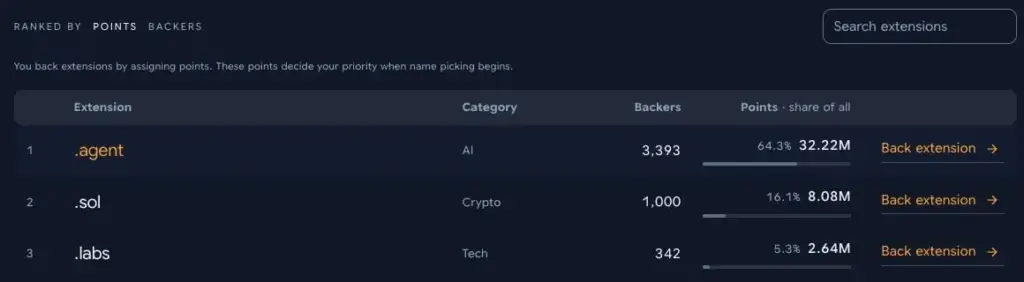
The current state of the Frontier leaderboard provides a fascinating glimpse into current market sentiment. As of the platform’s launch, the extension .agent has emerged as the clear frontrunner, capturing a staggering 64% of all points pledged on the platform. This dominance likely reflects the current global obsession with artificial intelligence and the anticipation of a massive wave of AI-driven services and autonomous agents that will require distinct digital identities.
 Web Hosting & Domain Management
Twente Region Set to Secure Dedicated Digital Identity with Application for .Twente Top-Level Domain
The digital landscape of the Netherlands is poised for a significant expansion...
 Web Hosting & Domain Management
Public Interest Registry Names TECHO as .Org of the Year at Annual Impact Awards in Washington, D.C.
The Public Interest Registry, the long-standing non-profit organization responsible for managing and...
 Web Hosting & Domain Management
Legal Battle Erupts Over .easy Top-Level Domain as Link Freedom Group Sues easyGroup and Appeals to ICANN
The high-stakes competition for the next generation of internet real estate has...






