
In a strategic move to reshape how new top-level domains (TLDs) are introduced to the market, the domain industry innovator D3 has announced the launch of Frontier. This new platform is designed to serve as a bridge between early-interest registrants and the registries that will eventually manage the next wave of internet extensions. By creating a structured environment for pre-orders, D3 intends to solve one of the most persistent challenges in the domain name industry: accurately gauging market demand before a TLD is fully operational, while simultaneously ensuring that the most dedicated users have a fair opportunity to secure high-value digital real estate.
The launch of Frontier comes at a pivotal time for the global domain ecosystem. As the industry prepares for the next major expansion of the internet’s root zone, both registries and registrants are seeking more efficient ways to navigate the complexities of new TLD rollouts. D3’s new platform aims to simplify this process by identifying which extensions carry the most significant market momentum and helping registrants secure their preferred names before they reach the stage of general availability.
A Multi-Phased Approach to Domain Allocation
The core of the Frontier platform is built around a proprietary "points" system, which functions as a proxy for user interest and commitment. Rather than a traditional first-come, first-served model—which can often lead to "land grabs" by automated bots—D3 has implemented a two-phase process designed to prioritize genuine demand and strategic interest.
In the initial phase, users are invited to pledge their Frontier points at the TLD level. This stage serves as a high-level popularity contest, allowing D3 and prospective registries to see which extensions are generating the most buzz. During this period, users do not select specific second-level domains (the "example" in "example.com"); instead, they signal their support for the extension itself (the ".com" portion). This data is invaluable for registries, providing them with a clear "leaderboard" of interest that can influence how they approach the eventual launch of the extension.
The second phase of the Frontier process moves from the general to the specific. Once participating TLDs are identified, name-level selection is opened to the community. At this point, a user can select the specific second-level domain they wish to register. To formalize their interest, the user commits a portion of their points to that specific name and sets a maximum first-year registration price they are willing to pay. This creates a commitment-based queue that balances a user’s "loyalty" or "activity" (represented by points) with their economic valuation of the domain.
The Mechanics of the Frontier Registration Period
One of the most innovative aspects of the Frontier platform is the "double-blind" allocation system used during what D3 calls the Frontier Registration Period. This period is strategically positioned within the standard ICANN-mandated startup process. According to the platform’s design, the Frontier phase occurs after the "Sunrise" period—the time during which trademark holders have the exclusive right to register their marks—but before the "Early Access Phase" and "General Availability" open to the public.
In the ICANN framework, this is categorized as a Limited Registration Period (LRP). By placing the Frontier phase here, D3 provides a middle ground for enthusiasts and early adopters who may not hold a registered trademark but are willing to commit resources to secure a specific name.
The allocation logic is designed to be equitable for both the registry and the registrant. When multiple users vie for the same second-level domain, the system looks at the user who submitted the highest number of points. However, the points alone do not guarantee a win. The user must also have posted a bid price that meets or exceeds the minimum "ask" price set by the registry for that specific domain.
The "double-blind" nature of this transaction is a critical feature. The registry does not see the specific bids or point totals from users before it submits the minimum price it is willing to accept for the domain. This prevents registries from artificially inflating prices based on known high bids. Conversely, users do not know the registry’s floor price, ensuring that their bids reflect their true valuation of the asset. If the highest point-committer’s price fails to meet the registry’s minimum, the system automatically moves to the next highest point-committer to see if their price meets the threshold.
Incentivizing Engagement Through Points and Crypto Integration
The Frontier ecosystem is fueled by points, and D3 has established several pathways for users to accumulate this "social and economic capital." Beyond the initial sign-up, users can earn points by participating in the broader D3 ecosystem. This includes depositing cryptocurrency into various third-party vaults, a move that highlights D3’s deep roots in the Web3 and blockchain communities.
This integration of crypto-economic incentives is a hallmark of D3’s broader strategy to bridge the gap between the traditional Domain Name System (DNS) and the emerging world of decentralized identity. In addition to financial deposits, users can bolster their point totals through referral programs and other community-driven actions, effectively gamifying the pre-order process to ensure that the most active and engaged participants are rewarded with higher priority during the name-selection phase.
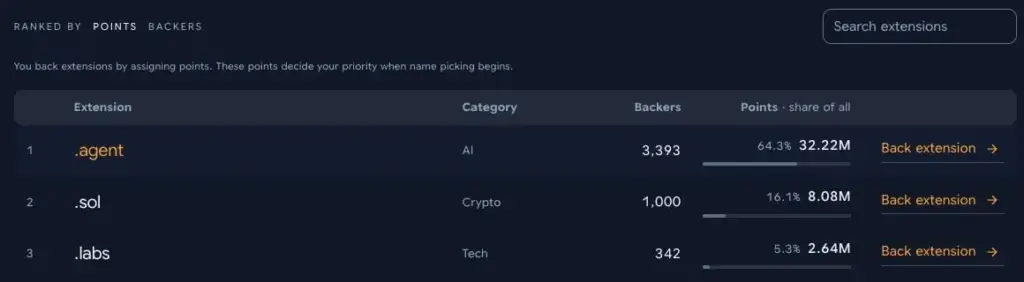
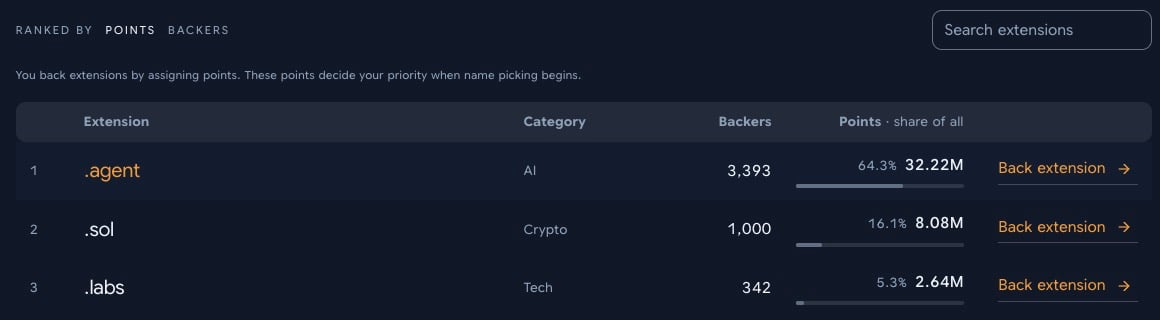
The current state of the Frontier leaderboard provides a fascinating glimpse into current market sentiment. As of the platform’s launch, the extension .agent has emerged as the clear frontrunner, capturing a staggering 64% of all points pledged on the platform. This dominance likely reflects the current global obsession with artificial intelligence and the anticipation of a massive wave of AI-driven services and autonomous agents that will require distinct digital identities.
Furthermore, the leaderboard is heavily populated by crypto-centric extensions. Top-ten contenders such as .sol (associated with the Solana ecosystem), .mask, and .sui demonstrate the strong demand for TLDs that can serve as both traditional web addresses and blockchain identifiers. The popularity of these extensions on Frontier suggests that the platform is successfully attracting the "power users" of the next-generation internet.
Navigating the Road to Official Registry Partnerships
While the launch of Frontier represents a significant technological and organizational milestone for D3, it is important to note the current status of the TLDs featured on the platform. D3 has been transparent in stating that the registries that will eventually operate these TLDs have not necessarily entered into formal agreements with the Frontier platform at this stage.
In its current iteration, Frontier serves primarily as a sophisticated market research and demand-generation engine. By aggregating user interest and point pledges, D3 is creating a data-driven "proof of concept" for each TLD. When D3 eventually approaches registries or participates in the ICANN application process, it will do so with a pre-existing list of interested registrants and a clear map of name-level demand.
For registries, the value proposition of Frontier lies in risk mitigation. Launching a new TLD is an expensive and complex undertaking. By utilizing the data generated by Frontier, registries can better understand the potential ROI of specific extensions and identify "premium" names that have high demand before the first registration is even processed.
For registrants, the platform offers a way to cut through the noise of a standard general availability launch. In many previous TLD rollouts, the most desirable "dictionary words" and short-character domains were snapped up in milliseconds by automated scripts. Frontier’s point-based priority system and its positioning as a Limited Registration Period offer a more deliberate and potentially more accessible path for human registrants to secure the names they value most.
As the domain industry moves closer to the next ICANN round, platforms like Frontier are likely to play an increasingly central role in how digital identities are distributed. By combining market signaling, crypto-incentives, and a structured allocation process, D3 is attempting to bring a new level of order and transparency to the often-chaotic world of new TLD launches. Whether the registries fully embrace this model remains to be seen, but the early data from the Frontier leaderboard suggests that the demand for such a system is already significant.
 Web Hosting & Domain Management
The Afterlife of Authority: How Expired Domains are Fueling a Global Casino Boom
The digital landscape is often built upon the ruins of what came...
 Web Hosting & Domain Management
The Expired Domain Gold Mine: How iGaming Operators are Resurrecting Old Brands for SEO Profit
The landscape of the domain name secondary market has undergone a radical...
 Web Hosting & Domain Management
Atom Enhances Domain Seller Experience with Launch of Dedicated Mobile Application
The landscape of the domain name aftermarket is one defined by speed,...







