
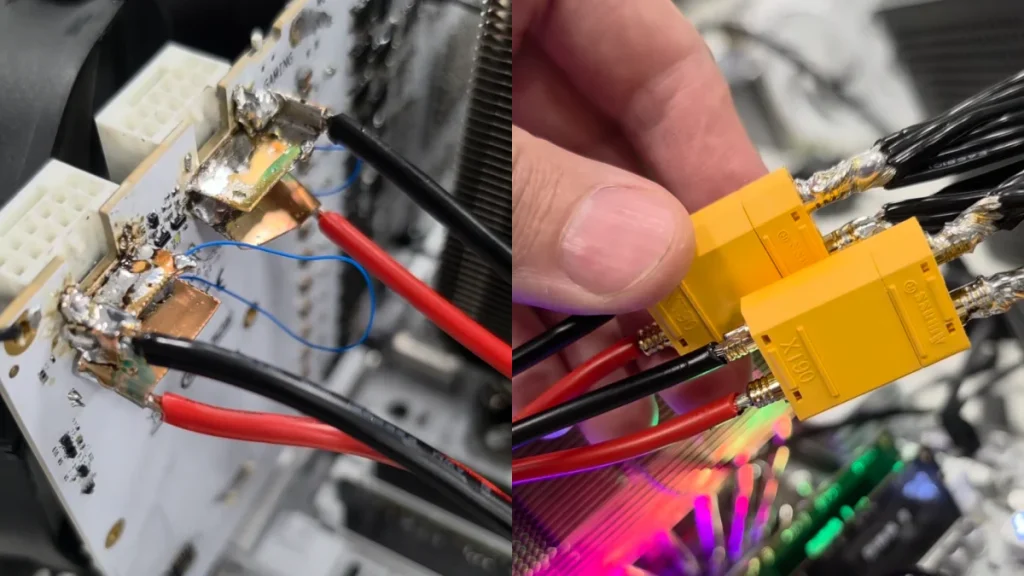
However, the claim of a "full warranty" for a modified high-end GPU is one that industry analysts and veteran builders are approaching with caution. While GRAVEPC.com is known for its specialized cooling work, the modification in question is not yet listed as a standard product on their official website. Furthermore, the history of warranty claims involving the 12VHPWR connector is fraught with complications. Manufacturers have historically been very protective of their hardware specifications, often citing any deviation from the provided power cables as a violation of warranty terms. PNY, in particular, has a documented history of being stringent when it comes to honoring warranty claims related to power connector failures, especially when third-party components are involved.
This skepticism is rooted in recent reports involving prebuilt systems and the 12VHPWR interface. In one notable instance, a consumer who purchased a high-end gaming PC valued at over $5,000 found themselves in a difficult position after their RTX 5090 connectors melted. The system, which had reportedly sat unused for a period, suffered a failure that the manufacturer, Digital Storm, and the card partner, PNY, declined to cover. The denials were based on a combination of expired coverage and the use of third-party power cables. Such incidents highlight the precarious nature of high-end PC ownership; even when a user invests a small fortune into their hardware, the fine print of a warranty agreement can leave them with a very expensive, non-functional component if the power delivery fails.
The technical necessity for a mod like the one presented by u/DallasGrave stems from the sheer amount of energy the RTX 5090 requires. As NVIDIA pushes the boundaries of what is possible with consumer-grade graphics processing, the power draw has climbed toward the 600-watt mark. Delivering this much power through a single, relatively small connector requires a high degree of precision. Any slight misalignment, dust ingress, or insufficient seating of the cable can increase resistance. According to the laws of physics, increased resistance at high current leads to localized heat—a phenomenon known as Joule heating. If this heat exceeds the melting point of the plastic housing or the solder joints, the connector fails. By splitting the load across more wires, the GRAVEPC module aims to ensure that no single wire or pin is pushed to its thermal limit, creating a wider safety margin for the user.
Despite the logical appeal of the mod, the broader PC gaming community remains divided on whether such solutions should be necessary in the first place. The 12VHPWR standard was intended to simplify cable management and provide a unified path for high-wattage delivery, but its implementation has been one of the most controversial topics in hardware circles for years. The transition from multiple 8-pin connectors to a single 16-pin interface was meant to usher in the future of the ATX 3.0 standard, yet the frequency of reported issues has led some to believe the design is fundamentally overextended for the power levels required by cards like the RTX 5090.
 Hardware Reviews & PC Building
Rising Component Costs and AI Demand Create Unprecedented Crisis for Consumer PC Market
The landscape of the consumer PC market is currently navigating a period...
 Hardware Reviews & PC Building
Nvidia launches Open Agent Safety Platform to restrain rogue AI agents — new hardware-and-software security stack…
The introduction of the Open Agent Safety Platform arrives at a critical...
 Hardware Reviews & PC Building
Intel Shifts Strategic Focus to Trust Domain Extensions as Software Guard Extensions Era Nears its Conclusion
In a significant realignment of its long-term data center security roadmap, Intel...






